

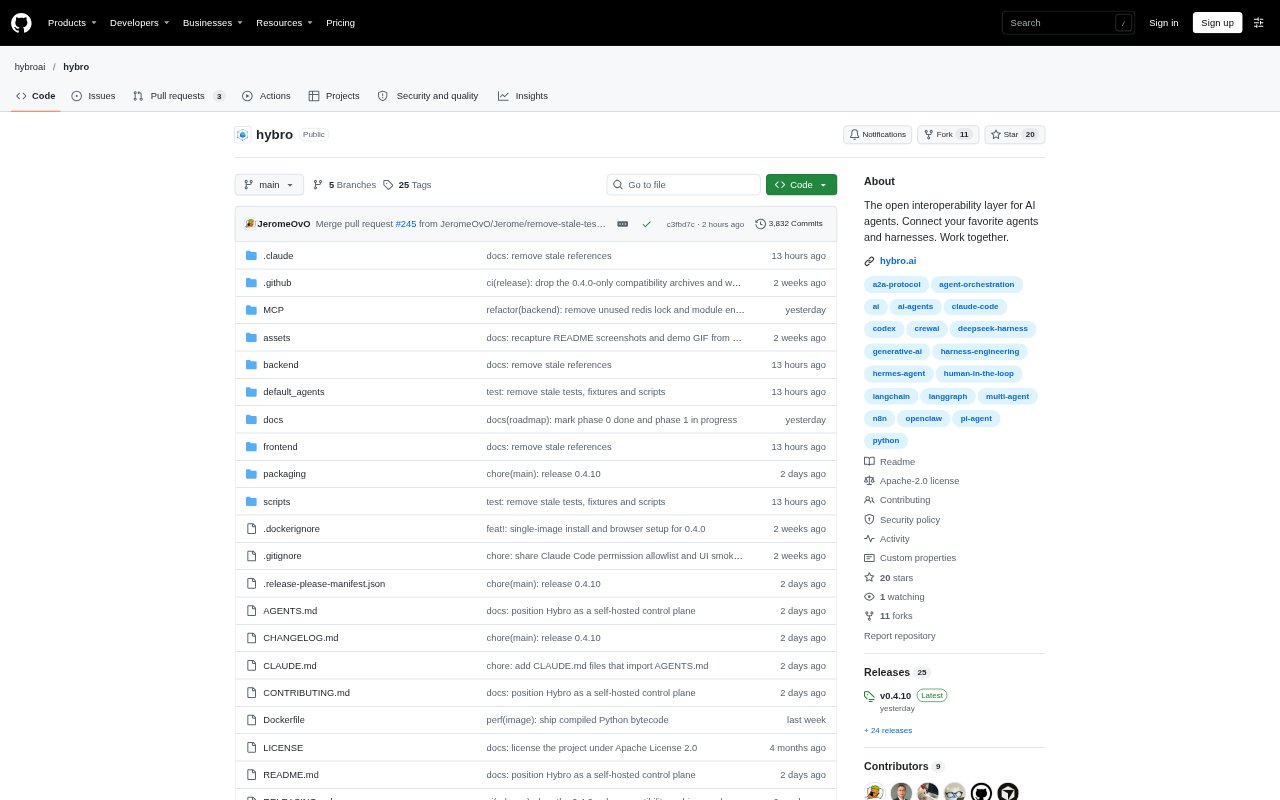
What is Hybro?
Hybro is an open-source platform for connecting AI agents so they can share work across multi-step tasks. Developers and teams can use its chat interface to direct work to specific agents or let Hybro choose among available agents, then follow their responses in a dashboard. It supports local and remote agents through the A2A standard and includes an MCP gateway for connecting assistant clients. Hybro runs in a Docker container, with a model provider configured in Settings.
Hybro Features:
Multi-Agent Chat: Send a request to named agents or let Hybro choose from available agents, then see their contributions and streamed replies in one chat.
A2A Interoperability: Connect independently built local and remote agents through the Agent2Agent standard, and group registered agents into subnets.
MCP Gateway: Connect MCP clients to Hybro through its gateway so sessions and agent requests can be handled in the app.
Human Approvals: Agents can pause to ask for information or approval, with options to answer, approve, or reject before work continues.
Network Map: View registered agents and the subnets they share in an interactive dashboard that shows how the network is arranged.
A2A Adapter: Use the open-source SDK and CLI to wrap tools such as Claude Code, Codex, LangGraph, and CrewAI as A2A agents.
Local Deployment: Install and run the app, API, MCP gateway, and bundled agents together in one Docker container on your machine.
Hybro Benefits:
Less Coordination: A single request can bring several specialists into the same workflow, reducing the need to assign and track each handoff yourself.
Visible Progress: Live replies and agent response details make it easier to understand which agents contributed and where a task stands.
Controlled Actions: Keeping people in the approval loop lets teams review sensitive outputs before they move forward or reach others.
Fewer Custom Links: A shared A2A network gives compatible agents a common way to communicate, rather than requiring a separate connection for each workflow.
Flexible Agent Choice: Teams can bring together agents built with different tools and frameworks instead of standardizing every task on one agent.
Use Cases:
Code Review: Coordinate a coding agent that writes a fix with another that reviews it and a test agent that runs the suite before an engineer approves the merge.
Invoice Follow-Up: Have finance and sales agents reconcile invoices and draft client reminders, with a controller reviewing the messages before they go out.
Support Reporting: Ask one agent to summarize support tickets and another to chart recurring issues, then send the combined report to a team lead for review.
Supplier Comparison: Bring procurement and finance agents into a workflow to compare supplier quotes and check the budget before a buyer approves a purchase order.
Trip Planning: Use travel and weather agents together to plan an itinerary and adjust activities when the forecast changes.