
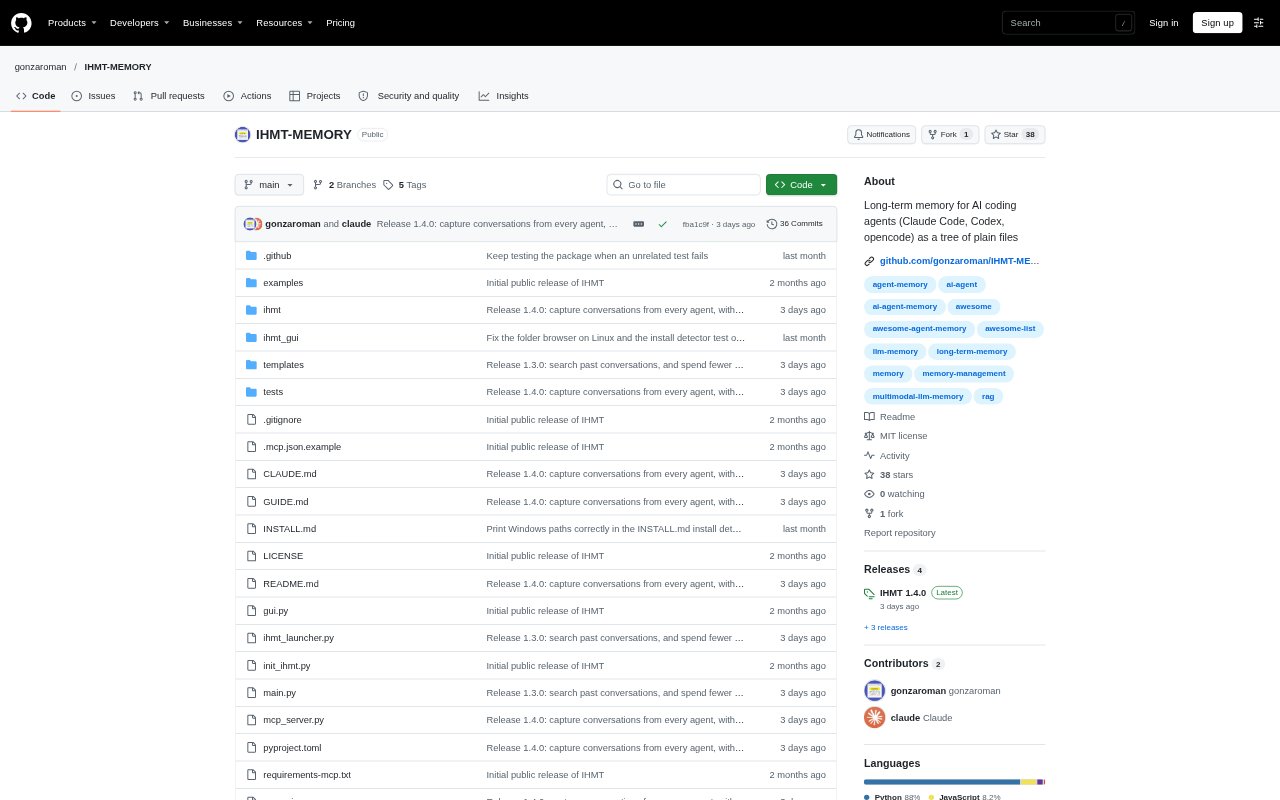
What is IHMT?
IHMT is a local, long-term memory system for AI coding agents. It stores decisions, setup details, preferences, corrections, and project knowledge in a hierarchical tree of readable text and JSON files, then retrieves relevant entries across future sessions. Claude Code is officially supported, and Codex and opencode have also been tested; agents that support local MCP servers may work as well. It is designed for people who want agents to retain useful context without a cloud memory service.
IHMT Features:
Hierarchical Search: IHMT organizes memories as a tree of text leaves and JSON summaries, then searches from the root toward relevant entries instead of scanning everything.
Shared Agent Memory: Claude Code, Codex, and opencode can use the same memory folder, allowing one agent to retrieve information saved by another.
Change History: When a fact is superseded, IHMT keeps the earlier version as history, marks it outdated, and prioritizes the current value in search results.
Ambiguity Checks: When a query could refer to more than one person or fact, IHMT can ask for a clue rather than return a guess.
Local File Storage: Memories stay on disk as plain text and JSON files, with no account, cloud storage, or database required.
Browse and Diagnose: The browser-based interface lets users explore the memory tree, review history and contradictions, and inspect search confidence and descent paths.
IHMT Benefits:
Less Repetition: Agents can reuse saved decisions, corrections, and environment details, so users do not have to restate the same context in every session.
Lower Context Overhead: Retrieving only the entries relevant to a question can reduce the need to paste large notes or project histories into a conversation.
Current Answers: Keeping superseded details visible as history helps users distinguish current facts from earlier choices or configurations.
More Control: Readable local files make it possible to inspect, back up, copy, or version-control a memory without relying on a hosted store.
Fewer Wrong Assumptions: Asking for clarification when a name or reference is ambiguous can prevent an agent from acting on the wrong memory.
Use Cases:
Carry Decisions Forward: Use IHMT to retain why a coding approach was chosen, so an agent can refer back to that reasoning during later work sessions.
Share Context Across Agents: Connect multiple supported coding agents to one memory folder when switching tools or asking different agents to work on a project.
Track Setup Changes: Store details such as development environment or database versions and let the memory retain older values when the setup changes.
Review Project Knowledge: Ingest notes or source files, then search the stored material for details such as how a particular feature or system was handled.
Inspect Conflicting Facts: Use the timeline and contradiction views to review changing values, such as a location or technology choice, and see which one is current.