

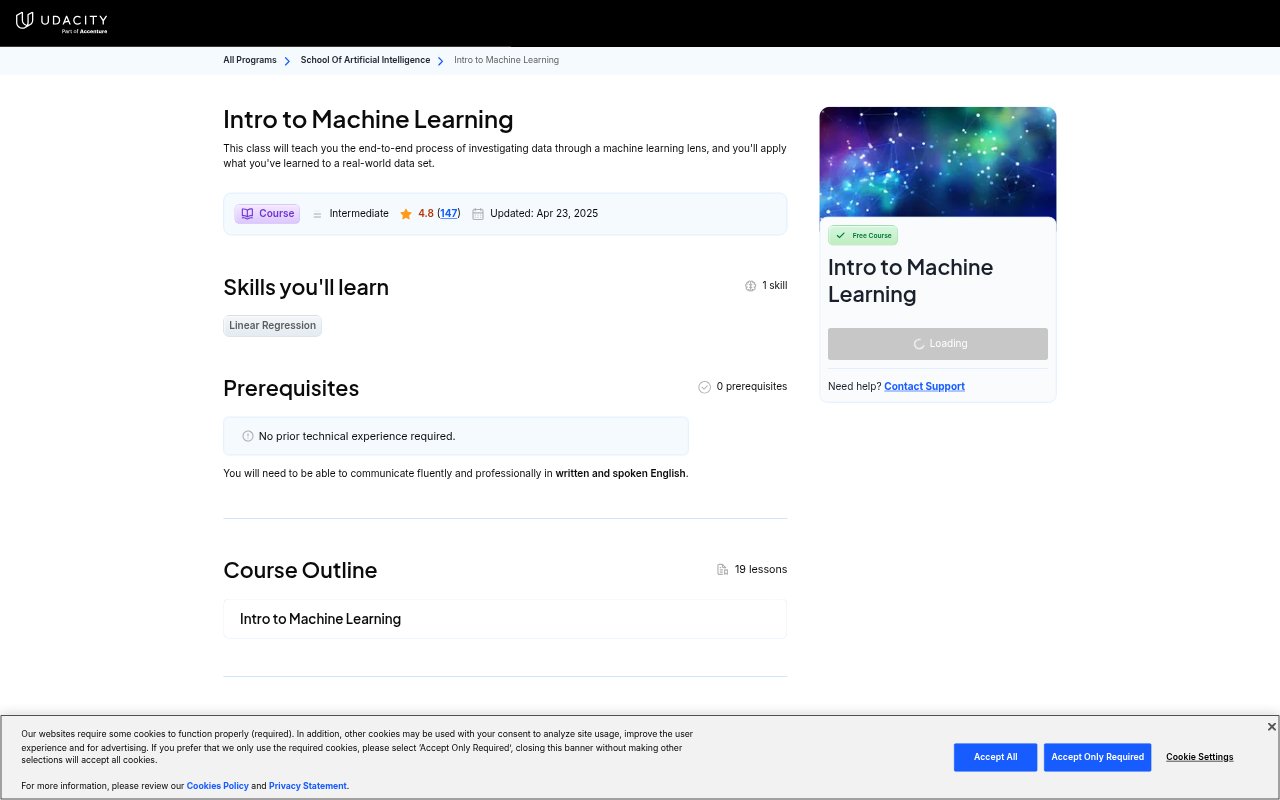
What is Introduction to Machine Learning?
Introduction to Machine Learning is an online Udacity course for learners building a practical foundation in machine learning. It covers how to investigate data using machine learning methods, with lessons on classification, regression, clustering, text data, and model evaluation. Learners work through algorithms and mini-projects using scikit-learn, including a project that applies a chosen classifier to terrain data. The course is marked intermediate and requires fluent, professional written and spoken English.
Introduction to Machine Learning Features:
Classification Algorithms: Learn how Naive Bayes, support vector machines, decision trees, k-nearest neighbors, AdaBoost, and random forests can classify data.
Model Validation: Study training and testing, cross-validation, and parameter grid searches for assessing and tuning machine learning models.
Regression Lessons: Explore linear regression as a way to model continuous data and learn about outlier detection and removal.
Unsupervised Learning: Learn the basics of clustering and use the k-means algorithm through scikit-learn.
Data Preparation: Cover feature rescaling, feature selection, and principal component analysis for working with model inputs and data dimensions.
Hands-On Projects: Apply course material in mini-projects, including choosing a classifier for terrain data and working with the Enron dataset.
Introduction to Machine Learning Benefits:
Broader Method Choices: Comparing several classification approaches helps learners choose an algorithm that fits the data and task they are investigating.
More Reliable Evaluation: Practice with validation and evaluation metrics helps learners judge model performance instead of relying on a single result.
Stronger Data Judgment: Lessons on outliers, feature selection, and scaling help learners make more considered choices before fitting a model.
Practical Understanding: Working through algorithms and projects connects machine learning concepts with decisions made during real data investigations.
Wider Data Coverage: Exposure to text, continuous values, terrain data, and clustering gives learners practice thinking about different kinds of problems.
Use Cases:
First ML Study: Use the course to build a foundation in machine learning methods before pursuing further study or practical work with models.
Classifier Practice: Work through a classification task and compare approaches such as decision trees, support vector machines, or Naive Bayes.
Terrain Classification: Try a mini-project that applies a selected algorithm to classify terrain data using options including k-nearest neighbors and random forests.
Text Data Learning: Follow the text-learning lesson to explore how text data can be used in a machine learning algorithm.
Model Assessment: Study validation and evaluation metrics when the job is to check whether a classifier is performing well.
Data Exploration: Use the course's Enron dataset lessons and mini-projects as a context for investigating data through a machine learning lens.