
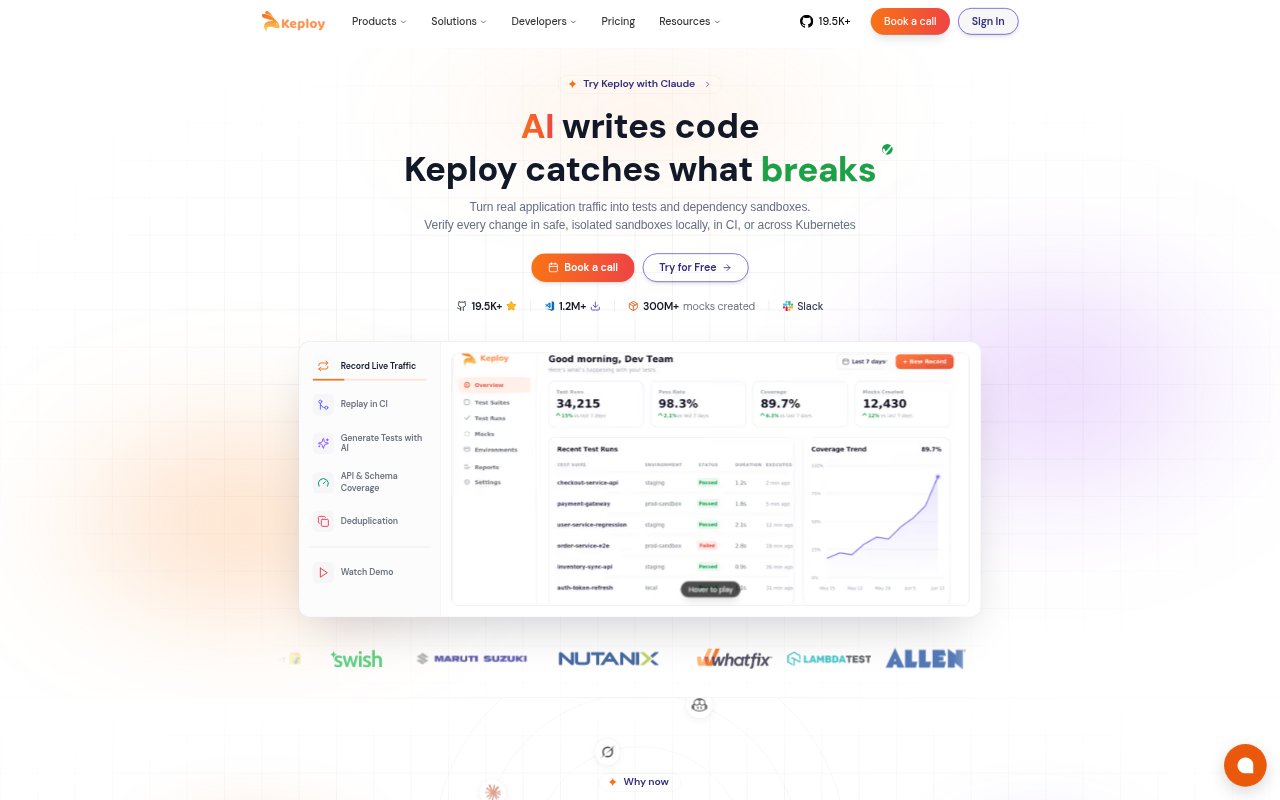
What is Keploy?
Keploy is a testing platform for software teams that want to verify code changes against real application behavior. It records API traffic and interactions with dependencies, then turns them into tests and mocks that can be replayed against new builds. Teams can run tests locally or in CI/CD, and use API specifications and application context to generate additional scenarios beyond recorded traffic.
Keploy Features:
Traffic Capture: Keploy captures incoming requests and outgoing dependency calls through eBPF and network-level interception, without requiring changes to application code.
Test Generation: It converts recorded requests, responses, dependency interactions, and data states into editable tests, and can also generate tests from API specifications.
Dependency Mocks: The platform virtualizes databases, queues, APIs, caches, and other dependencies so recorded application flows can be replayed in isolation.
Regression Replay: Teams can replay recorded tests against new builds locally or in CI/CD to check for changes in application behavior.
Edge Case Discovery: Keploy uses API schemas and application context to add edge cases, connected flows, and scenarios beyond those in the original recordings.
Pipeline Support: Tests can run in GitHub, GitLab, or Jenkins pipelines, and teams can work with YAML tests, contract testing, and load testing.
Keploy Benefits:
Catch Regressions Earlier: Checking changes against recorded behavior before merging or deployment helps teams find unintended breaks before they reach users.
Reduce Manual Setup: Generating tests and mocks from real application traffic means teams have less need to define every test interaction and dependency mock by hand.
More Realistic Checks: Tests based on actual requests and dependency interactions reflect how the application behaves in practice, rather than relying only on manually written examples.
Broader Scenario Coverage: Adding edge cases and connected flows helps teams examine behavior beyond the requests already captured from normal application use.
Isolated Test Runs: Virtualized dependencies let teams replay application behavior without relying on live databases, queues, or external APIs during each test.
Use Cases:
Verify AI-Written Code: Run tests against changes produced by coding agents or developers to see whether they preserve existing application and dependency behavior.
Protect API Releases: Replay captured API traffic against a new build before release to find response, schema, or contract regressions.
Test Service Integrations: Use recorded calls and virtualized dependencies to check services that communicate with databases, queues, caches, or third-party APIs.
Automate CI Checks: Add test replay to a CI/CD pipeline so changes are checked as part of the team's regular build and merge process.
Expand API Test Suites: Start with API specifications or recorded traffic, then generate additional edge cases and connected flows for a broader test suite.