

What is Kimi K2?
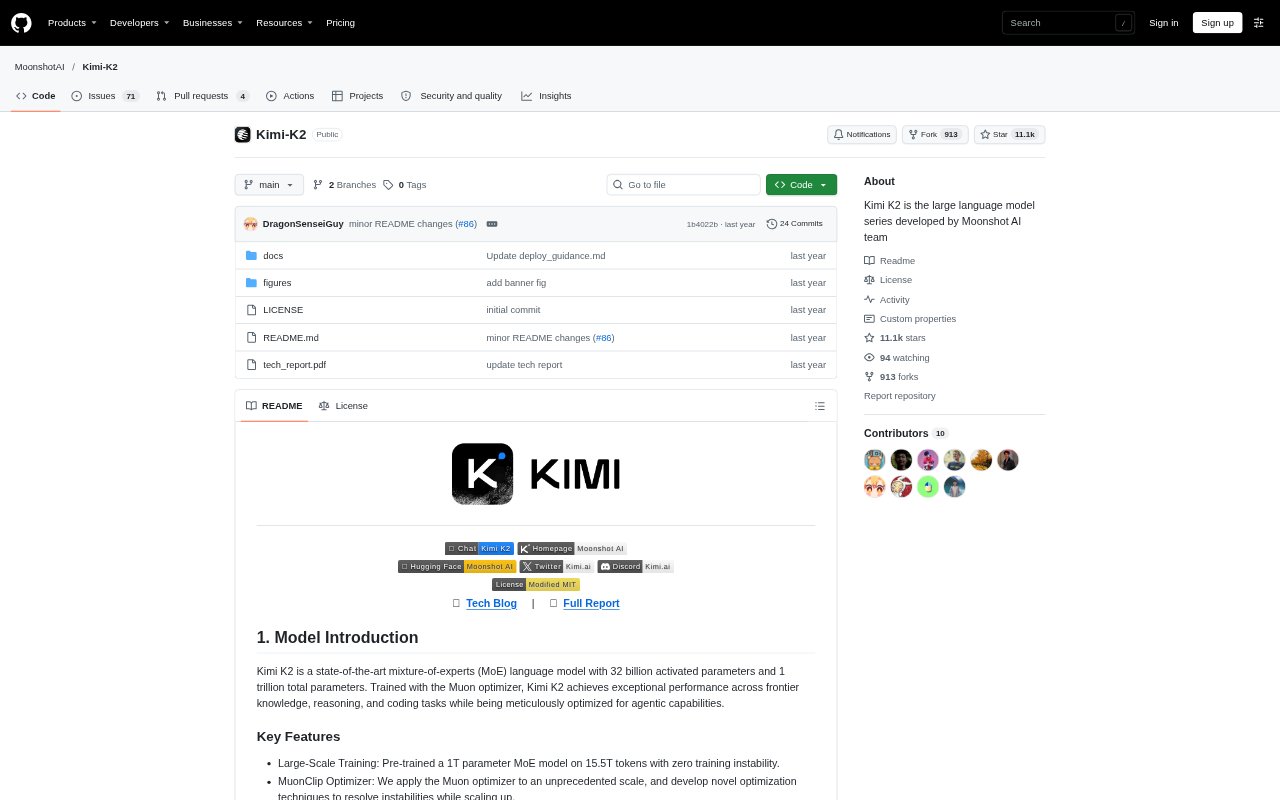
Kimi K2 is a large language model series from Moonshot AI for people building chat assistants, coding workflows, and tool-using agents. It is designed for reasoning, autonomous problem-solving, and general-purpose conversation, with a base model for builders who want to fine-tune or customize and an instruct model for chat and agentic applications. The model uses a mixture-of-experts architecture and supports a context length of 128K tokens.
Kimi K2 Features:
Mixture of Experts: The model has 1 trillion total parameters, with 32 billion activated parameters, using a mixture-of-experts architecture.
Model Variants: Kimi-K2-Base is intended for fine-tuning and custom solutions, while Kimi-K2-Instruct is a post-trained option for general-purpose chat and agentic experiences.
Agentic Capabilities: The model is designed for tool use, reasoning, and autonomous problem-solving in agentic workflows.
Coding Tasks: Coding is a stated focus, with evaluations covering programming challenges, repository issue fixes, terminal tasks, and multiple programming languages.
Long Context: A 128K-token context length lets the model process a large amount of input within a single context.
Knowledge and Reasoning: The model is trained for frontier knowledge and reasoning, with evaluations spanning mathematics, STEM, and logic tasks.
Kimi K2 Benefits:
Customization Control: Builders can start from the base model and shape it for a specific product or workflow through fine-tuning.
Flexible Deployment: Having both a foundation model and an instruct model gives teams a choice between customization and a ready-made chat-oriented starting point.
Fewer Context Splits: The long context can keep more source material or task history together, reducing the need to divide some jobs into smaller prompts.
Broader Agent Work: Tool-use and problem-solving capabilities can support workflows that need more than a single conversational response.
One Model, Many Tasks: Its focus on coding, knowledge, and reasoning offers a single model option for teams with varied language-model tasks.
Use Cases:
Code Assistance: Use the model to help with programming questions, code generation, or work across multiple programming languages.
Repository Issue Work: Apply it to software maintenance tasks that involve understanding a repository and proposing a fix for an issue.
Tool-Using Agents: Build an agent workflow where the model reasons through a task and uses tools as part of its problem-solving.
Math and STEM: Use it to work through mathematical problems or questions in science, technology, engineering, and mathematics.
Custom Chat Products: Start with the instruct variant when building a general-purpose chat experience, or adapt the base variant for a specialized assistant.