
What is Kolega Code?
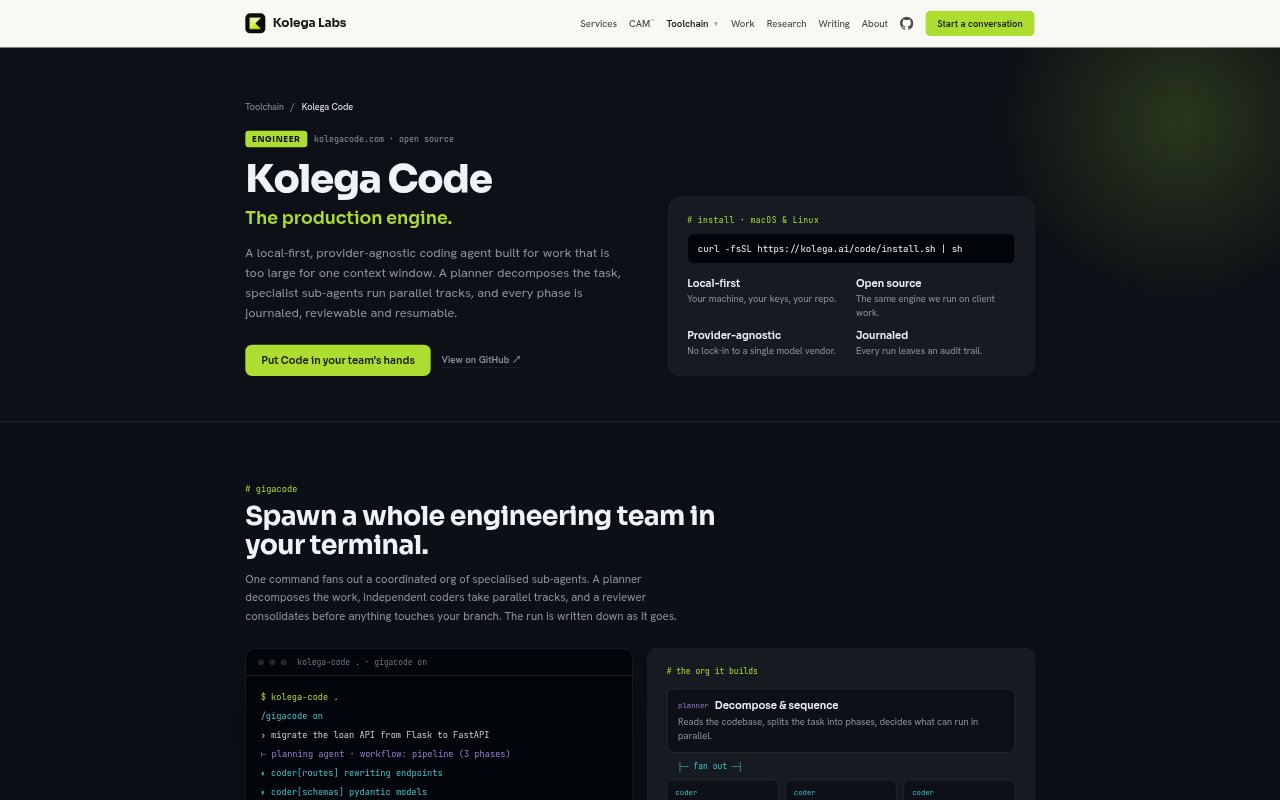
Kolega Code is an open-source, terminal-native coding harness for developers tackling work too large for a single context window. It uses a planner to break a task into parallel tracks for specialist coding agents, then brings their work together for review before changes reach a branch. The tool is local-first and provider-agnostic, with sessions, tokens and transcripts kept on the machine running it. It is suited to complex builds, migrations and refactors where developers need control over how code changes are made.
Kolega Code Features:
Multi-Agent Planning: A planner decomposes a task into parallel tracks for specialist coding agents, with a reviewer consolidating their work before anything touches your branch.
Plan and Build Modes: Plan mode investigates and proposes without changing files, while Build mode applies reviewed diffs; Shift+Tab switches between the two.
Session Permissions: Permissions can be granted for one path and one run, while shell commands, network calls and writes outside the working tree ask first.
Run Journaling: Transcripts, phase journals and diffs are recorded to disk as work happens, and runs can be resumed.
Provider Choice: The coding agent is provider-agnostic and can use frontier, hosted or fully on-premise models, with provider choice treated as configuration.
Kolega Code Benefits:
Manage Large Changes: Splitting work across specialist agents helps developers tackle builds that exceed one context window without relying on a single, extended coding conversation.
Review Before Editing: Separating investigation from build work gives developers a chance to inspect a proposal and reviewed diffs before files are changed.
Keep Work Auditable: A record of transcripts, phases and diffs makes it easier to inspect what happened during a run and provide evidence for regulated changes.
Fit Data Constraints: Choosing a hosted or on-premise provider lets developers account for where data may go when selecting a model.
Use Cases:
Cross-Cutting Migrations: Use coordinated coding tracks to handle a migration that spans many dependent changes rather than treating it as one long task.
Multi-Service Refactors: Coordinate work on a refactor that touches multiple services, with the phases and diffs available for review.
Parallel Feature Tracks: Run independent feature work in parallel on one repository, then have a reviewer consolidate the results before they reach a branch.
Framework Upgrades: Break an upgrade that touches every layer of an application into specialist tracks that can be reviewed before implementation.