

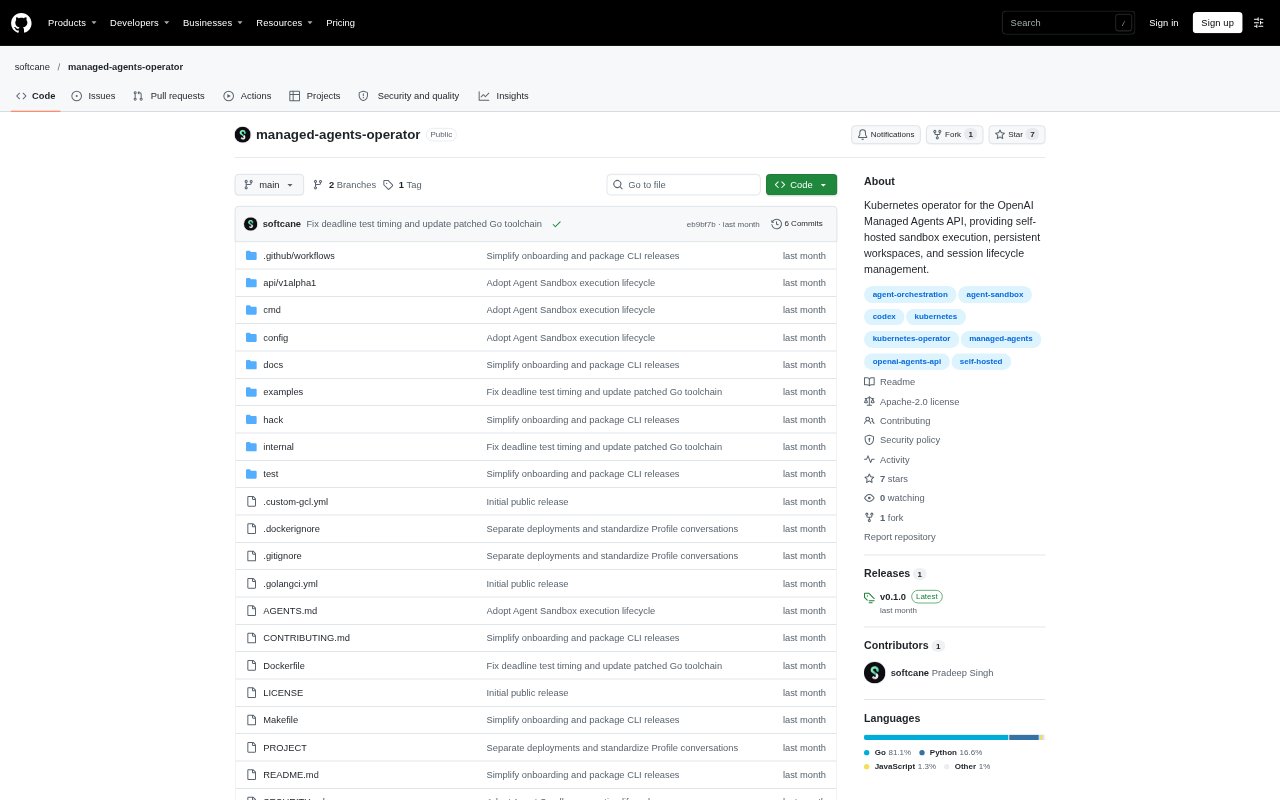
What is Kubernetes Operator for the OpenAI Managed Agents API?
Codex Session Operator runs OpenAI coding agents on Git repositories, with OpenAI handling the agent loop and model inference while a Kubernetes cluster runs commands and stores repository files. It is aimed at teams that want to manage coding-agent sessions and workspaces in Kubernetes, with results available through an HTTP API or CLI. The project is in alpha and requires OpenAI Agents API access, which incurs API charges; installation also requires Kubernetes Agent Sandbox and PostgreSQL.
Kubernetes Operator for the OpenAI Managed Agents API Features:
Profile Configuration: A Profile combines an Agent, an execution Environment and a spending policy to define how a task session runs.
Sandboxed Execution: Kubernetes Agent Sandbox prepares an isolated workspace where the executor runs commands against the repository.
Repository Setup: Workspace templates can configure a repository checkout, executor image, storage and runtime settings for a task.
Session Continuation: Follow-up messages continue the conversation in the same Session and workspace, so the agent can keep working with its files.
Saved Task Records: The gateway stores messages, results and approvals in PostgreSQL, and provides access to assistant output and command results.
Spend Policies: Profiles can allow unlimited spending or request a per-Session cap, with capped spending requiring provider-project support.
Kubernetes Operator for the OpenAI Managed Agents API Benefits:
Cluster Control: Keeping command execution and repository files in your cluster lets your team manage the task workspace alongside its Kubernetes resources.
Work Continuity: Continuing in the same workspace avoids having to restart a repository task from a fresh checkout for each follow-up.
Reviewable Results: Saved messages, approvals and command results give teams a record to inspect when reviewing what an agent did.
Cost Guardrails: A per-Session spending cap can help limit inference costs for configured tasks when provider-project support is available.
Use Cases:
Repository Coding Tasks: Send an agent a coding task for a Git repository and inspect its response and command results through the HTTP API or CLI.
Iterative Development: Use follow-up messages to ask an agent to refine work in the existing repository workspace rather than beginning a new Session.
Custom Runtime Setup: Prepare a workspace with a project-specific executor image and runtime configuration before assigning repository work.
Controlled Agent Runs: Choose a Profile with a spending policy when running coding tasks that need either a configured cap or unlimited inference spending.