

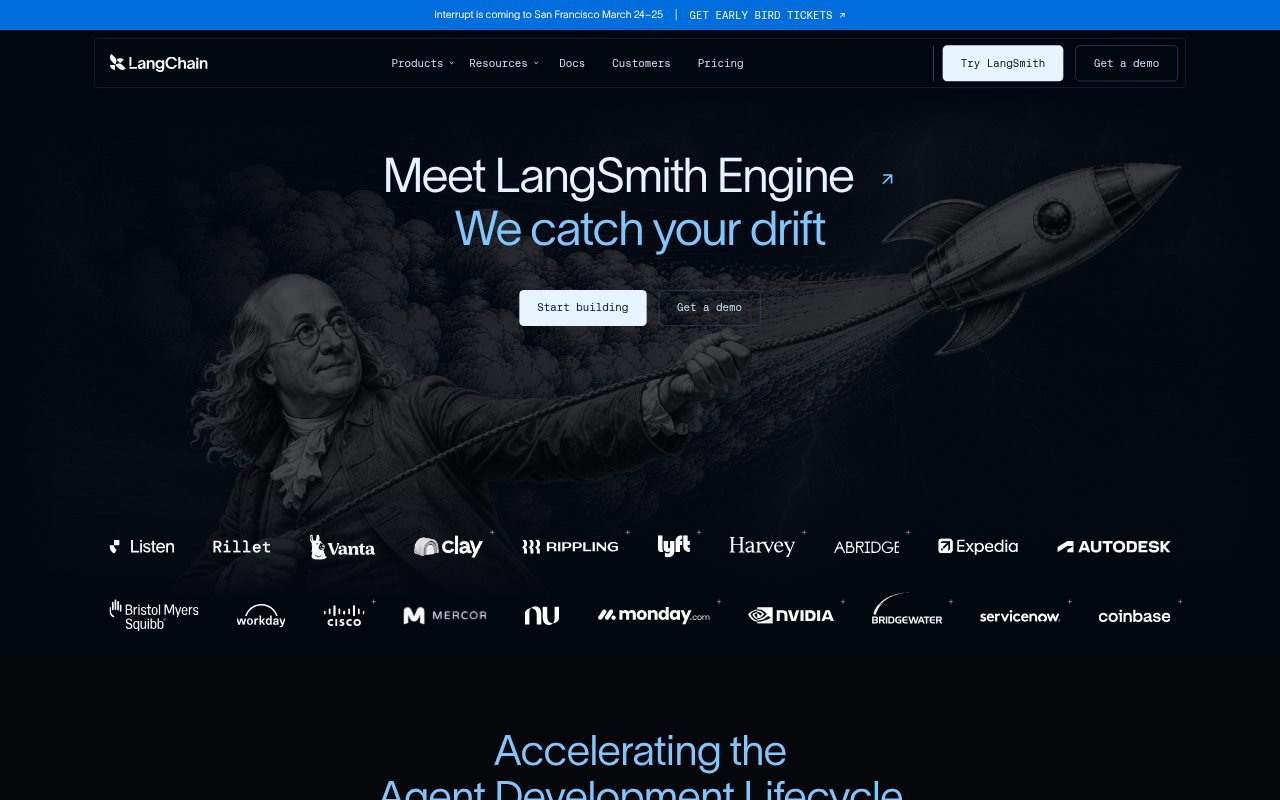
What is LangChain?
LangChain is an open platform for building and operating AI agents, aimed at teams developing agent applications and managing them in production. Its LangSmith agent engineering platform supports the development lifecycle, from building and testing to deployment, monitoring, and iteration. Teams can use LangChain’s open-source frameworks with any model provider, while LangSmith provides tools for tracing runs, evaluating behavior, deploying agents, and governing model use. It serves both individual developers and organizations coordinating agent work.
LangChain Features:
Agent Building: Build agents with or without code, start from established agent patterns, and customize the harness, context, memory, and model choice as needed.
Trace Debugging: Inspect agent runs step by step, query complex traces with SmithDB, and turn traces into datasets for further testing.
Agent Evaluation: Evaluate agent behavior at each step, and standardize expert review as evaluations that can be used in the development feedback loop.
Agent Deployment: Deploy agents using a consistent organizational pattern, build user experiences with more than 30 Agent Server endpoints, and run agent-generated code in isolated sandboxes.
Production Monitoring: Use online evaluations, dashboards, and alerts to track production quality, cost, latency, errors, and tool behavior.
Governance Controls: Use LLM Gateway to control model calls and spending, detect sensitive data, require human approval for sensitive actions, and deploy in SaaS, BYOC, or self-hosted environments.
LangChain Benefits:
Faster Diagnosis: Step-level traces and production signals give teams more context for finding where an agent run went wrong.
Earlier Validation: Testing behavior before release helps teams catch regressions before they reach users.
Shared Workflows: Standardized deployment patterns and evaluation practices make it easier for teams to work consistently across agent projects.
Controlled Spending: Model-call and cost controls help organizations keep agent usage within limits they set.
Safer Operations: Sensitive-data detection and approval requirements provide additional checkpoints around potentially risky agent activity.
Use Cases:
Agent Prototyping: A developer can use an existing agent pattern to start a prototype, then adjust its context, memory, harness, or model.
Prelaunch Testing: An agent team can build evaluation datasets from traces and check behavior before releasing a new version.
Production Troubleshooting: An engineering team can investigate a customer-facing agent issue by reviewing its execution steps, errors, and tool behavior.
Agent Deployment: An organization can establish a shared deployment approach for agents that need persistent state or isolated code execution.
Sensitive Actions: A business can require human approval before an agent performs an action that needs review, while monitoring model use and sensitive data.