

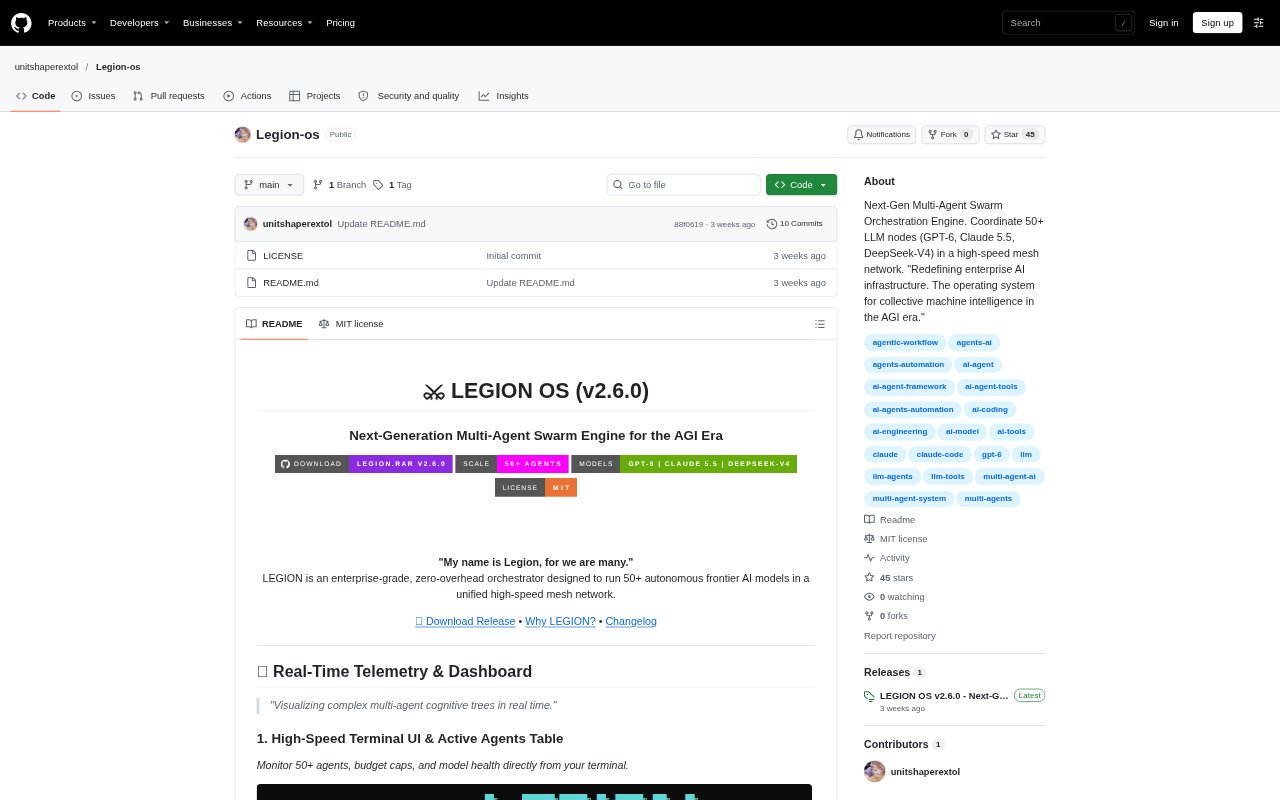
What is LEGION?
LEGION is a desktop and command-line tool for coordinating multi-agent AI workflows. It routes tasks among agents using models from multiple providers, with configuration for cluster topology and options to run with a dashboard or in headless mode. It is aimed at teams and developers who want to manage larger agent clusters, inspect their activity, and control model budgets from a single orchestration engine.
LEGION Features:
Mesh Routing: LEGION uses dynamic auction and mesh routing to send tasks between agents rather than relying only on a sequential pipeline.
Mixed Models: A single swarm can assign different models to different roles, with support described for OpenAI, Anthropic, Google, and DeepSeek.
Budget Guardrails: Set hard spending caps and route work to less expensive models when an agent approaches its budget limit.
Task Recovery: A supervisor can invalidate a response after a timeout or hallucination and respawn the affected subtask.
Output Validation: Validation layers check results for schema compliance before merging outputs from multiple agents.
Session Monitoring: Use the terminal interface or web dashboard to inspect agent activity, budget telemetry, model health, and session metrics.
CLI Exports: The command-line interface can export session logs, metrics, and state graphs in PDF or JSON formats.
LEGION Benefits:
Larger Workflows: The ability to coordinate dozens of agents gives teams room to divide complex work across more roles than a small agent setup can handle.
Spend Control: Budget limits and lower-cost rerouting help teams keep model spending within a chosen ceiling.
Fewer Stalled Runs: Automatic recovery from timeouts and invalidated responses can reduce the need to restart a workflow manually.
More Usable Results: Checking schema compliance before results are combined helps teams avoid carrying malformed outputs into later steps.
Clearer Oversight: Live status and budget views make it easier to spot agent or model issues while a cluster is running.
Use Cases:
Research Pipelines: Assign research, planning, and validation tasks to different model agents within one coordinated workflow.
Multi-Agent Projects: Configure a larger agent cluster for projects that need many concurrent nodes working on separate subtasks.
Budgeted Runs: Set a spending cap for a workflow and let routing shift work toward cheaper models as agents near that limit.
Server Deployments: Run a configured cluster in headless mode when a terminal dashboard is not needed during execution.
Run Audits: Export logs, metrics, and state graphs after a session for review or record keeping.