
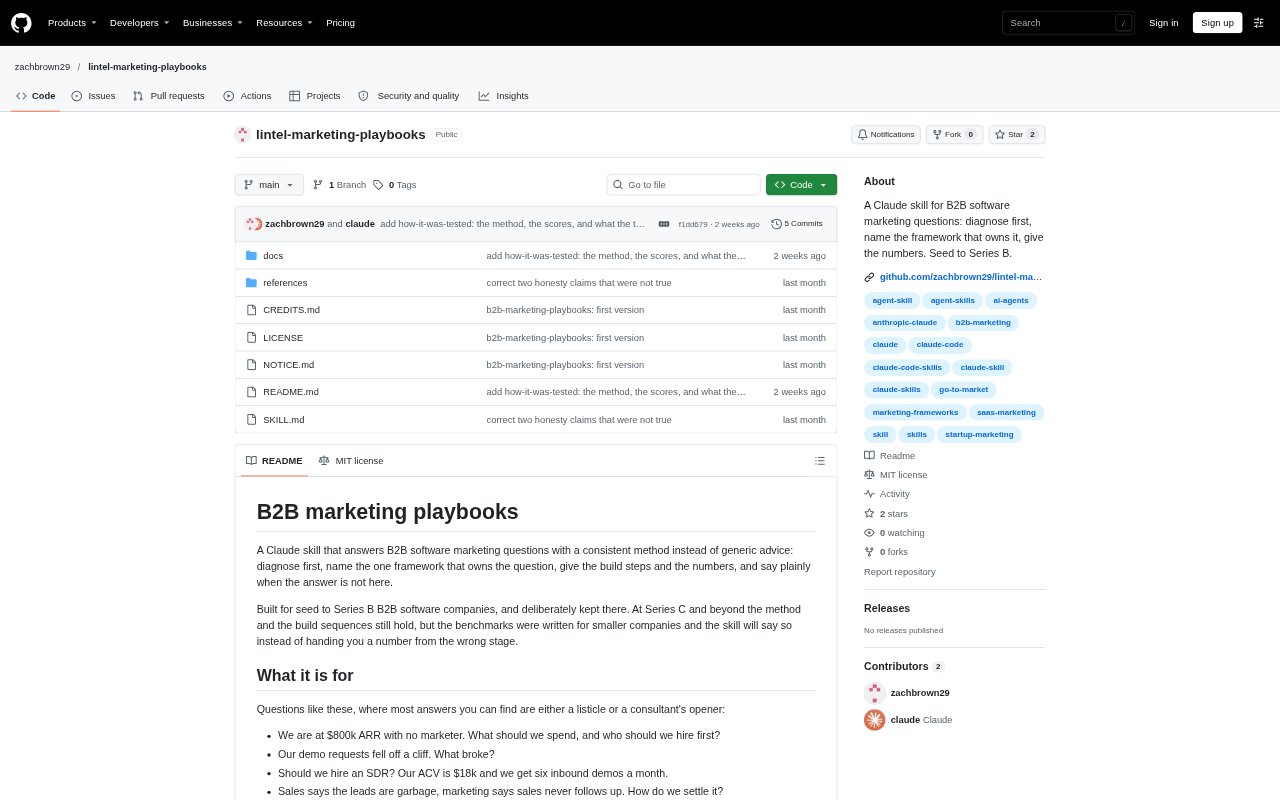
What is Lintel Marketing Playbooks?
Lintel Marketing Playbooks is a Claude skill for answering B2B software marketing questions with a consistent, diagnostic approach. It is designed for seed to Series B companies and helps users work through issues such as hiring, lead quality, declining demo requests, and pricing pages. Rather than writing copy or running campaigns, it offers structured guidance based on the information users provide about their company, and it identifies areas it does not cover.
Lintel Marketing Playbooks Features:
Diagnosis First: The router loads a diagnosis reference before a topic file, helping distinguish the reported marketing problem from its underlying cause.
Topic Routing: A router directs questions to the relevant one of 13 topic files and loads that material on demand.
Maturity Tiers: Guidance uses four maturity levels—Reactive, Building, Operating, and Compounding—and advises working on the next tier.
Decision Guidance: Answers include a company stage, an ordered build sequence, a decision rule with a threshold, and a benchmark.
Framework Attribution: The skill names the framework behind its guidance, while models created by others are credited in its credits file.
Stated Limitations: It flags gaps such as website information architecture and review-site programs, and cautions that later-stage benchmarks may not fit smaller companies.
Lintel Marketing Playbooks Benefits:
Less Generic Advice: A consistent diagnostic method gives teams a more focused starting point than broad marketing tips or an opening sales pitch.
Clearer Priorities: Ordered build steps help a small team decide what to tackle next instead of trying to improve every marketing activity at once.
Better Context: Stage-aware guidance reduces the risk of applying benchmarks written for a different company size.
Easier Scrutiny: Named frameworks and stated benchmark qualifications give teams a basis for questioning or discussing the recommendations.
More Honest Boundaries: Explicitly identified gaps make it easier to recognize when an answer is outside the skill’s coverage.
Use Cases:
Marketing Budget Planning: A B2B software company with no marketer can ask what to spend and which marketing role to hire first.
Falling Demo Requests: A team seeing a sharp drop in demo requests can investigate what may have changed before choosing a response.
SDR Hiring Decision: A company weighing an SDR hire can consider the decision in light of its average contract value and inbound demo volume.
Lead Handoff Dispute: Marketing and sales teams can examine disagreements about lead quality and follow-up as a shared process problem.
Pricing Page Planning: A team that cannot publish prices can ask what information to include on its pricing page instead.