

What is Liquid Inference?
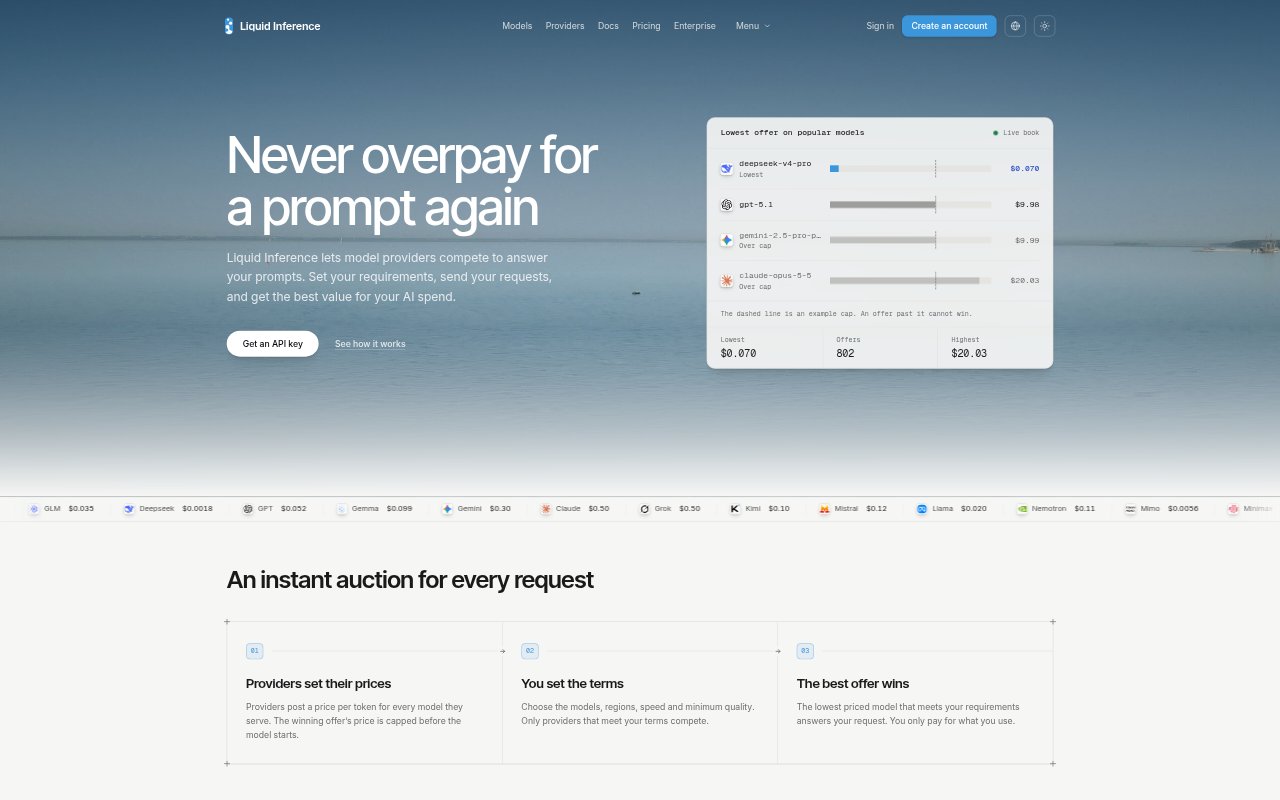
Liquid Inference is an exchange for sending AI requests to model providers that compete to answer them. You set requirements such as model, region, speed and minimum quality; eligible providers offer prices, and the lowest-priced offer that meets your terms handles the request. It is aimed at people and teams using AI through APIs, including those with OpenAI- or Anthropic-compatible clients. You pay for the tokens used, subject to a price cap set before the model starts.
Liquid Inference Features:
Provider Auctions: For each request, providers submit per-token prices for the models they serve, creating a separate competition for that job.
Request Requirements: You choose the models, regions, speed and minimum quality required, and only providers meeting those terms can compete.
Capped Pricing: The winning offer sets a price cap before generation begins, and the request cannot cost more than that cap.
Usage Billing: Charges are based on the tokens a job uses, while any unused amount under its cap remains in your balance.
API Compatibility: Clients that speak the OpenAI or Anthropic API can connect by changing the base URL and API key, using a model name listed by the exchange.
Job Receipts: Each job has a receipt showing the winning offer, usage and cost, with the charge broken into parts.
Prompt Retention: You can set retention to none so a request is offered only to providers that promise not to keep it.
Liquid Inference Benefits:
Spend Control: Choosing requirements and a cap for each request makes it easier to keep AI usage aligned with a budget.
Cost Visibility: A receipt for each job helps you review what the request used and understand how its charge was calculated.
Less Integration Work: Teams using compatible clients can try the exchange without rewriting their request flow, since the listed changes are the base URL and API key.
Retention Choice: Setting requests to none gives privacy-conscious teams a way to limit which providers receive prompts they agree not to retain.
Failure Handling: If a provider fails before returning output, the exchange can try another offer, and a job with no output incurs no exchange fee.
Use Cases:
Budget-Conscious API: Route routine AI API requests through the exchange when you want eligible providers to compete on price for each job.
Region-Constrained Requests: Set a region requirement for requests that must be handled by providers serving a chosen location.
Speed-Sensitive Work: Specify a speed requirement when configuring requests for tasks where response speed matters alongside price.
Compatible Client Setup: Connect an existing OpenAI- or Anthropic-speaking client by updating its base URL and API key, then selecting an exchange-listed model.
First API Trial: Send initial requests from a new workspace using its starting credit, without needing to add a card first.