

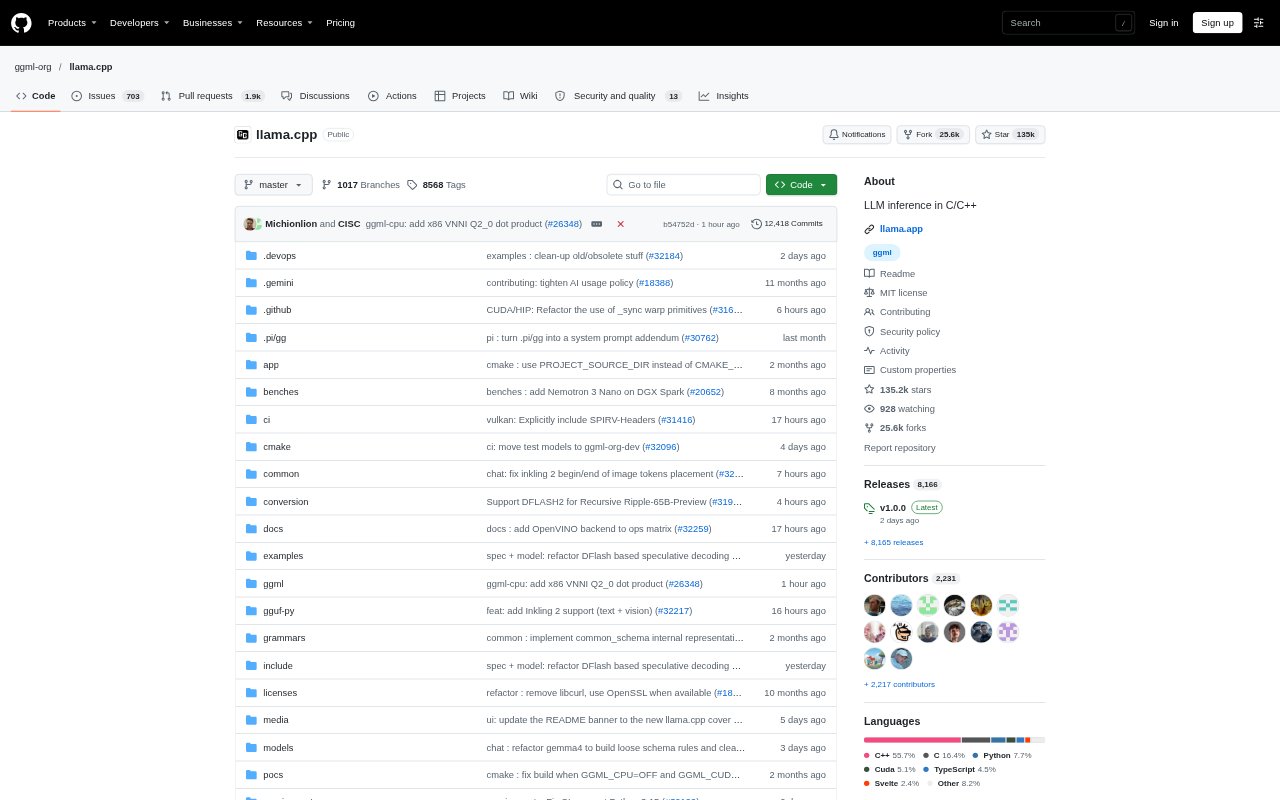
What is llama.cpp?
llama.cpp is an open-source inference engine for running large language and vision-language models on local machines or in the cloud. It provides command-line tools and a server, so developers can run models directly or connect applications to a local API. Its C and C++ implementation supports a range of hardware, from Apple silicon and desktop CPUs to GPUs and other accelerators. The project is released under the MIT licence.
llama.cpp Features:
Hardware Backends: Run inference using backends including CPU, Apple Metal, NVIDIA CUDA, AMD HIP, Vulkan, SYCL, and other supported accelerator options.
Quantized Models: Use model weights quantized to several bit widths, from 1.5-bit through 8-bit, to reduce memory use and support faster inference.
Hybrid Inference: Combine CPU and GPU inference to accelerate models that are larger than the available GPU memory.
Command Line: Download a model from Hugging Face and run it with the command-line interface, or start an inference server from the terminal.
Compatible API: Serve models through an OpenAI-compatible API, with support for streaming, tool calling, structured output, and vision.
llama.cpp Benefits:
Hardware Choice: Teams can run models on hardware they already have, rather than relying on a single required GPU vendor or hosted inference service.
Lower Memory Use: Quantization gives users options for fitting model inference into systems with tighter memory limits.
Flexible Deployment: The same inference project can support local experimentation and cloud deployments across a broad range of hardware.
Simpler Integration: An OpenAI-compatible API lets developers connect applications using that API format without building a separate model interface.
Use Cases:
Local Model Testing: Developers can download a model and try prompts from the command line before choosing how to use it in an application.
Application Prototyping: Build a prototype that sends requests to a locally served model through an OpenAI-compatible API.
Vision Workflows: Run vision-language models for application tasks that need image input, using a compatible model and supported setup.
Constrained Hardware: Explore inference on a machine with limited GPU memory by using quantized models or splitting work between CPU and GPU.