
What is LLM Stats?
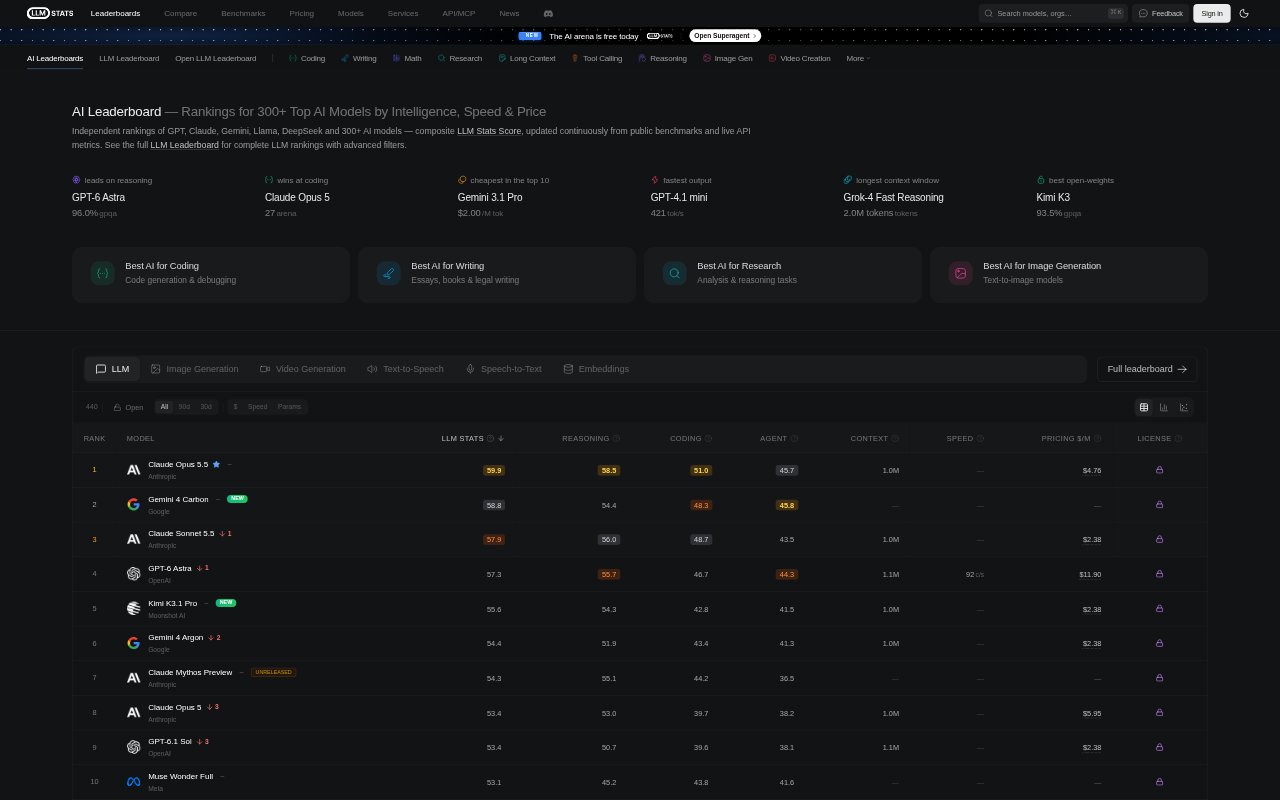
LLM Stats is a model research and comparison directory for people choosing AI models for products, workflows, or experiments. Its leaderboards cover more than 300 models, combining public benchmark results with live API metrics in rankings for intelligence, reasoning, coding, agent tasks, speed, context size, and price. Visitors can also compare model costs, explore benchmark and category pages, and check newly announced models.
LLM Stats Features:
Model Leaderboards: Rankings cover models from providers including OpenAI, Anthropic, Google, Meta, DeepSeek, Qwen, and Mistral, with a composite LLM Stats Score.
Performance Metrics: Model entries compare reasoning, coding, and agent scores alongside context window size, output speed, and pricing.
Benchmark Coverage: Benchmark pages include GPQA, MMLU, MMLU-Pro, AIME 2025, MATH, HumanEval, MMMU, LiveCodeBench, and SWE-Bench Verified.
Pricing Comparisons: Pricing views show input, cached input, and output costs per million tokens, along with observed cost per turn.
Comparison Filters: The full leaderboard offers advanced filters, while model pages and comparison tools help visitors examine specific options.
Specialized Rankings: Separate directories rank models for jobs such as coding, web development, writing, finance, image generation, and data analysis.
LLM Stats Benefits:
Faster Shortlisting: A shared view of capability, speed, context, and price makes it easier to narrow a broad field of models to candidates worth testing.
Cost Awareness: Comparing token rates and observed turn costs helps teams spot potential expense differences before choosing a model for regular use.
More Informed Tradeoffs: Side-by-side performance measures help users weigh strengths in areas such as coding or reasoning against speed and cost.
Benchmark Context: Benchmark-specific results give users more context for a ranking than a single overall score can provide on its own.
Updated Model Picture: Continuously refreshed rankings and a new-model section help visitors account for changes in a fast-moving model landscape.
Use Cases:
Selecting a Model: Compare candidates for a new AI feature by reviewing their reasoning, coding, agent, context, speed, and price measures.
Estimating API Costs: Review token pricing and observed cost per turn when assessing models for an application that will make repeated API calls.
Choosing Coding AI: Use coding-oriented rankings and benchmarks to identify models to evaluate for software development or web development tasks.
Researching Open Models: Explore the open-model leaderboard when looking for models whose published rankings and license details can inform an evaluation.
Finding Task-Specific Options: Start with a specialized ranking when comparing models for writing, finance, image generation, or Excel data analysis.