
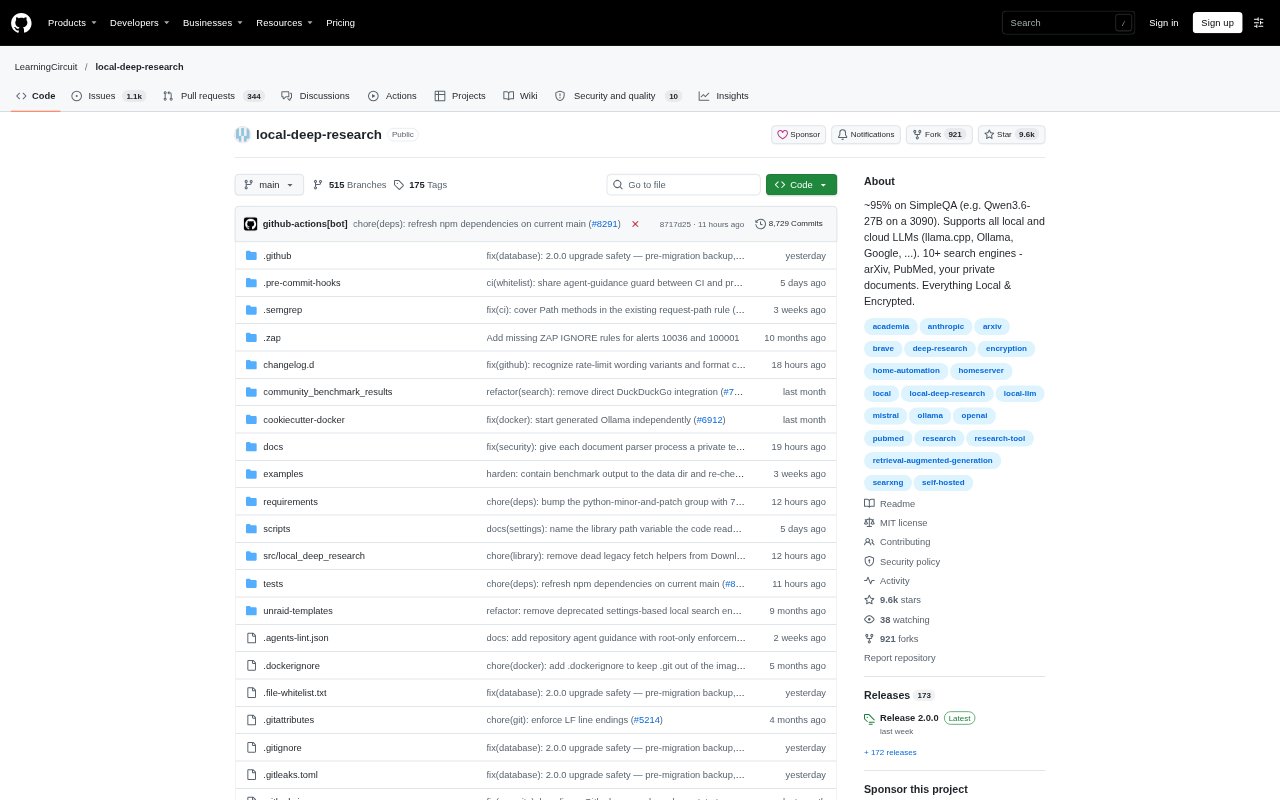
What is Local Deep Research?
Local Deep Research is a self-hosted AI research assistant for people who need to investigate complex questions and assemble findings. It searches the web, academic sources and documents in a personal library, then synthesizes material into reports with citations. Users can choose quick research pipelines or an agentic mode that adapts its searches as it works. It can run with local language models or cloud LLMs, and is available through a web interface.
Local Deep Research Features:
Agentic Research: In LangGraph agent mode, the model chooses what to search, selects specialized engines and adjusts its search approach as findings emerge.
Multi-Source Search: Research can draw on web search, academic sources such as arXiv and PubMed, and documents stored in a personal library.
Cited Reports: The assistant combines gathered material into research reports with citations, helping connect conclusions to their sources.
Searchable Library: Users can save web pages and academic papers, extract their text, index them and search across those materials in later research.
Encrypted Data: Each user has an isolated SQLCipher database encrypted with AES-256, with its encryption key derived from the user's password.
LLM Options: The application supports local and cloud language models, including models accessed through Ollama or OpenAI-compatible endpoints.
Local Deep Research Benefits:
Less Manual Research: Automated searching and synthesis can reduce the time spent gathering material and assembling an initial account of a complex topic.
Easier Verification: Citations make it easier to inspect the source material behind a report and check whether its conclusions are supported.
Growing Reference Base: Saved and indexed sources remain available for future questions, so useful research can inform later investigations instead of being rediscovered.
Data Control: Self-hosting and encrypted user databases give teams a way to keep research materials under their own control.
Flexible Setup: Choosing between local and cloud models lets users adapt the research setup to their available infrastructure and preferences.
Use Cases:
Academic Literature Review: A researcher can investigate a topic across sources such as arXiv, PubMed and Semantic Scholar, then organize findings into a cited report.
Market Background Research: A founder can gather and synthesize web sources to understand a market, emerging trend or unfamiliar industry before making a decision.
Internal Document Questions: A team can index its own documents and ask questions that combine those materials with current information from the web.
Complex Topic Investigation: An analyst can use agentic mode for a question that needs multiple searches and changing research directions rather than a quick factual lookup.
Source Collection: A knowledge worker can save useful web pages and academic papers during research and build a searchable reference library for future projects.