

What is Maat?
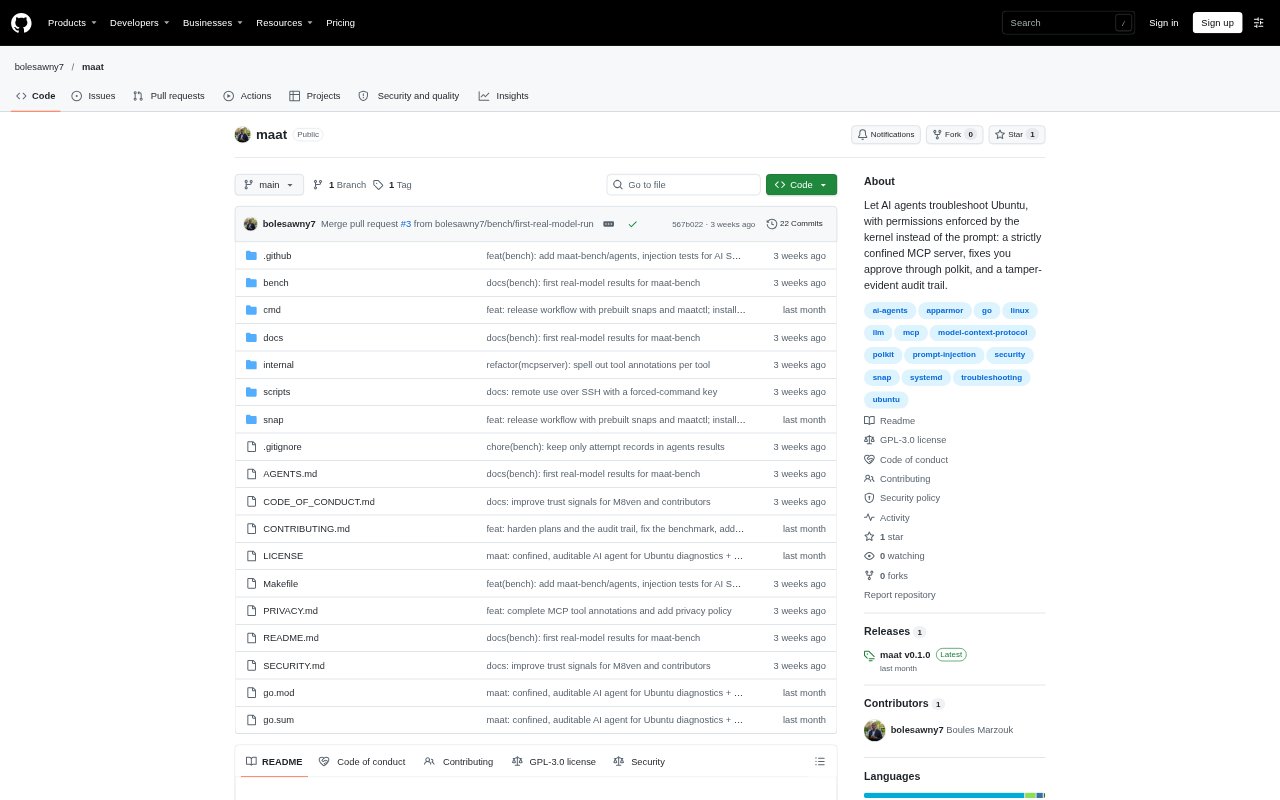
Maat is an open-source MCP server and toolkit for AI-assisted diagnosis and repair of Ubuntu machines. Its confined server lets agents inspect system information and propose fixes, while a separate command-line tool handles review and approval before changes are applied. It is aimed at Ubuntu administrators and developers who want agents to help troubleshoot without giving them a shell or independent access to change the host. Maat is in developer preview.
Maat Features:
Read-Only Inspection: The confined server can inspect Ubuntu logs, systemd units, processes, disks and other system state without network access or permission to make changes.
Condensed Log Analysis: Maat removes secrets, groups repeated log lines, ranks findings and clips long fields to prepare evidence for a model's context window.
Evidence References: Findings carry evidence IDs, and proposed plans show the supporting evidence while flagging citations that Maat did not issue.
Typed Repair Plans: Agents can propose an action from a limited catalog, and Maat derives its preconditions, success check and undo step.
Human-Approved Changes: The separate maatctl program checks a plan, displays its steps and evidence, then applies it after terminal confirmation and polkit authorization.
Audit Trail: Proposals, approvals, executions and verifications are recorded in a hash-chained trail with checkpoints in the systemd journal.
Maat Benefits:
Safer Troubleshooting: Kernel-enforced confinement limits what an agent can do, reducing the risk that a faulty or manipulated model changes the host.
Faster Log Review: Condensed, ranked findings help users and models focus on relevant system evidence instead of working through noisy raw logs.
Informed Approval: Seeing a proposed action and the evidence behind it gives administrators a clearer basis for deciding whether to authorize a repair.
Verifiable History: The chained records and journal checkpoints help administrators detect changes, deletions, reordering or truncation in the activity trail.
Model-Free Diagnosis: Administrators can get a plain diagnostic report without connecting an AI model or MCP client.
Use Cases:
Failed Service Triage: Ask an agent to examine failed systemd units and related journal entries, then review a proposed restart for a named service.
Ubuntu Log Investigation: Use Maat to organize system logs and their evidence when investigating an issue such as repeated authentication failures.
Repair Review: Have an agent suggest a specific repair, inspect its preconditions and undo step in maatctl, and approve it through polkit if appropriate.
Change Auditing: Verify the recorded trail after an agent-assisted troubleshooting session to check whether its entries remain intact.
Model Evaluation: Use maat-bench's deliberately broken Ubuntu machines to measure how models identify root causes and respond to instructions planted in logs.