

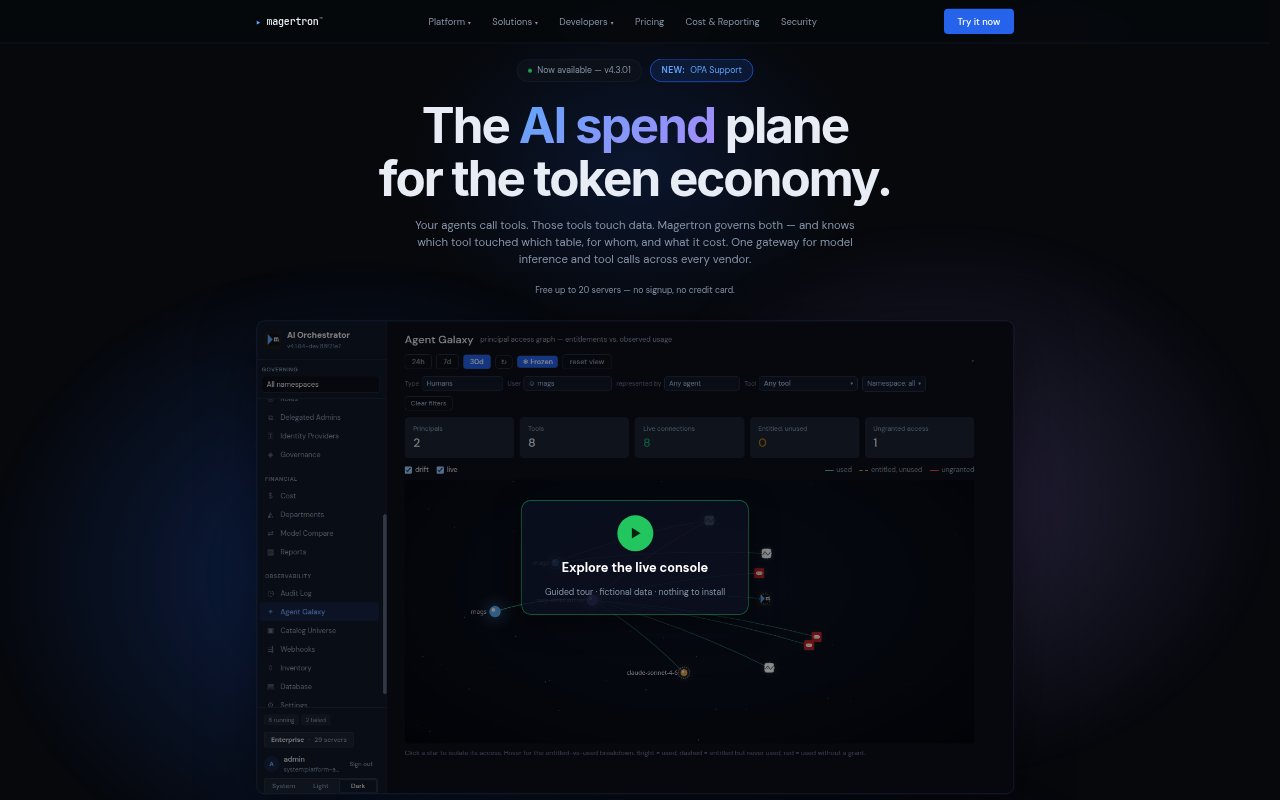
What is Magertron?
Magertron is a Kubernetes-native control plane for organizations running AI agents and MCP servers. It governs access to models, APIs, and tools through a shared gateway and policy layer, while tracking usage and costs by team. Teams can deploy and manage server workloads in their own cluster, and use endpoint inventory to find MCP servers configured on managed devices. A free option supports up to 20 servers.
Magertron Features:
Unified Gateway: The Envoy gateway applies a common enforcement boundary to calls going to MCP tools, REST APIs, and model providers.
Policy Controls: Governance policies and OPA rules determine which callers may reach particular tools, models, or APIs.
Cost Metering: Usage can be metered by team, capped, and reported for departmental chargeback.
MCP Discovery: Magertron reads MCP client configurations on managed endpoints to show servers in use, including unapproved ones.
Server Management: Teams can deploy MCP servers and LLM pods from container images, view CPU and memory metrics, and scale workloads.
Operational History: The control plane provides Kubernetes pod logs, deployment history, one-click rollback, and audited actions.
Identity Controls: Access options include scoped developer tokens, role-based controls, namespace isolation, and SSO and SCIM provisioning.
Magertron Benefits:
Consistent Governance: A shared policy boundary helps teams apply access rules across tools, APIs, and model providers instead of managing each path separately.
Clearer Spend: Team-level metering and chargeback reports make it easier to see where agent costs accumulate and assign them to departments.
Earlier Detection: Inventory of MCP configurations on managed endpoints can reveal servers operating outside approved processes.
Stronger Traceability: A signed audit trail helps teams review agent activity and connect tool access with the people and costs involved.
Safer Changes: Deployment history and rollback give operators a way to recover from server changes without rebuilding their deployment process.
Local Control: Running the control plane in a Kubernetes cluster lets organizations govern agent traffic within their own environment.
Use Cases:
Agent Access Review: Set rules for which AI agents, teams, or callers can use specific MCP tools, models, and APIs.
Shadow Server Audit: Find MCP servers configured on managed laptops and endpoints, then direct them toward the gateway through a policy change.
Department Chargeback: Track model and tool usage by team when departments need to understand or allocate AI agent costs.
MCP Operations: Deploy containerized MCP servers, monitor their resource use, inspect pod logs, and roll back a deployment when needed.
Model Routing: Apply routing policies when different callers or requests should reach different model providers through one gateway.
Data Access Governance: Govern the data agents can reach across configured sources such as Databricks Unity Catalog, Snowflake, and BigQuery.