

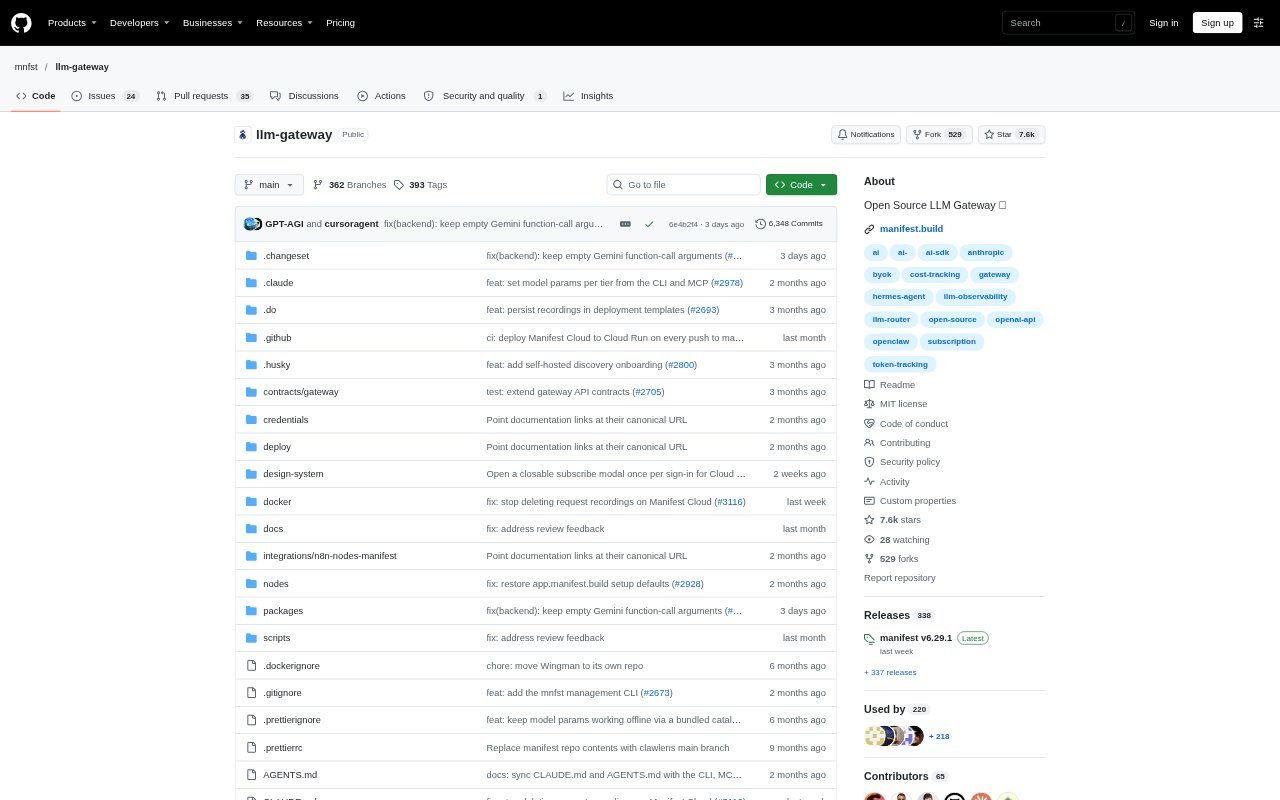
What is Manifest?
Manifest is an open-source gateway for routing language-model requests from AI agents, applications and workflows. It connects cloud providers, subscription plans, custom compatible endpoints and local models through one OpenAI-compatible endpoint, so teams can manage model selection and inference in one place. Builders can run it on their own infrastructure for free or use the hosted service for $19 per month. They supply provider credentials and pay providers directly, with no token markup from Manifest.
Manifest Features:
Provider Routing: Connect API-key services, subscription plans, local models and custom OpenAI- or Anthropic-compatible providers, then route requests through one endpoint.
Routing Rules: Choose a model and provider for each route, configure model parameters visually, and apply limits to requests.
Model Fallbacks: Set up automatic retries through another provider when the selected provider is unavailable or a request fails.
Request Autofix: Manifest can repair supported malformed requests before returning them to the agent or application that made the call.
Request Logs: Review full request and response bodies, including error messages, for calls routed through the gateway.
Spend Tracking: View inference costs by agent, key and provider, and configure budgets, limits and notifications.
Self-Hosting: Run the gateway on your own infrastructure or machine, or use the hosted service managed by Manifest.
Manifest Benefits:
Fewer Interruptions: Fallbacks and request repair can help keep agents and applications working when a provider is down or a call contains an avoidable error.
Provider Flexibility: Teams can change providers or combine subscription, usage-based and local inference without tying every workflow to one provider.
Clearer Spending: Per-agent, key and provider cost views make it easier to spot where inference consumption is coming from.
More Cost Control: Using existing subscriptions, local models and budget limits can help teams manage usage before it becomes an unexpected bill.
Data Control: Self-hosting lets teams keep the gateway and its data on their own infrastructure rather than sending it to a hosted service.
Use Cases:
Agent Provider Setup: Connect a personal or team AI agent to subscription providers, API-key services or local models through one endpoint.
Application Reliability: Add fallbacks and request repair to an AI application that needs to handle provider outages and malformed calls.
Inference Cost Reviews: Use spend breakdowns and request logs to investigate which agents, keys or providers are driving model costs.
Local Model Routing: Direct selected queries to models running through Ollama, LM Studio, llama.cpp or another local server.
Team Usage Oversight: Give a team a shared gateway for managing provider settings, tracking consumption and applying budgets to engineers' AI calls.