
What is Marcus?
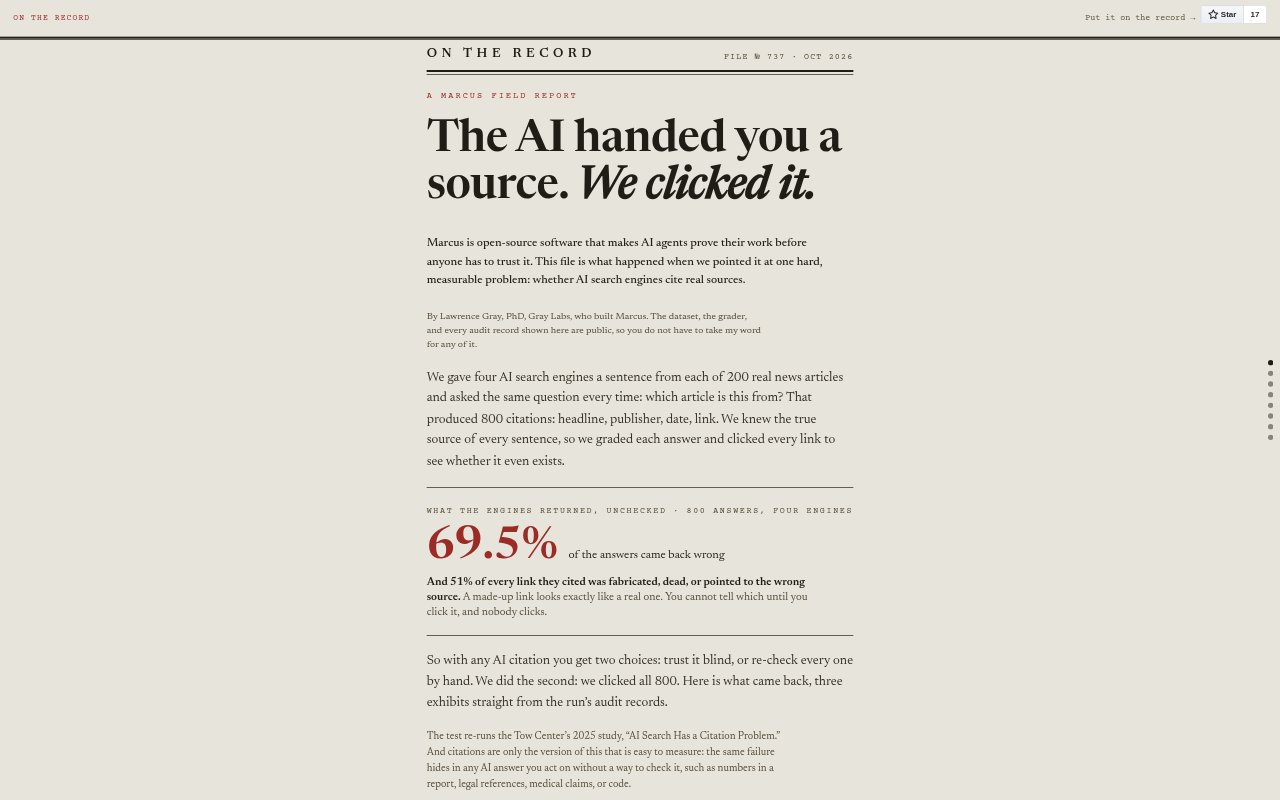
Marcus is open-source software for coordinating AI agents and people on work that needs to be checked before it can be relied on. Work moves through a shared board, where agents take tasks, provide proof, and have that proof checked by someone other than the worker; a person can sign off where needed. Teams can use Marcus to coordinate agent-built software or to verify claims such as citations, figures, and code results before acting on them.
Marcus Features:
Shared Work Board: Tasks and their progress are visible on one board where people and AI agents can work together.
Task Breakdown: For software projects, Marcus turns a description of what to build into tasks on a shared kanban board.
Agent Coordination: Agents pull tasks independently and coordinate through the board rather than through chat.
Independent Checks: Work must include proof that is checked by someone other than the agent or person who produced it.
Human Sign-Off: A person can sign off on work where human approval matters before it is marked done.
Audit Bundles: An exported audit bundle records who made a claim, who checked it, the evidence, the human signature, and the cost.
Script-Based Verification: A checkpoint can use scripts to check claims, including links, figures against source documents, code against tests, and legal citations against court records.
Marcus Benefits:
Less Manual Review: Teams can spend less time re-checking every agent output themselves because work must arrive with checked proof.
Clear Refusals: When a claim fails verification, its documented reason helps people understand why it was declined instead of treating it as a valid answer.
Traceable Decisions: The record makes it possible to follow who produced and checked a result, what evidence supported it, and who approved it.
Parallel Progress: Agents can work on separate tasks at the same time, giving teams a way to coordinate a larger project through one shared board.
More Actionable Work: Teams can make decisions from results that passed their checks rather than spending the saved time rebuilding confidence in each output.
Use Cases:
Agent-Built Software: Describe a software project, split it into board tasks, and let agents such as Claude Code, Codex, or Gemini CLI work through them.
AI Citation Review: Check whether links cited in an AI search answer resolve before passing the answer on to a reader.
Report Fact-Checking: Verify a number in an AI-generated report against the document it is supposed to come from.
Legal Reference Checks: Use a script to compare a legal citation in an answer with the relevant court record before relying on it.
Code Verification: Require code produced by an agent to be checked against its tests before marking the work complete.