

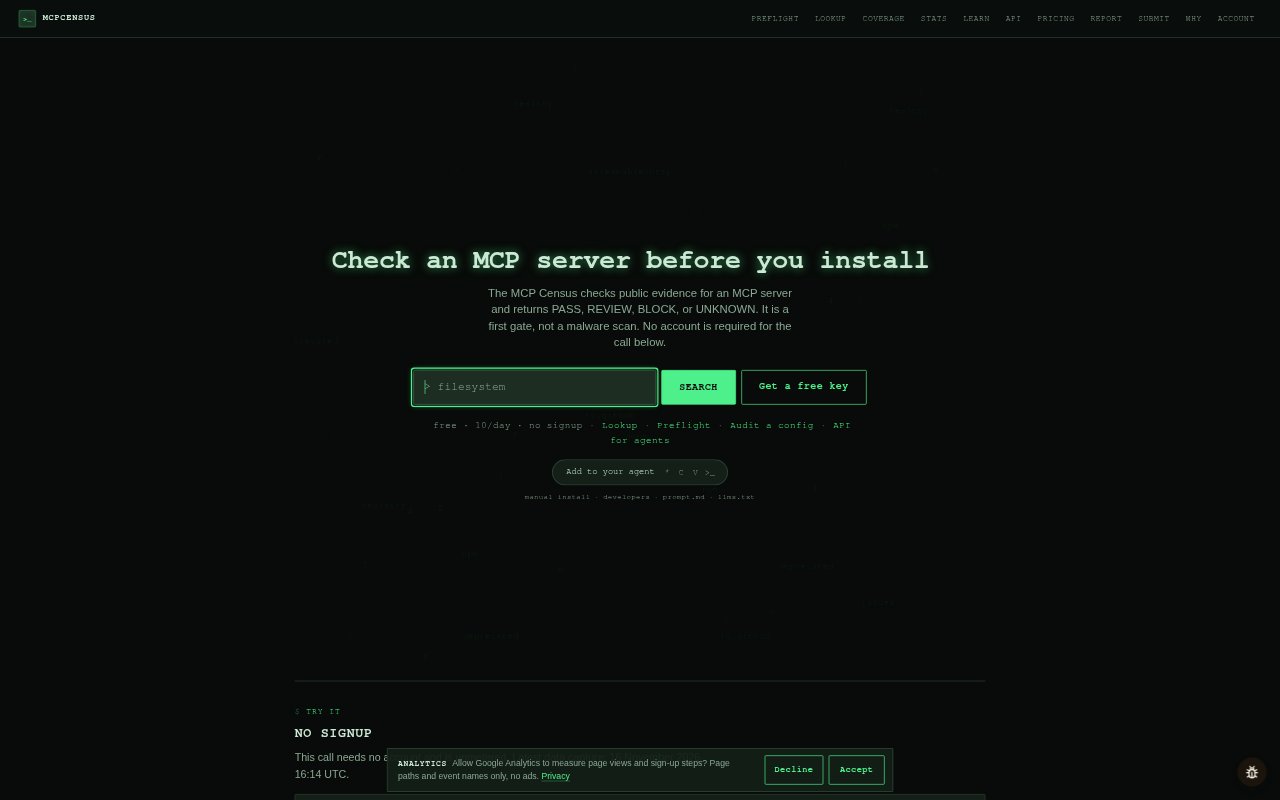
What is MCP Census?
MCP Census checks public evidence about MCP servers and returns a PASS, REVIEW, BLOCK, or UNKNOWN decision. It is designed for developers and teams that want to check a server before installing or connecting it, and for agents that need to apply a check during setup or use. It can also audit an MCP configuration and track changes over time. The service is a first gate, not a malware scan or a guarantee of safety.
MCP Census Features:
Evidence-Based Decisions: Each server check returns PASS, REVIEW, BLOCK, or UNKNOWN, with claims linked to public evidence rather than a claim that the server is safe.
Server Lookup: Search and lookup cover health and ownership information for more than 56,000 MCP servers, helping distinguish a vendor server from a lookalike.
Config Audits: Submit an MCP configuration to receive a decision for each entry, with anonymous checks available for one configuration of up to 25 entries per IP per day.
Agent Access: Agents can use REST or MCP, including the census_stamp and census_audit_config tools, to check servers before installation, enabling, or use.
Change Feed: A cursor-based feed records changes such as a repository appearing, an endpoint going down, a tool list changing, or a health or verification status flipping.
Watch Records: Scheduled checks record what they observed, so users can retrieve changes since an earlier check without rereading the full server record.
MCP Census Benefits:
Faster Screening: A clear status and linked evidence give developers a quicker starting point than manually gathering basic ownership and health clues for every server.
Clear Uncertainty: Separate REVIEW and UNKNOWN outcomes help teams recognize when evidence needs human attention instead of treating missing information as approval.
Consistent Checks: Applying the same pre-install rule across an agent workflow helps avoid relying on memory or repeating informal checks from one server to another.
Earlier Change Awareness: A record of changes can bring altered endpoints, tool lists, or health status to a team's attention before they rely on outdated details.
Less Manual Review: Checking a whole configuration in one request can save the effort of looking up each entry separately and assembling the results.
Use Cases:
Before Installation: Check an MCP server's ownership and public health evidence before adding it to a developer's local setup.
Agent Tool Calls: Set an agent to run a Census stamp before enabling or calling an MCP server, stopping on BLOCK and asking a person to review REVIEW.
Config Review: Audit a team's existing MCP configuration to identify entries that need attention before a rollout or routine maintenance.
Vendor Verification: Compare a server's public identity evidence with the expected vendor when deciding whether a listing may be a lookalike.
Ongoing Monitoring: Use scheduled checks and the change feed to follow repository, endpoint, tool-list, health, or verification changes for servers a team relies on.