
What is MELRA?
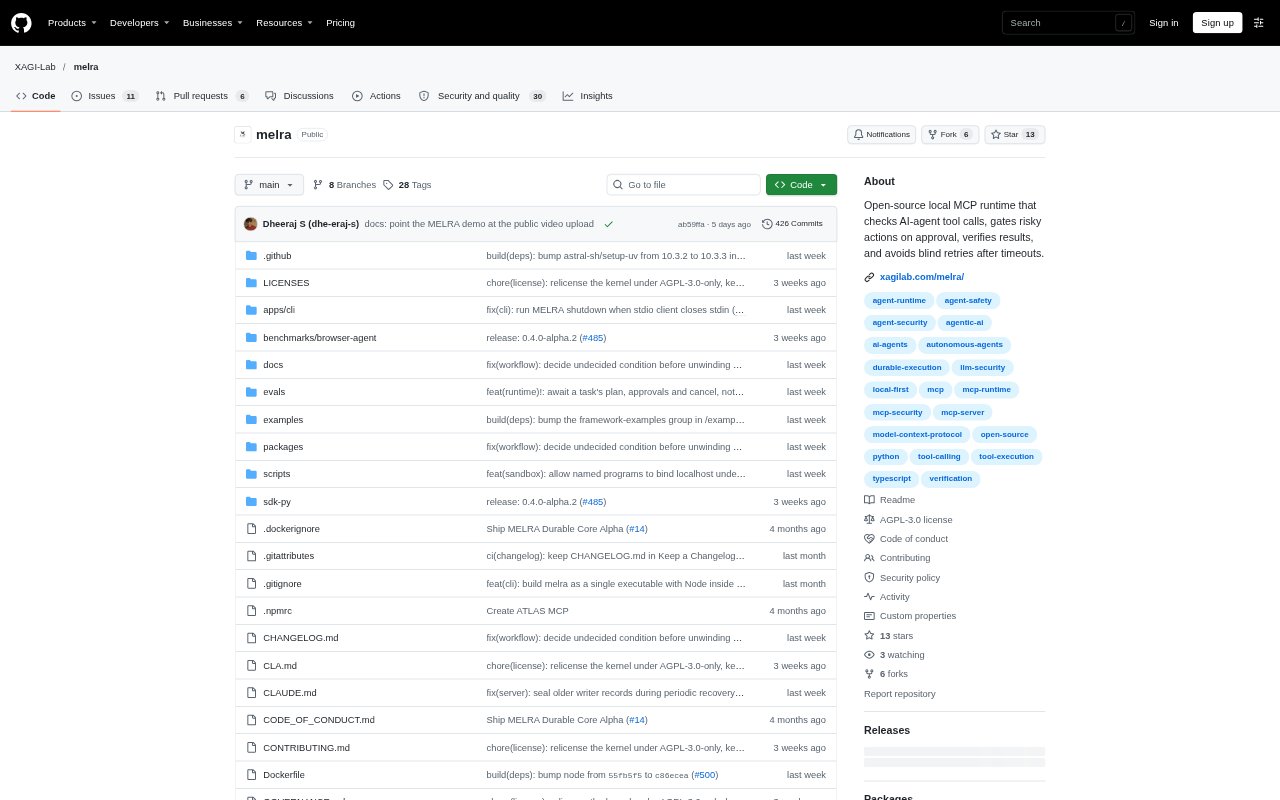
MELRA is an open-source local execution layer for AI agents, governing the tool calls routed through it. It checks actions against policy, can pause risky changes for human approval, verifies declared evidence, and records outcomes in receipts. It is designed for people using agent clients such as Claude Code, Cursor, Codex, Gemini CLI, or other MCP clients who want more control over what those agents do. MELRA is alpha software, and its APIs may change before version 1.0.
MELRA Features:
Policy Checks: MELRA checks each routed tool call against a configured policy and checks it again when the action is about to run.
Human Approval: Actions that require approval can be held until a person approves the specific change, while disallowed actions are refused before execution.
Evidence Verification: An action counts as complete only when its declared evidence holds, such as a file existing, a successful exit code, or expected page content.
Crash Recovery: MELRA records mutations before dispatch, runs each at most once, and parks uncertain outcomes for reconciliation rather than blindly retrying.
Action Receipts: Each action that reaches an outcome leaves a redacted, append-only receipt with a digest that can be used to audit what ran and why.
Local Runtime: The runtime runs locally and can be set up from a project workspace, where its configured boundary applies to file and command operations.
Agent Compatibility: MELRA works with listed coding-agent clients and any MCP client, and its setup wizard can configure a selected client.
MELRA Benefits:
Fewer Unapproved Changes: Policy checks and approval gates help teams keep risky agent actions under human control instead of relying on an agent’s judgment alone.
Clearer Completion: Evidence-based verification gives users a defined basis for deciding whether an action succeeded, rather than treating the absence of an error as proof.
Safer Recovery: Recording work before execution and avoiding blind replays reduces the chance that a recovery attempt repeats an uncertain mutation.
Auditable Activity: Receipts make it easier to review which routed actions ran, who requested them, and the basis for allowing them.
More Consistent Controls: Applying one execution layer across supported agent clients gives users a shared place to govern tool calls routed through MELRA.
Use Cases:
Reviewing File Edits: Route an agent’s file changes through MELRA, require approval for risky edits, and check that the resulting file matches the expected evidence.
Guarding Shell Commands: Use policy checks and the workspace boundary when an agent needs to run commands as part of a coding or maintenance task.
Checking Web Actions: Verify an agent’s web-related action against declared page content before treating the requested change as complete.
Managing API Mutations: Govern tool calls that change data through an API, and leave uncertain outcomes parked for review rather than automatically replaying them.
Auditing Agent Work: Review receipts after an agent task to understand what MELRA allowed, what ran, and whether its declared evidence held.