

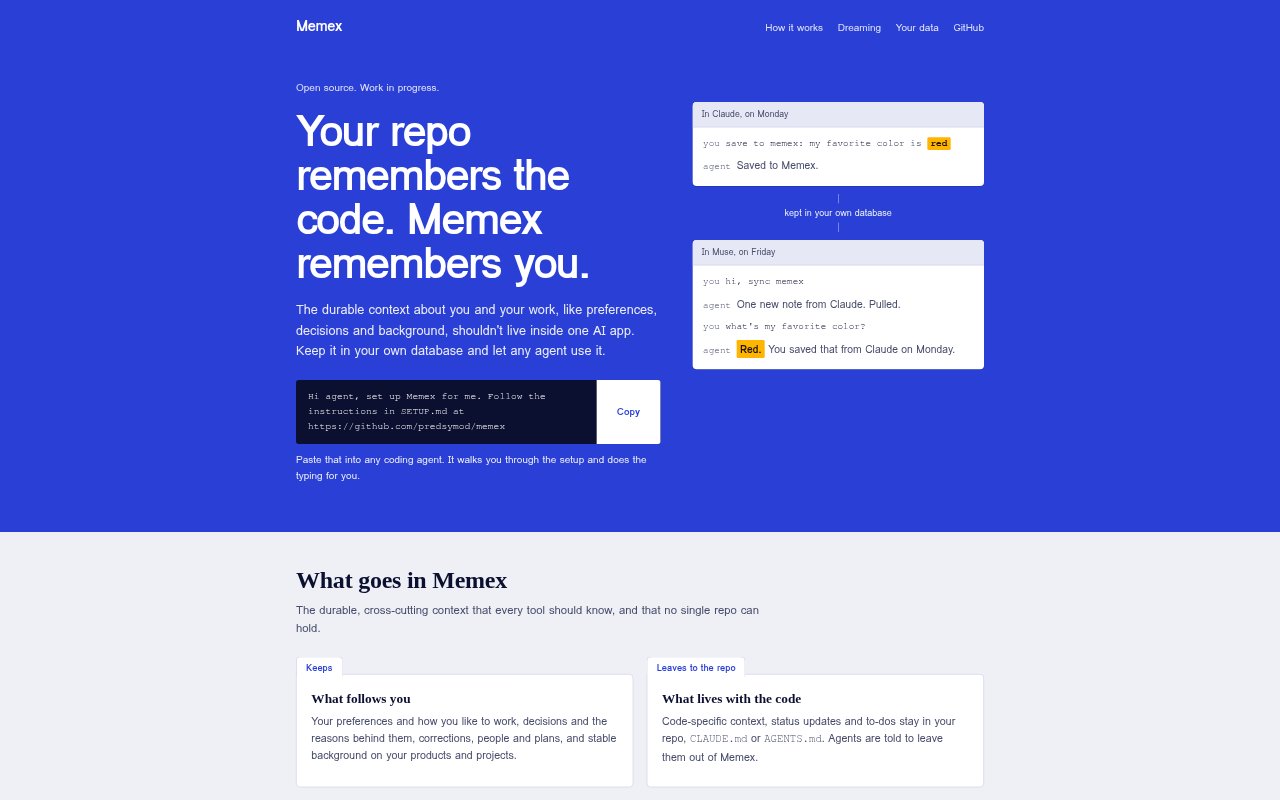
What is Memex?
Memex is an open-source context layer for people who use AI agents and want durable information about themselves and their work to carry across tools. It runs as an MCP server on your own Supabase project, where agents can save and retrieve preferences, decisions, corrections, and background about your products or projects. The project is marked as a work in progress, and its setup instructions are designed to let an agent guide the installation.
Memex Features:
Owned Memory Store: Memex keeps memories in your own Supabase database, rather than in a database hosted by the Memex project.
Shared Agent Context: Agents can save durable context and retrieve what other connected agents have learned, with permission settings for what each agent may save.
Blended Search: Search combines meaning-based matching with exact words, can favor recent notes, and surfaces the current version when a memory has been corrected.
Scheduled Sync: Agents that support scheduled tasks can periodically fetch new memories or, with your approval, save durable facts and decisions.
Memory Safeguards: Memex limits unattended saves, skips likely secrets and repeats, and lets you retract a set of notes without deleting them.
Nightly Organization: Optional Dreaming adds tags, summaries, dates, and links between memories, while logging changes so they can be undone.
MCP Connections: The server is tested with Claude and Muse, and agents supporting MCP over HTTP can connect using a URL and key.
Memex Benefits:
Less Repetition: You can avoid re-explaining stable preferences and work background each time you switch to another AI agent.
More Consistent Answers: Agents can draw on shared decisions and corrections, reducing the chance that each tool works from a different version of your context.
Clearer Ownership: Keeping the database and keys under your control gives you a direct say over where persistent context is stored.
Safer Background Use: Limits on unattended saves and the ability to retract notes make automatic syncing easier to review and correct.
Easier Recall: Meaning-based and exact-word search helps you find useful notes even when you do not remember their precise wording.
Use Cases:
Cross-Agent Handoffs: Use Memex when moving between coding agents so each can consult shared preferences, project background, and durable decisions.
Decision Tracking: Save a decision and its rationale so a later agent can account for why a product or project direction was chosen.
Preference Recall: Keep recurring instructions about how you like to work available to different agents without entering them into each tool separately.
Daily Context Catch-Up: Schedule an agent to gather new memories from other tools and provide a short summary of what changed.
Project Background: Store stable information about products, people, and plans that is useful across repositories rather than specific to one codebase.