

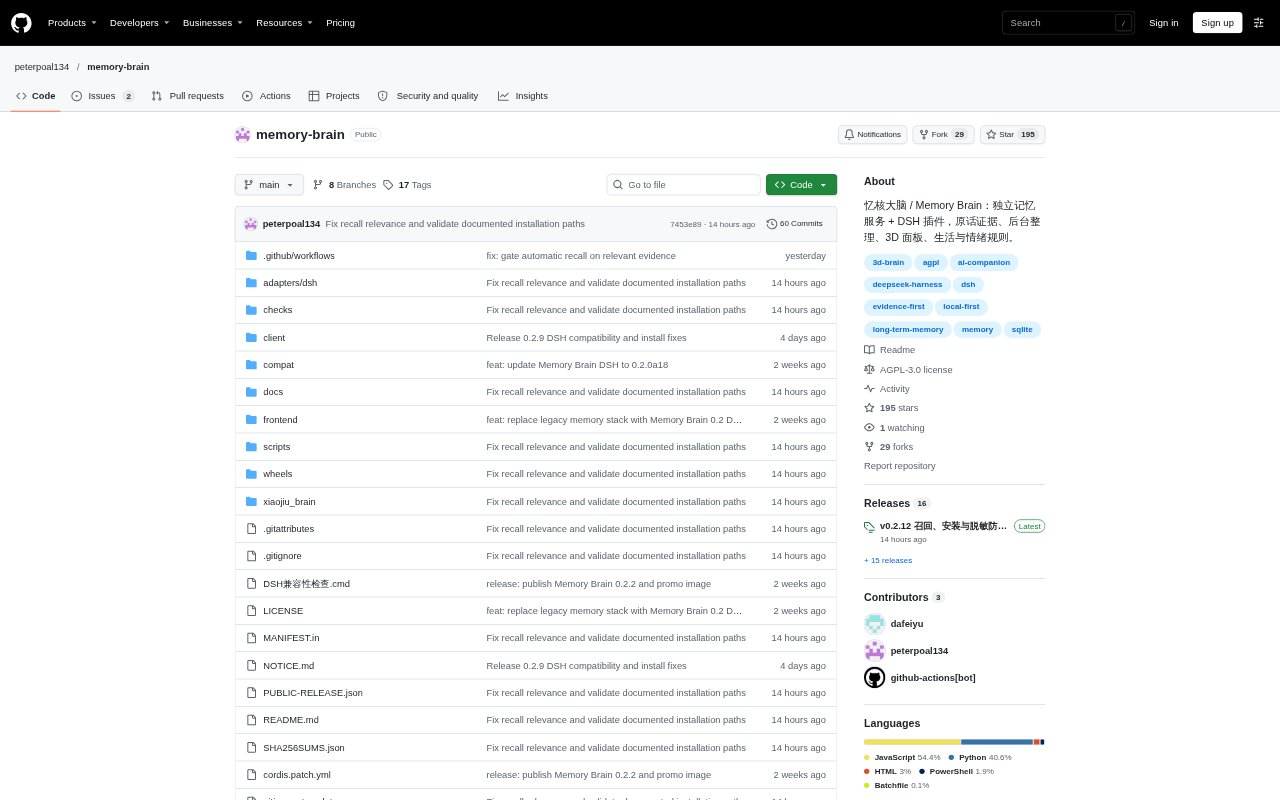
What is memory-brain?
Memory Brain is a locally running memory service and DSH plugin for keeping original conversation messages, organizing them into derived facts and summaries, and retrieving them with source evidence. It is aimed at people who want an AI host to retain useful context across conversations and offers a control panel for reviewing and managing that information. The documented direct-install setup targets personal, low-concurrency use on Windows; other hosts can connect through its HTTP protocol.
memory-brain Features:
Original Message Storage: The service stores observed messages locally and makes original text available for lexical search as soon as it is saved.
Background Organization: When a model is configured, a background process can organize accumulated messages into separate summaries and derived facts.
Evidence Retrieval: Search combines multiple candidate routes, then retrieves original-message evidence and source excerpts for the current request.
Conversation Context: Context management can summarize earlier conversation history while retaining recent completed turns and the current input.
Memory Control Panel: The panel lets users review original messages and derived memories, search candidates, add notes, pin or archive items, and delete them.
Usage and Backups: The panel reports available token usage, supports SQLite backups and JSON export, and shows unknown usage separately from reported amounts.
memory-brain Benefits:
Traceable Recall: Keeping original messages alongside derived memories makes it easier to check a recalled detail against its source rather than treating a summary as proof.
Flexible Setup: Basic saving and lexical search work without model configuration, so users can start collecting and finding original messages before enabling model-based organization.
Safer Context Updates: Conversation history is retained when original messages cannot be confirmed or summarization fails, reducing the risk of losing context during compression.
Clearer Record Keeping: Separate views for originals, derived memories, and reported usage help users inspect what was stored and distinguish known amounts from missing data.
Local Data Control: A local service, explicit deletion, and backup and export options give users direct control over their memory data and recovery process.
Use Cases:
Personal Assistant Memory: Use it with DSH to retain details from prior conversations and retrieve relevant original messages during a later request.
Reviewing Recall: Check a remembered preference or detail in the panel by opening the derived entry and inspecting its cited source excerpt.
Long Conversations: Use context management to condense earlier history in an active session while keeping recent turns and the original messages available.
Memory Maintenance: Write a note, adjust a memory's importance, pin or archive an item, or explicitly delete information that should no longer be retained.
Local Usage Review: Inspect reported chat and background-organization usage, then create a database backup or JSON export before maintenance or migration.