

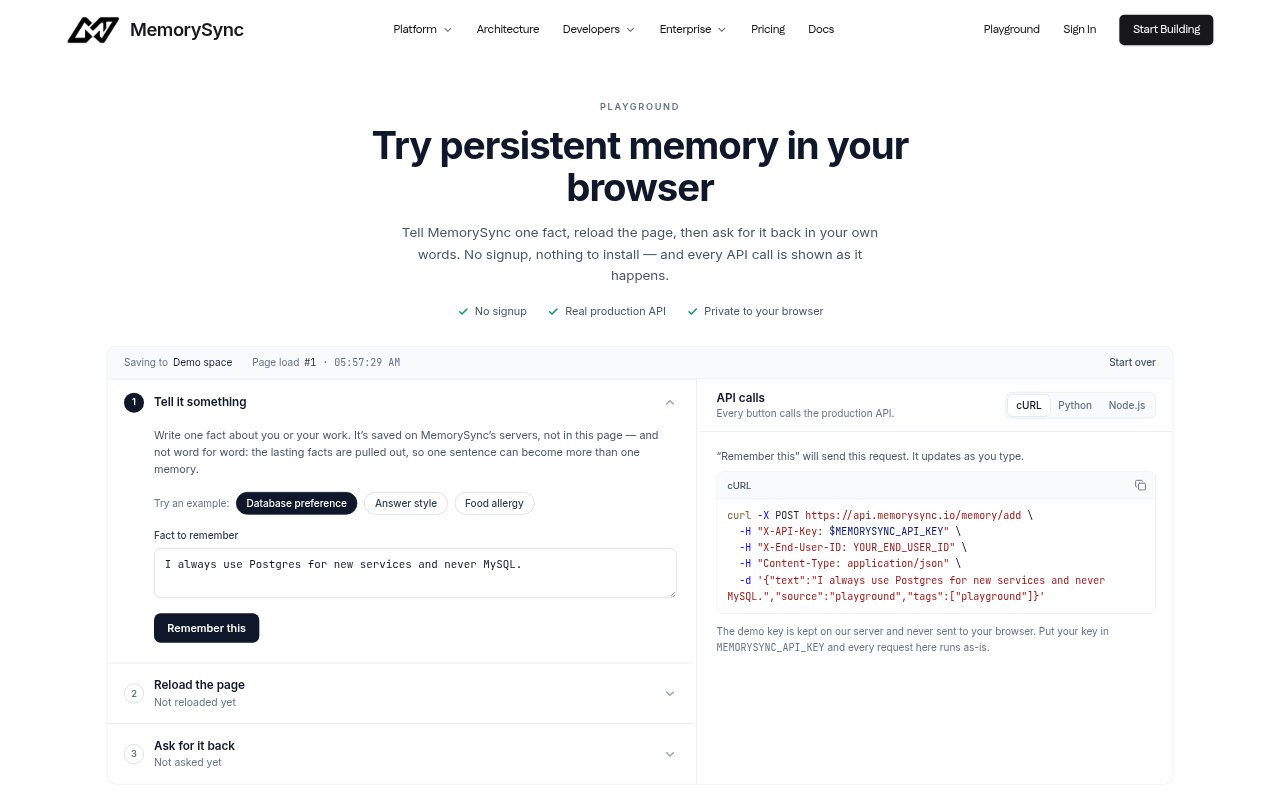
What is MemorySync?
MemorySync is a persistent memory layer for production AI applications, giving agents a way to store context beyond an individual conversation and retrieve relevant details later. Its APIs and Python and Node.js SDKs support memory storage and semantic retrieval, while a control plane exposes retrieval and governance activity. Teams can connect it to agent frameworks and content sources, and use tenant scopes and access controls when building multi-user systems.
MemorySync Features:
Persistent Memory: Store lasting facts outside a single session so an agent can retrieve them after a conversation ends or a page reloads.
Semantic Recall: Search stored context by meaning, allowing a query to find relevant memories without repeating the original wording.
Memory Compaction: Summarize related memories and merge duplicates to keep prompts within a workable context budget.
Memory Intelligence: Surface relationships between entities, thematic clusters, and conflicting statements across stored information.
Tenant Isolation: Scope memories to an organization, project, and end user so one customer’s context is not retrievable by another.
Access Governance: Apply role-based permissions and maintain audit records of memory access and changes.
Developer Integrations: Use Python and Node.js SDKs, a REST API, webhooks, and connectors for sources including Slack, Notion, and Google Drive.
MemorySync Benefits:
Less Repetition: People can continue working with an agent across sessions without having to restate every useful detail.
More Relevant Context: Meaning-based retrieval helps agents find useful information even when a request uses different words from the saved memory.
Focused Prompts: Condensing related memories helps teams keep the context supplied to a model within a manageable budget.
Safer Separation: Tenant scoping helps prevent information belonging to one customer from appearing in another customer’s agent context.
Clearer Oversight: Access records and retrieval traces help teams inspect how memory is being used and governed.
Use Cases:
Cross-Session Agents: Give a conversational agent durable context so it can recall facts learned during earlier interactions.
Knowledge-Connected Assistants: Make permitted content from tools such as Slack, Google Drive, or Notion available alongside an application’s own memories.
Framework-Based Agents: Add persistent memory to an application built with a supported framework such as LangChain, CrewAI, or Vercel AI SDK.
Multi-User Applications: Keep memory for different organizations, projects, and end users separately scoped in a shared AI application.
Memory Operations: Review retrieval activity, orchestration decisions, and governance policies while operating an AI memory system.