
What is Meta AI?
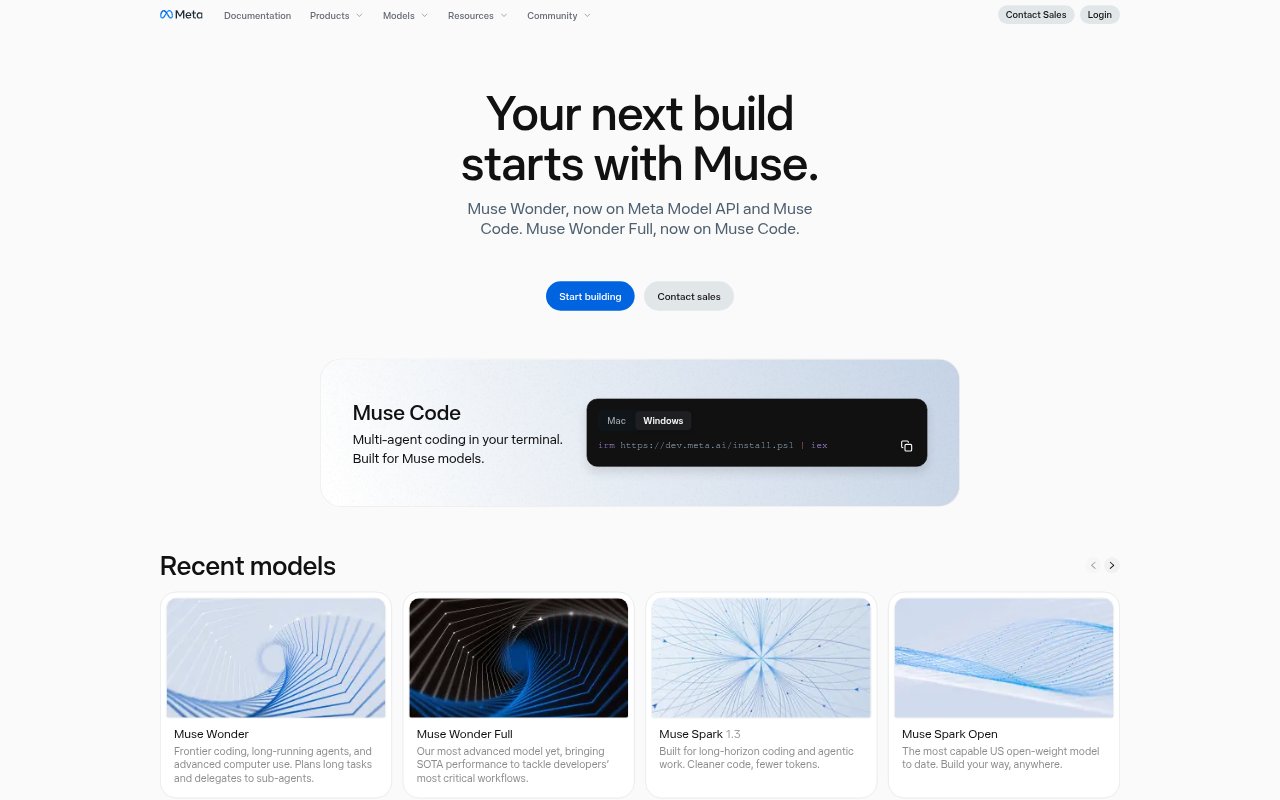
Meta AI’s developer offering brings together Meta’s Muse models and related tools for building AI-powered software and workflows. Developers can work with Muse models through Muse Code and the Meta Model API, alongside tools for image and video analysis, speech transcription, image generation, and local agents. The catalog includes coding-focused, open-weight, and specialized models for developers exploring different approaches to coding, perception, and agentic applications.
Meta AI Features:
Muse Code: This terminal-based, multi-agent coding environment is built for Muse models and gives developers a command-line setting for coding work.
Long-Running Agents: Muse Wonder plans long tasks and delegates work to sub-agents, and is designed for coding and agentic workflows.
Computer Use: Muse Wonder includes advanced computer-use capabilities for workflows that involve interacting with software through a computer.
Object Tracking: SAM 3.1 can detect, segment, and track objects from a text prompt across images and video.
Speech Transcription: Muse Voice Transcribe turns speech into text and includes speaker diarization and turn detection.
Image Refinement: Muse Image plans, self-corrects, and refines as an agentic image model.
Local Agents: Muse Glimmer is built to enable always-on local agents and is available on Hugging Face.
Meta AI Benefits:
Less Task Oversight: Delegation and planning can reduce the need for developers to break long coding jobs into individually managed subtasks.
Concise Coding Work: Muse Spark 1.3 is described as producing cleaner code with fewer tokens, which can make coding workflows more concise.
Faster Visual Review: Prompt-based object detection and tracking can help teams find and follow visual subjects without defining each step of the analysis themselves.
Easier Transcript Review: Speaker and turn information can make speech transcripts easier to follow when several people are part of a conversation.
Local Agent Options: Support for always-on local agents gives developers a way to build agent experiences that do not depend on running entirely in the cloud.
Use Cases:
Agentic Coding: Use Muse models and Muse Code to build coding workflows that plan and carry out longer development tasks.
Computer Workflows: Explore agent workflows that need to use a computer to complete tasks across software interfaces.
Video Analysis: Track a subject across video footage when reviewing visual material for a project or application.
Interview Transcripts: Transcribe recorded interviews and distinguish speakers and turns when preparing text for review.
Image Creation: Build image-generation workflows that can plan and refine images through an agentic model.
Local Agent Builds: Prototype always-on local agent experiences using Muse Glimmer.