

What is Meteosource MCP Server?
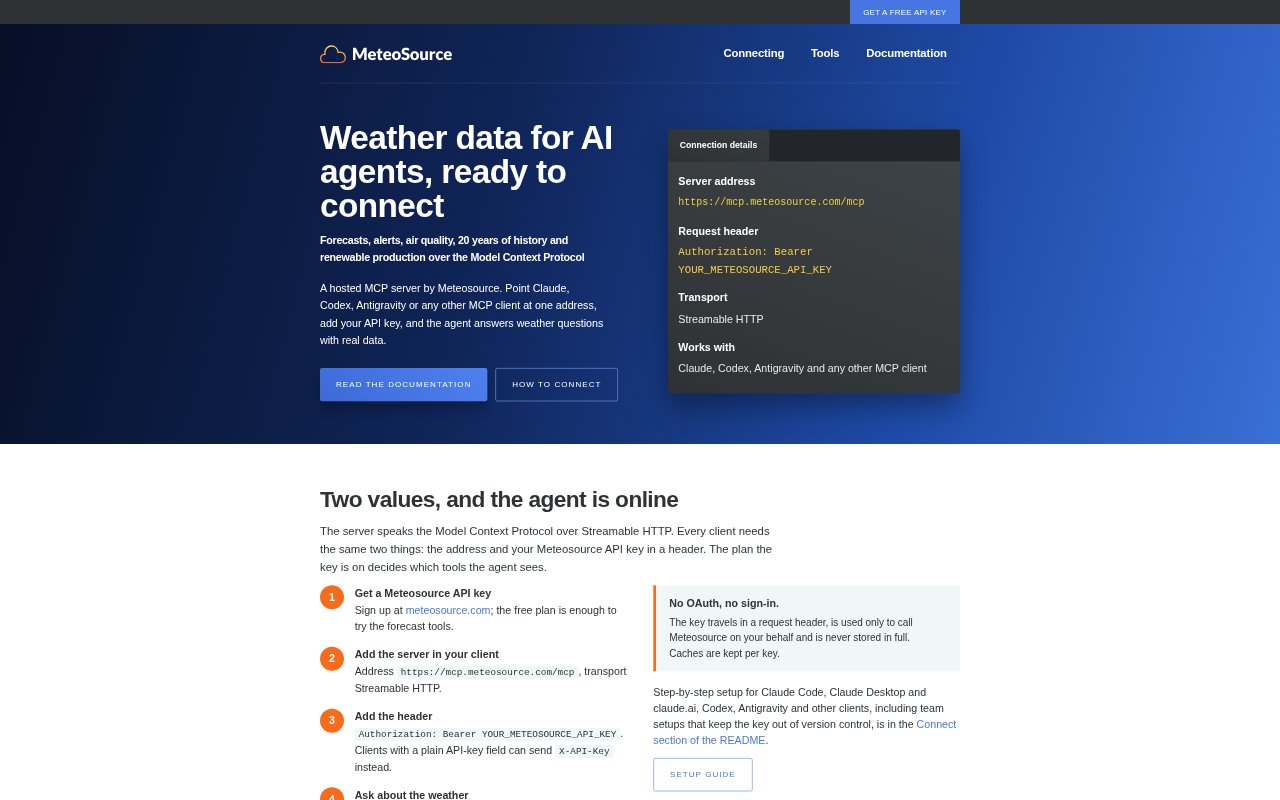
Meteosource MCP Server is a hosted weather-data service that connects AI agents to Meteosource through the Model Context Protocol. It gives compatible MCP clients access to forecasts, severe-weather alerts, air-quality information, historical weather, and renewable-energy production data. Setup uses a server address and a Meteosource API key, with Streamable HTTP transport. It is intended for people who want an AI agent to answer weather questions using live data without building a separate weather interface.
Meteosource MCP Server Features:
Place Lookup: Search by place name, postal code, or coordinates to get a place ID for use with the weather tools.
Weather Forecasts: Retrieve current conditions, hourly and daily forecasts, and minute-by-minute precipitation, with up to 20 locations in one call.
Severe Weather Alerts: Get official severe-weather warnings for locations in the United States, the European Union, and Canada.
Weather History: Request past weather by hour, day, or month, along with long-term normals and weather records.
Air Quality: Access hourly air-quality information with forecasts extending about four days ahead.
Solar Production: Retrieve estimated output for a photovoltaic system across a period ranging from 20 years in the past to four days ahead.
Wind Production: Retrieve wind-farm production data for a period reaching 20 years back and four days into the forecast.
Meteosource MCP Server Benefits:
Ask in Context: People can ask weather questions through an MCP client they already use instead of switching to a separate weather-data interface.
Less Setup Work: A hosted server and a shared connection pattern spare teams from setting up a weather MCP endpoint themselves.
Broader Planning: Forecasts, history, alerts, and air quality give an agent several kinds of weather context for a single planning conversation.
Location Comparison: Multi-location forecast requests help users consider conditions across several places without repeating the same request for each one.
Key Control: The API key is sent in a request header and is not stored in full, reducing the need to expose a complete key in client setup.
Use Cases:
Trip Planning: Ask an agent to check forecast conditions and precipitation for destinations before choosing travel dates or planning outdoor stops.
Weather Monitoring: Use an agent to check official severe-weather warnings for a location in the United States, the European Union, or Canada.
Site Comparison: Compare forecast conditions across multiple candidate locations when deciding where to schedule an outdoor activity or operation.
Historical Review: Ask about past hourly, daily, or monthly weather, including long-term normals and records, when reviewing local conditions.
Renewable Output: Check solar-system or wind-farm production data across historical and near-term periods when examining renewable-energy output.