

What is MIKE?
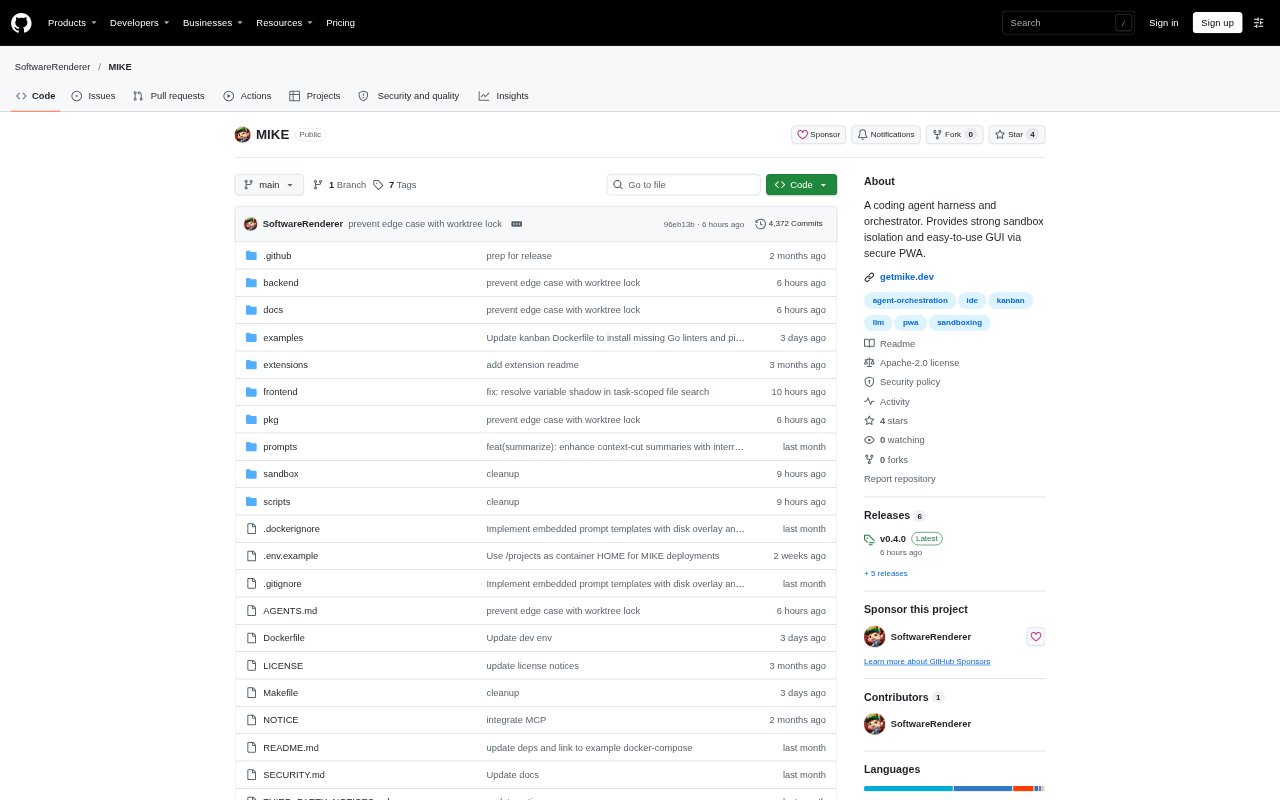
MIKE is a local-first harness for coordinating AI agents on software development work. Its kanban board gives developers a place to delegate tasks, run parallel work streams, and review results, while isolated containers and Git worktrees help keep agent activity separated from the main repository. MIKE works with llama.cpp and inference providers that support the OpenAI Chat Completions API. It is designed for developers who want a graphical interface for code changes and reviews.
MIKE Features:
Kanban Work Streams: The board organizes tasks into Backlog, In Progress, Review, and Done columns, with each card representing a separate task that can run alongside others.
Sandboxed Agents: Agent activity runs in gVisor-isolated containers through rootless Podman, with point-and-click configuration for setting and reviewing access.
Git Worktrees and Threads: MIKE combines Git worktrees, sandboxes, and a read-only repository mount to provision agents, while Threads let users explore different ideas.
Inference Provider Choice: MIKE is built for llama.cpp and can use any inference provider that exposes the OpenAI Chat Completions API.
Secure Extensions: Custom extensions can run inside gVisor, iframe, or WASM sandboxes, keeping third-party features within isolated environments.
Progressive Web App: The Progressive Web App is designed for use on spotty or high-latency networks, and the interface can be used from different locations.
Task Recovery: MIKE can recover from issues such as failed tool calls, loops, crashes, and inference-provider rate limits without losing task progress.
MIKE Benefits:
Safer Delegation: Separating agent activity from the repository and limiting access helps developers delegate coding work with more control over what agents can reach.
Parallel Throughput: Running separate tasks at the same time gives teams a way to move multiple development jobs forward without handling each one in sequence.
Fewer Lost Tasks: Recoverable progress helps preserve work when an agent or inference provider encounters an error during a task.
More Flexible Setup: The choice of local llama.cpp or a compatible inference provider lets developers work with an inference setup suited to their environment.
Remote Continuity: A web app built for unreliable connections makes it easier to keep track of development work when network conditions are poor.
Use Cases:
Code Review: Assign an agent a code review task, keep its progress visible on the board, and inspect its work in the Review column.
Small Code Changes: Delegate a quick modification to an agent working in an isolated environment, then review the resulting changes before using them.
Parallel Development: Run separate coding tasks at once, such as working on distinct changes or having agents build and test different parts of a project.
Idea Exploration: Use Threads to explore alternative approaches to a development problem without treating one initial idea as the only path.
Remote Task Tracking: Check on delegated coding work from a high-latency or spotty network using MIKE’s Progressive Web App interface.