
What is MinusX?
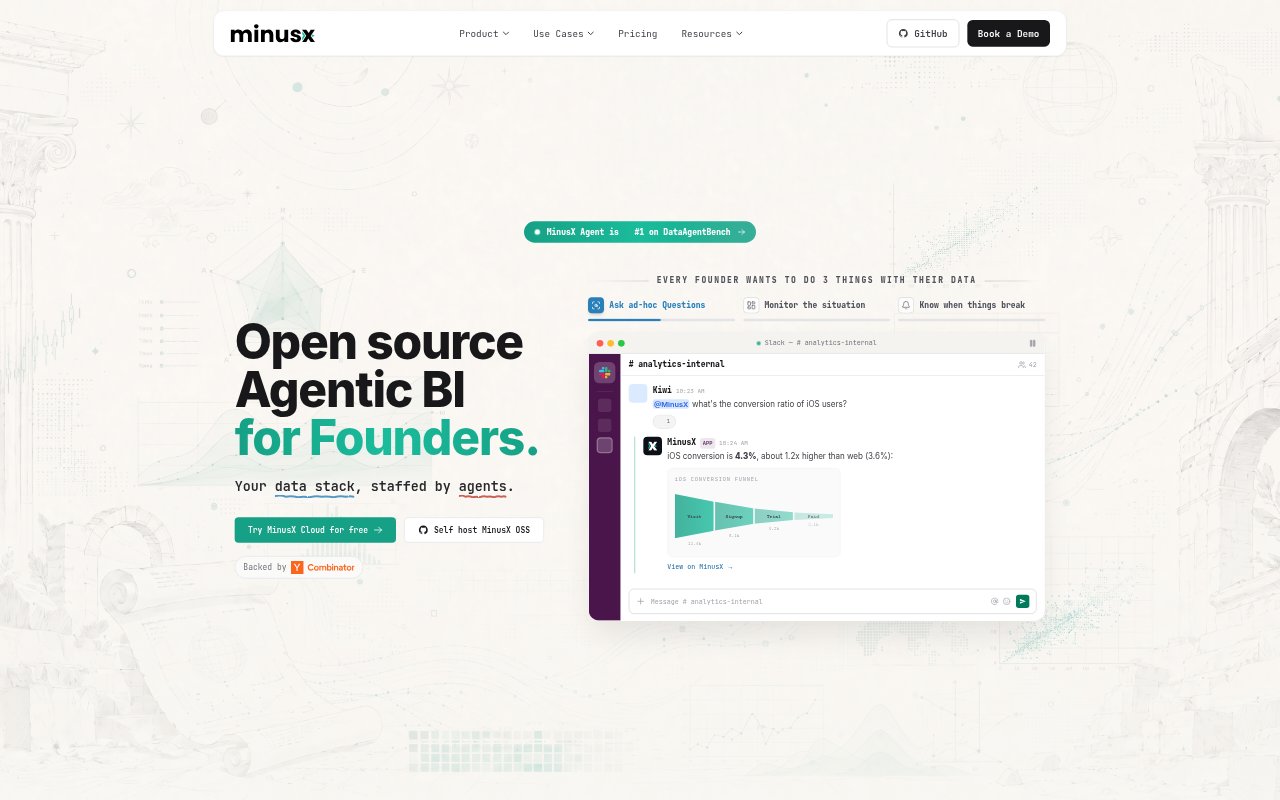
MinusX is an agentic business intelligence platform for founders and teams that want to ask questions of company data, explore results, and share analysis. People can ask in plain English, follow up to investigate a result, and turn findings into dashboards, reports, or data stories. It supports self-hosted and managed cloud deployments, with options for teams that want to keep their warehouse in their own environment or bring their own LLM keys.
MinusX Features:
Natural Language Analysis: Ask questions about company data in plain English, then follow up to drill into results and get charts without writing SQL.
Data Connections: Connect data sources including Postgres and BigQuery, or upload CSV files and Google Sheets for analysis.
Business Context: The agent learns context from interactions to understand company-specific definitions, and teams can test its answers with Evals.
Charts and Dashboards: Create visualizations such as funnels, maps, and heatmaps, refine them in a SQL editor or query builder, and add charts to dashboards.
Reports and Alerts: Schedule reports, set threshold alerts, and receive proactive nudges based on company data.
Data Stories: Turn analyses into presentations or scrollable stories with charts, annotations, and takeaways drafted by the agent.
Flexible Deployment: Run the open-source platform in your own environment or use managed cloud hosting, with the option to provide your own LLM keys.
MinusX Benefits:
Faster Answers: Teams can investigate everyday data questions themselves instead of waiting for an analyst to prepare each query or report.
Shared Understanding: Company-specific context helps make answers more relevant to how a team defines measures such as revenue or active users.
Clearer Findings: Charts and narrative summaries make analysis easier to interpret and share with colleagues who do not work directly with data.
Earlier Awareness: Scheduled reports and threshold alerts can help teams notice important changes without repeatedly checking dashboards.
Deployment Choice: Teams can choose a self-hosted setup or managed cloud based on their infrastructure preferences and control over LLM keys.
Use Cases:
Growth Analysis: A growth team can compare acquisition channels, user segments, cohorts, and retention to understand where growth is coming from.
Finance Reviews: Finance teams can examine revenue, burn rate, runway, and unit economics while preparing for financial reviews or planning decisions.
Product Metrics: Product teams can investigate funnels, retention, and adoption to see how users move through a product and where they drop off.
Marketing Performance: Marketing teams can examine customer acquisition cost, return on ad spend, and attribution when reviewing campaign performance.
Operations Tracking: Operations teams can monitor service-level agreements, fulfillment, and incidents to spot changes that may need attention.