

What is MLflow?
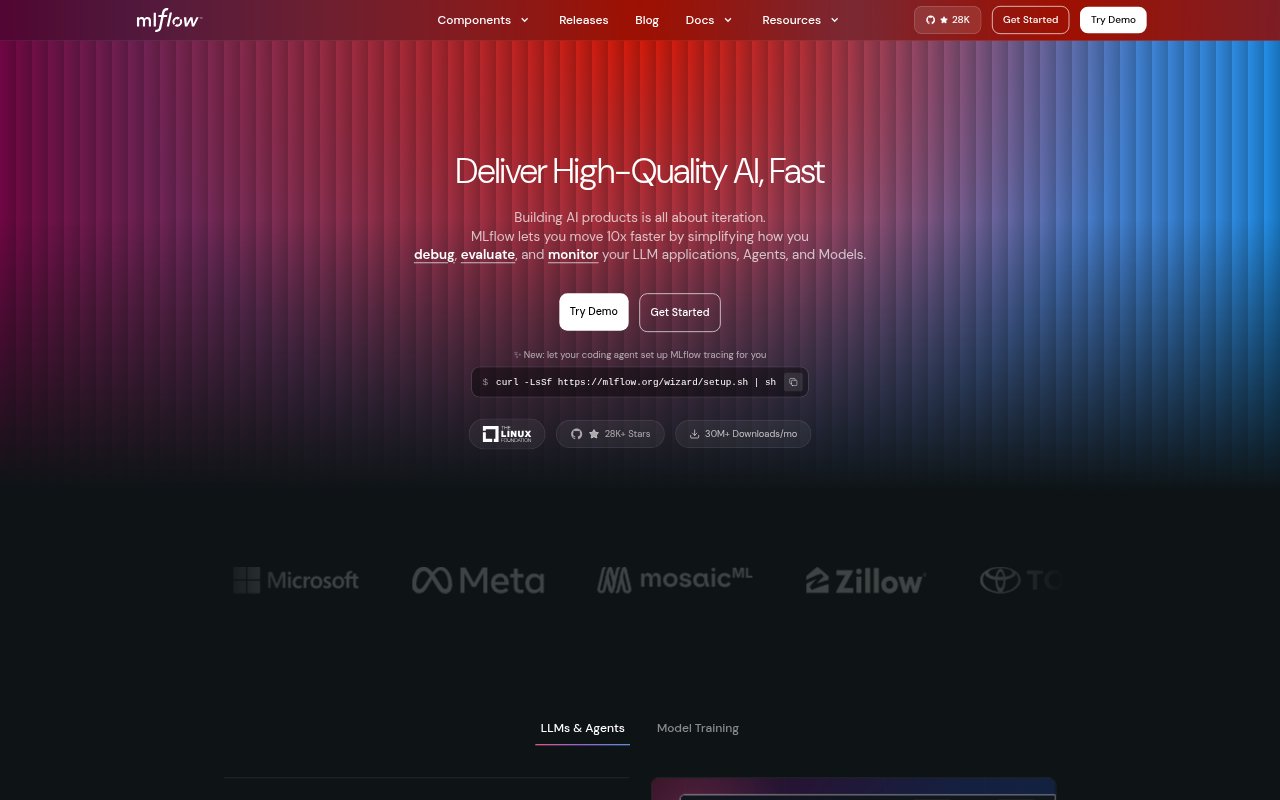
MLflow is an open-source platform for building and managing AI agents, large language model applications, and machine learning models. It brings tools for tracing, evaluation, prompt management, and model lifecycle work into one platform. It is suited to teams developing AI applications or training models, from early experimentation through production deployment.
MLflow Features:
Application Tracing: Capture traces from LLM applications and agents, with support for OpenTelemetry, different LLM providers, and agent frameworks.
Evaluation Tools: Run systematic evaluations with built-in metrics and LLM judges, or define custom evaluations through flexible APIs.
Prompt Management: Version, test, and deploy prompts with lineage tracking, and use optimization algorithms to improve prompt performance.
AI Gateway: Route requests across LLM providers, manage rate limits and fallbacks, and control costs through an OpenAI-compatible interface.
Agent Hosting: Deploy agents using a FastAPI-based server with request validation, streaming support, and built-in tracing.
Model Lifecycle: Track experiments, tune hyperparameters, evaluate models, and manage model registration and deployment.
MLflow Benefits:
Faster Debugging: Detailed traces make it easier to find where an agent or LLM application behaves unexpectedly.
Earlier Regression Detection: Tracking evaluation results over time helps teams identify quality changes before they reach production.
More Consistent Prompts: Prompt versions and lineage give teams a record of changes and a clearer basis for comparing results.
Cost Visibility: Monitoring costs alongside production quality helps teams make informed choices about their AI applications.
Flexible Infrastructure: Support for different clouds, frameworks, and tools lets teams change vendors without being tied to one provider.
Use Cases:
Agent Troubleshooting: Inspect traces to understand execution, latency, or adherence issues in an AI agent.
Release Evaluation: Evaluate an LLM application and track its quality metrics before promoting changes to production.
Prompt Iteration: Test and compare prompt versions, then keep lineage as prompts are prepared for deployment.
Provider Routing: Manage LLM requests through a shared gateway when an application needs routing, rate limits, or fallbacks.
Model Experimentation: Track experiments and hyperparameter tuning while developing machine learning or deep learning models.