

What is ModelRefs?
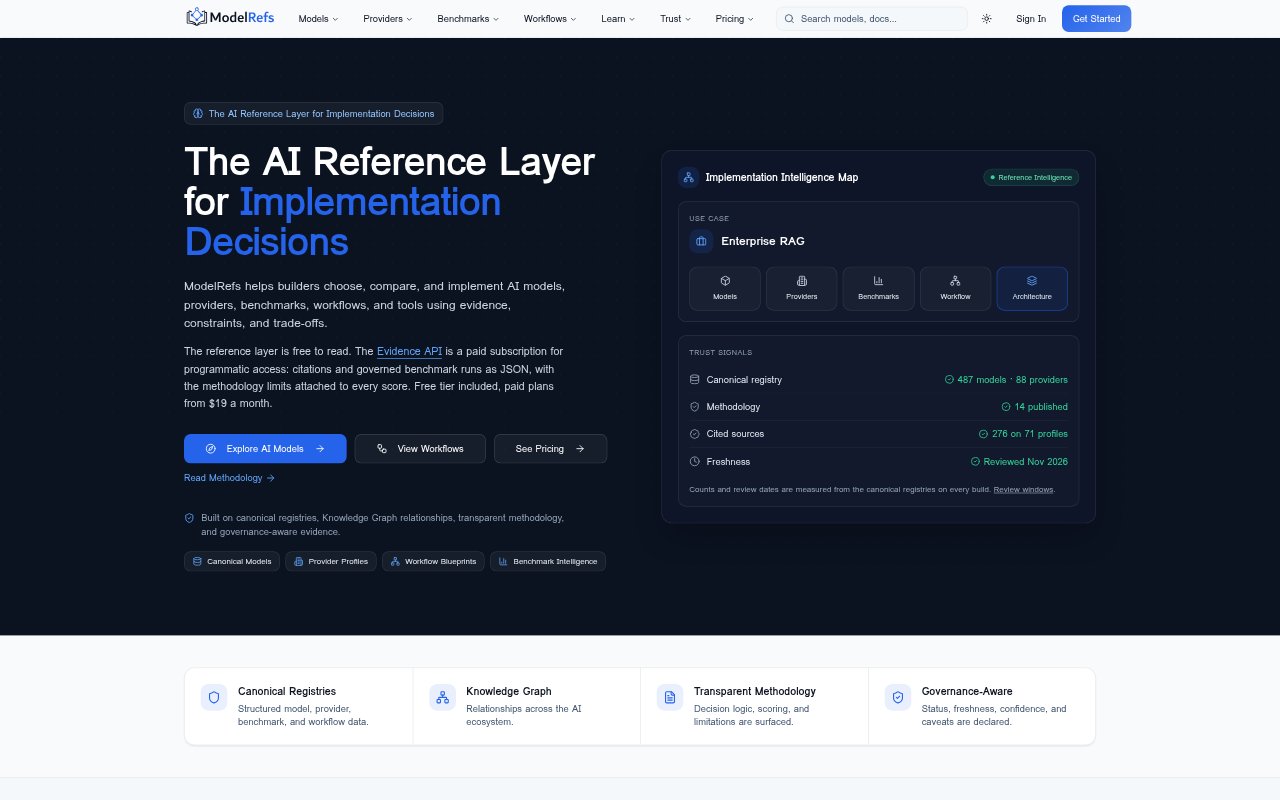
ModelRefs is a structured reference service for people making AI implementation decisions. It connects information about models, providers, benchmarks, workflows, and tools so builders can compare options and find guidance for a particular use case. The reference layer is free to read without an account, while the paid Evidence API provides programmatic access to evidence as JSON, including citations and benchmark methodology limits.
ModelRefs Features:
Model Profiles: Reference profiles and selection guidance help builders assess AI models against the needs of a project.
Provider Comparisons: Compare provider options, deployment paths, and integration trade-offs when deciding where to run an AI system.
Benchmark Context: Explore benchmark references alongside evaluation methods and stated limitations, rather than relying on scores alone.
Workflow Blueprints: Implementation blueprints cover patterns such as enterprise RAG, AI agents, model evaluation, and AI governance.
Connected References: Structured registries and Knowledge Graph relationships connect models, providers, benchmarks, workflows, and related tools.
Evidence API: The subscription API returns governed evidence as JSON with citations and methodology limits attached to benchmark runs.
Decision Guidance: A decision helper maps a described use case to relevant models, providers, benchmarks, workflows, and implementation guidance.
ModelRefs Benefits:
Faster Research: Connected references reduce the effort of piecing together implementation information from separate tutorials and vendor documentation.
Clearer Trade-Offs: Comparisons across providers and models make it easier to see relevant differences before committing to an implementation path.
Grounded Decisions: Citations, confidence information, freshness notes, and caveats help teams judge how much weight to give each recommendation.
More Useful Scores: Benchmark context helps users avoid treating evaluation results as universal measures of model quality.
Less Rework: Implementation blueprints give builders a starting point for common AI system patterns instead of relying only on copied prompts.
Use Cases:
Model Selection: Compare candidate models and their reference guidance when choosing what to use for a new AI feature.
Provider Planning: Review deployment paths and integration trade-offs before selecting a provider for an application or internal platform.
RAG Design: Use the enterprise RAG workflow guidance when planning a system that retrieves, grounds, and synthesizes answers from company data.
Agent Architecture: Explore agent implementation patterns when designing systems that plan, act, and observe across tools and services.
Model Evaluation: Consult benchmark references and evaluation methods while setting up a repeatable assessment of model quality, safety, or reliability.