
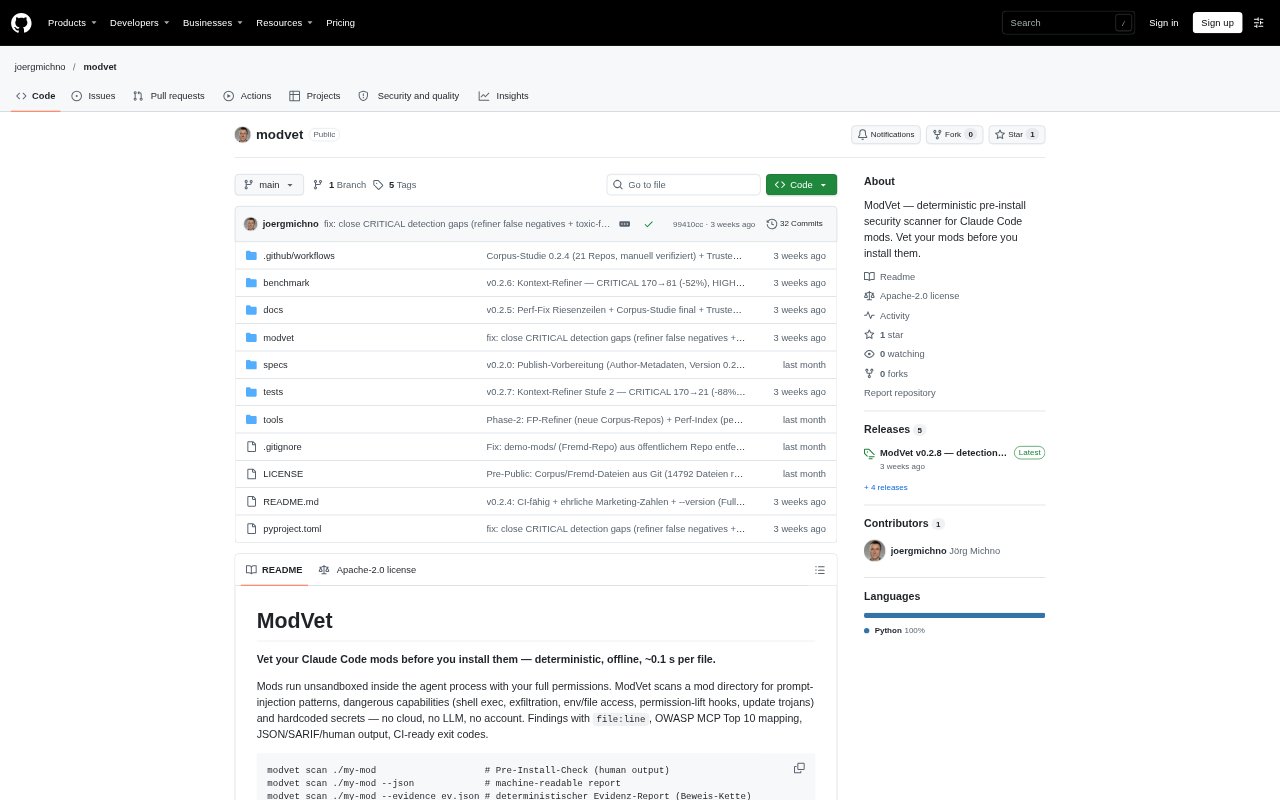
What is ModVet?
ModVet is a local security scanner for Claude Code mods, designed for people who want to inspect a mod before installing it. It checks mod directories for prompt-injection patterns, risky capability combinations, dangerous hooks and update behavior, and hardcoded secrets. Scans run offline without a cloud service, language model, or account, making the tool suitable for developers and security reviewers who need a repeatable pre-install check.
ModVet Features:
Offline Scanning: Scan a mod directory on your machine without sending its contents to a cloud service or relying on an LLM.
Injection Detection: Check for English and German prompt-injection and instruction-override patterns, including obfuscated text using homoglyphs, Base64, zero-width characters, or reversed text.
Capability Combinations: Flag risky combinations such as environment-variable reads paired with POST requests or command execution paired with network fetching, rather than treating each capability alone as suspicious.
Mod-Specific Checks: Detect prompt-compose rewrites, PreToolUse argument rewrites, permission-lifting hooks, configuration rewrites, update-delta trojans, and other listed attack primitives.
Evidence Reports: Create deterministic reports with scanner version, rule fingerprint, file hashes, and the file, line, rule, and matched text behind each finding.
Update Drift Checks: Save a clean installation as a snapshot, then compare a later mod version against it to review changes in the update.
Scan Outputs: Produce human-readable, JSON, or SARIF reports, generate an SVG status badge, and return exit codes for clean scans, findings, or usage errors.
ModVet Benefits:
Keep Code Local: Offline scanning lets teams review sensitive or unpublished mods without uploading their contents to a scanning service.
Focus Review Time: Combination-based checks distinguish ordinary individual capabilities from riskier pairings, helping reviewers direct attention to more concerning behavior.
Explain Findings: File-and-line details and matched text give reviewers concrete evidence to investigate instead of an unexplained warning.
Repeatable Audits: Deterministic evidence makes it possible to reproduce a scan result with the same input and rules during an internal or external review.
Review Updates Faster: Comparing a new version with a saved baseline narrows attention to changes rather than requiring reviewers to start their assessment from scratch.
Use Cases:
Pre-Install Review: Scan a Claude Code mod directory before adding it to an environment where the agent runs with the user's permissions.
Mod Update Review: Compare a downloaded update with a saved snapshot to investigate new or changed files before installing the release.
CI Security Checks: Run scans in a build workflow and use the configured finding threshold and exit code to decide whether the job should fail.
External Audit: Give an auditor a deterministic evidence report that identifies the scanned files, scanner rules, and basis for each finding.
Code Scanning Reports: Export findings as SARIF for use with GitHub Code Scanning, or produce JSON for other automated reporting workflows.