

What is Msty?
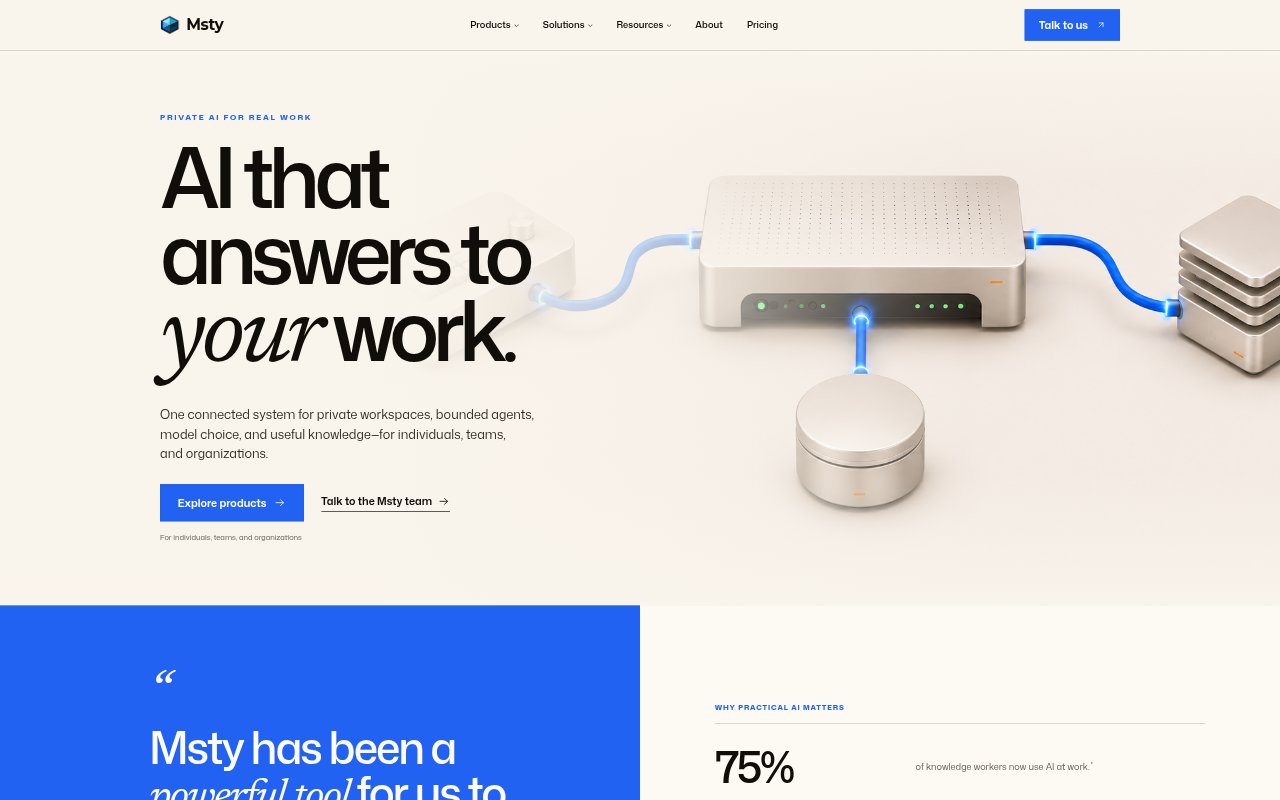
Msty is a private AI ecosystem for individuals, teams, and organizations, with products for AI workspaces, agents, model connections, and governed knowledge. Studio brings model conversations, prompts, media creation, and knowledge into a workspace, while Go is for bounded agent workflows. Nexus manages model connections and related controls, and Stack packages approved sources into reusable Knowledge Stacks. Teams can choose one product or connect several around their workflows.
Msty Features:
Model Choice: Studio supports conversations with local and online models, including local inference engines such as Ollama, Llama.cpp, and MLX.
Workspace Tools: Studio brings conversations, attachments, workspaces, projects, prompts, personas, skills, and media creation into one desktop workspace.
Bounded Agents: Studio and Go offer agent workflows with scoped tasks, and Studio lets users review agent steps and maintain control.
Knowledge Stacks: Studio can use Knowledge Stacks for retrieval, while Stack is designed to package approved sources into versioned collections for approved AI apps.
Model Controls: Nexus provides a local control center for managing model runtimes, providers, credentials, policies, app tokens, and usage.
Team Management: Studio Teams includes user and team management, role-based access, audit logs, SSO integrations, and shared team resources.
Msty Benefits:
More Deliberate Routing: Choosing between local and hosted models lets teams direct work according to the task and the sensitivity of its context.
Reusable Context: Packaging approved sources into Knowledge Stacks helps teams reuse useful context instead of rebuilding it for each workflow.
Visible Agent Work: Scoped tasks and review points give people a way to inspect agent work and keep it within defined boundaries.
Repeatable Team Work: Shared resources and team controls help colleagues apply useful prompts, knowledge, and workflows consistently.
Flexible Starting Point: Separate products let an individual or organization begin with the part of private AI that fits its immediate work.
Use Cases:
Course Materials: Faculty and staff can work with course documents and approved institutional sources while keeping sensitive academic context on infrastructure they control.
Legal Work: Legal professionals can use a workspace for sensitive context, model choice, and reviewable AI-assisted work.
Long-Running Operations: Operations teams can direct work with explicit scope, approved models, and visible review points from a desk or on the move.
Research Workflows: Research teams can compare approved models, work from source material, and keep useful research patterns available to colleagues.
Healthcare Evaluation: Healthcare teams can evaluate model choice, source context, and deployment control through non-clinical workflows.