

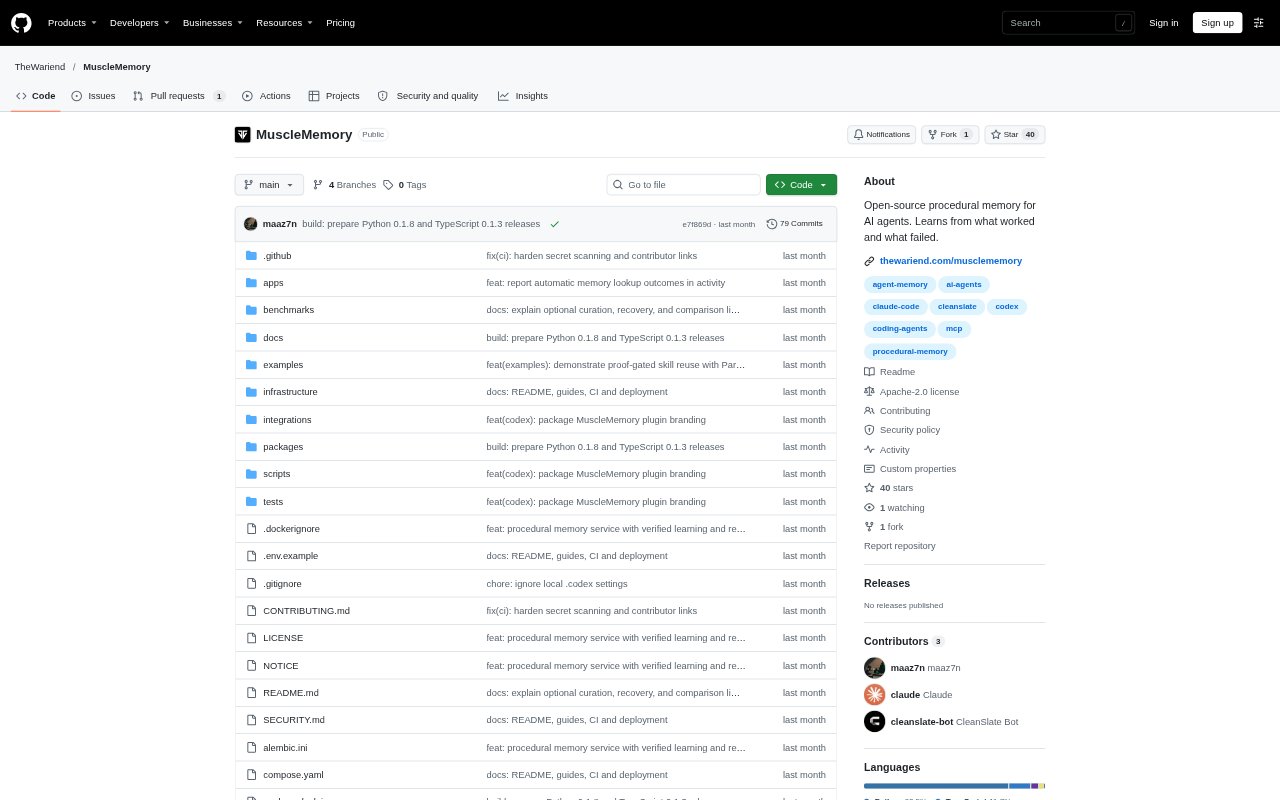
What is MuscleMemory?
MuscleMemory is an open-source procedural memory tool for people who use AI agents, especially coding agents. It observes agent sessions and turns successful, tested work into short instructions that can be offered when a similar task comes up again. It also records lessons from failed attempts. The tool runs locally by default, and its approval and verification steps are designed to keep unproven procedures from being passed to agents.
MuscleMemory Features:
Session Capture: Hooks record an agent’s tool calls, arguments and results, removing secrets before the captured information is stored.
Test-Gated Learning: A session can teach a procedure only when a test passes after the last code change and the session’s tool calls were captured.
Independent Checks: A new procedure must pass two later sessions and receive your approval before it is shared with an agent.
Failure Notes: Failed attempts can contribute watch-out notes that help an agent recognize approaches that did not work.
Task Recall: When a similar task starts, the agent can receive one brief note with relevant files, key edits, a test command and cautions.
Agent Connections: Connect Claude Code, Codex, Cursor or CleanSlate, use an MCP client, or integrate your own agent with the Python and TypeScript SDKs.
Local Dashboard: Review procedures, their source tasks, files and tests in the dashboard, and approve or manage what agents can reuse.
MuscleMemory Benefits:
Less Relearning: Agents can start repeat work with useful context from earlier verified sessions instead of rediscovering the same files and test steps.
Lower Overhead: In a published benchmark of nine paired Codex tasks, input tokens, tool calls and wall time were lower with MuscleMemory, while all tasks passed in both conditions.
Fewer Unhelpful Prompts: When no procedure fits, MuscleMemory adds nothing, so the agent does not receive irrelevant memory notes or spend extra tokens on them.
More Control: Review and approval requirements let you decide which learned procedures are trusted and available to agents.
Cross-Agent Reuse: Procedures learned with one supported agent can be available to others, reducing the need to repeat the same setup and discovery work.
Use Cases:
Recurring Code Changes: Use it when an agent repeatedly handles similar issues and needs reminders about which files to inspect and modify.
Test Workflows: Preserve a verified test command and the changes associated with it for future tasks in the same project.
Avoiding Dead Ends: Give coding agents cautions based on failed attempts so they can avoid repeating approaches that caused problems.
Shared Agent Work: Carry a proven procedure from a Codex session into work handled by Claude Code or Cursor.
Browser Procedures: For browser agents, learn from site-confirmed tasks and run checked steps when requested, while leaving the final submission to the agent.