
What is NPCTalk?
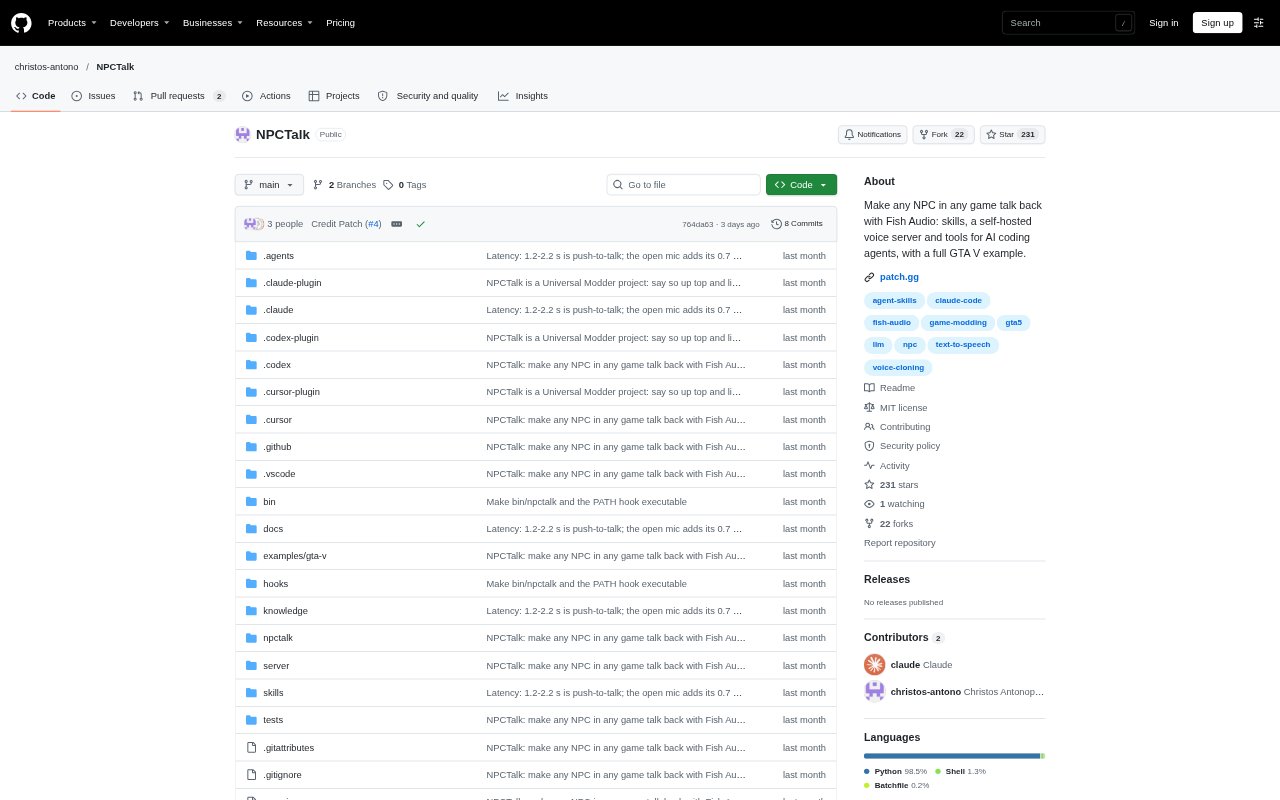
NPCTalk is a toolkit for using an AI coding agent to add spoken, responsive NPCs to games. Players can speak to a character and hear a reply generated in that character’s voice, with dialogue shaped by the scene and the NPC’s persona. The project includes an end-to-end GTA V example and skills that guide agents through adapting the approach to other games. It is aimed at game modders and developers who can work with the required game hooks, services, and setup.
NPCTalk Features:
Agent Setup: Install the skills, fal MCP server, and npctalk command-line tool for agents including Claude Code, Codex, Gemini CLI, Cursor, and Copilot.
Voice Server: Host Fish Audio Drama 3 or S2 Pro on Modal, or use the provided fal option, to serve generated speech through a streaming API.
Voice Cloning: Prepare reference and mood clips from recordings you have rights to, then upload a voice folder for use by the server.
Live Dialogue: Generate in-character lines using NPC personas, scene facts, and samples of the character’s own dialogue, with an OpenAI-compatible LLM.
Voice Input: Set up push-to-talk or open-mic input with voice activity detection and speech-to-text, so players can address nearby NPCs by speaking.
NPC Actions: Connect dialogue to physical behavior and spoken orders through TypeSafe Jev, with guidance for mapping actions to animations.
Voice Evaluation: Use the evaluation skill to compare voice similarity against held-out recordings and check word error across multiple runs.
NPCTalk Benefits:
Guided Adaptation: A defined set of game hooks and engine-specific notes gives modders a practical starting point instead of requiring them to design the whole integration from scratch.
More Believable NPCs: Combining character voice, persona, and scene context can make conversations feel more specific to the game world than generic spoken responses.
Measured Voice Changes: Similarity and transcription checks help developers judge whether a voice adjustment improved the result rather than relying only on a quick impression.
Clearer Setup: The staged build and verification process helps teams identify which part of the voice and game connection needs attention before adding more complexity.
Reusable Workflow: Separating game-specific hooks from shared voice and dialogue components makes it easier to carry useful work into another compatible project.
Use Cases:
GTA V Conversations: Build a single-player mod that lets players approach characters in Los Santos, speak through a microphone, and hear replies in cloned character voices.
Custom Game NPCs: Use an AI coding agent to plan the hooks needed for NPC identity, surrounding scene facts, voice playback, and actions in a game of your own.
Villager Dialogue: Add spoken responses to villagers or other game characters, with lines informed by their personas and what is happening nearby.
Spoken Orders: Prototype NPCs that respond to a player’s spoken instructions with an in-game action, such as performing a mapped animation.
Voice Tuning: Compare cloned voice settings against reference recordings when refining a character voice or investigating why generated speech sounds different.