

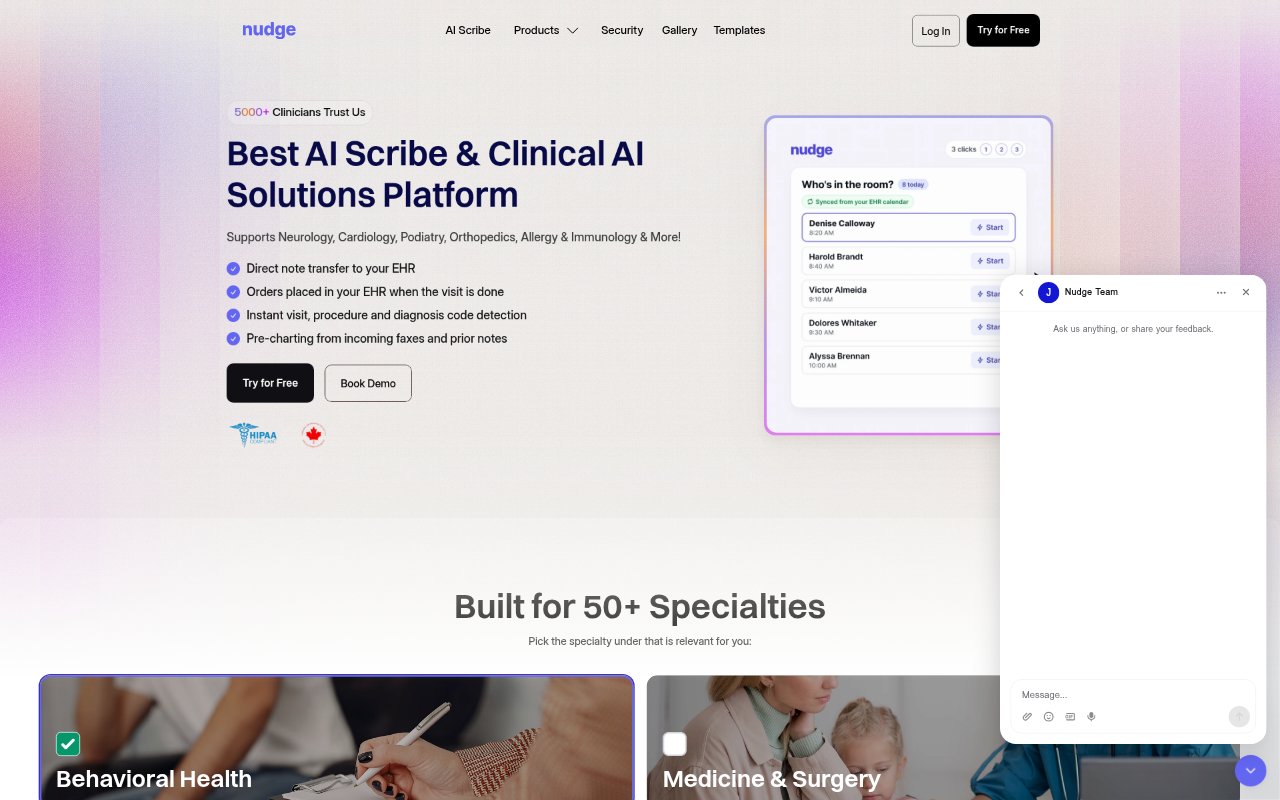
What is Nudge AI?
Nudge AI is a clinical documentation and coding platform for clinicians and healthcare practices. Its tools turn telehealth or in-person sessions into clinical notes, identify billing and diagnostic codes, and transfer documentation into supported EHRs. The platform also includes an AI receptionist and an auditor for existing documentation. It serves more than 50 specialties, including behavioral health and medicine and surgery, and offers web and mobile access for its AI Scribe.
Nudge AI Features:
Ambient Scribe: The scribe captures telehealth or in-person sessions and generates clinical notes, with options to use or customize templates.
Template Gallery: Clinicians can choose from more than 75 prebuilt templates or create reusable templates based on their preferred notes.
EHR Transfer: Notes can be sent with one click to more than 25 supported EHRs, including through a Chrome plugin.
Smart Coding: The coding tool identifies CPT codes, billable add-ons, and E/M levels, with justifications based on clinical complexity.
Diagnostic Coding: The diagnostic coder extracts clinical evidence from sessions to suggest ICD-10 codes and provide supporting rationale.
Patient Context: The platform can reference prior notes to show treatment progress and provide context for medical justification.
AI Receptionist: The receptionist answers practice-related questions, gathers patient information, schedules appointments, and can connect callers with the team.
Nudge AI Benefits:
Less After-Visit Work: Generating notes from sessions can reduce the amount of documentation clinicians need to finish after seeing patients.
Fewer Workflow Switches: Transferring notes from within the EHR helps clinicians keep documentation in their existing workflow instead of manually copying between screens.
More Consistent Notes: Reusable templates help clinicians maintain a preferred structure across visits while adapting notes to their practice.
Billing Visibility: Code suggestions and add-on detection can help practices spot billing opportunities that might otherwise be missed.
Patient Continuity: Prior-note context can make it easier to carry treatment progress and medical justification forward into new documentation.
Use Cases:
Behavioral Health Visits: Therapists, psychologists, and psychiatrists can document individual sessions using notes tailored to their preferred format.
Specialty Consultations: Clinicians in areas such as neurology, cardiology, podiatry, and orthopedics can capture visits and review code suggestions.
EHR Documentation: A practice can move session notes into its supported EHR without manually copying and pasting between applications.
Billing Review: A clinician or practice can review suggested CPT codes and billable add-ons after a session before completing documentation.
Incoming Patient Calls: A practice can use the receptionist to respond to routine questions, collect information, and handle appointment scheduling.