

What is numbrone?
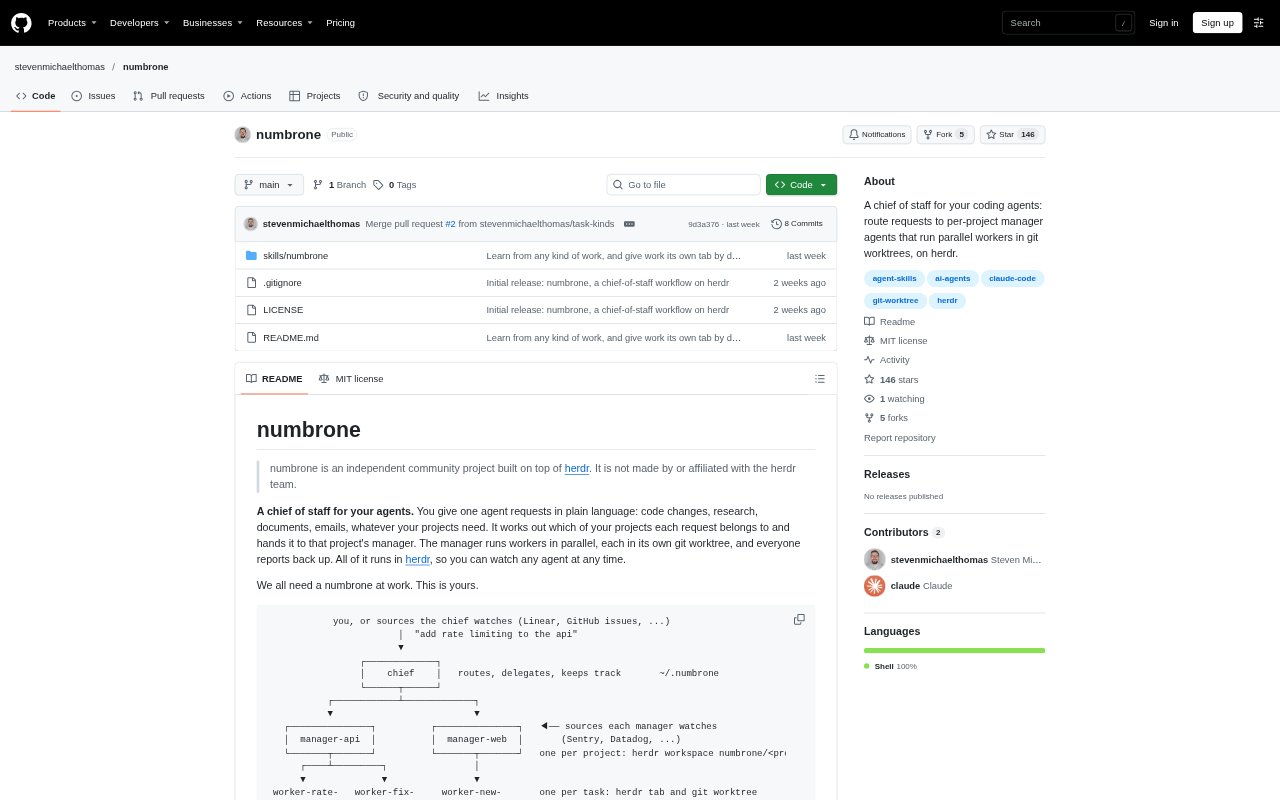
numbrone is an agent-orchestration setup that acts as a chief of staff for coding agents. You give one agent requests in plain language, and it routes them to managers for the relevant projects; those managers coordinate workers on coding and non-coding tasks. Designed for people managing software projects, it runs workers in separate Git worktrees within herdr, where you can watch their sessions, and requires macOS or Linux, herdr, git, jq, and a supported coding agent.
numbrone Features:
Request Routing: A chief agent interprets requests, identifies the relevant project, and assigns each task to that project's manager.
Parallel Workers: Managers can launch workers for separate tasks, with each worker using its own herdr tab and Git worktree.
Manager Review: Managers handle small requests themselves, delegate larger work, and review workers' results before reporting them as ready.
Watched Inputs: Agents can watch configured sources such as Linear issues, GitHub issues, Sentry errors, Datadog monitors, and CI failures.
Persistent Context: Markdown files hold project context, shared knowledge, and learned preferences for agents to use in later sessions.
Task Tracking: A command-line status view shows task project, status, worker, and latest update, while daily work logs record outcomes and decisions.
Agent Choices: The setup supports coding agents that work with herdr, including Claude Code, Codex, Gemini, and OpenCode.
numbrone Benefits:
Less Coordination: You can submit work through one chief instead of assigning each request to a project team yourself.
Safer Concurrency: Separate worktrees let multiple tasks proceed without interfering with one another or your own checkout.
Clearer Oversight: Visible agent sessions, status updates, and work logs make it easier to see what is underway and what has been delivered.
Consistent Standards: Saved project context and learned preferences help agents carry goals and prior feedback into future work.
Fewer Repeated Checks: Watching configured sources can turn new issues or service alerts into tasks without requiring you to spot and route each one manually.
Use Cases:
Cross-Project Requests: Ask for changes across several repositories, such as fixing an API test while adding a feature to a web application.
Issue Triage: Have a chief monitor a shared Linear team or GitHub issue source and route new items to the relevant project.
Service Monitoring: Configure a project manager to watch its Sentry errors, Datadog monitors, or CI failures and decide whether to handle or delegate them.
Research and Writing: Assign project managers tasks such as research, document drafting, or email writing, with worker findings saved in task notes.
Reviewing Agent Work: Check in on parallel coding tasks, review the manager's report, and use the work log to revisit decisions or outcomes.