

What is Nysa?
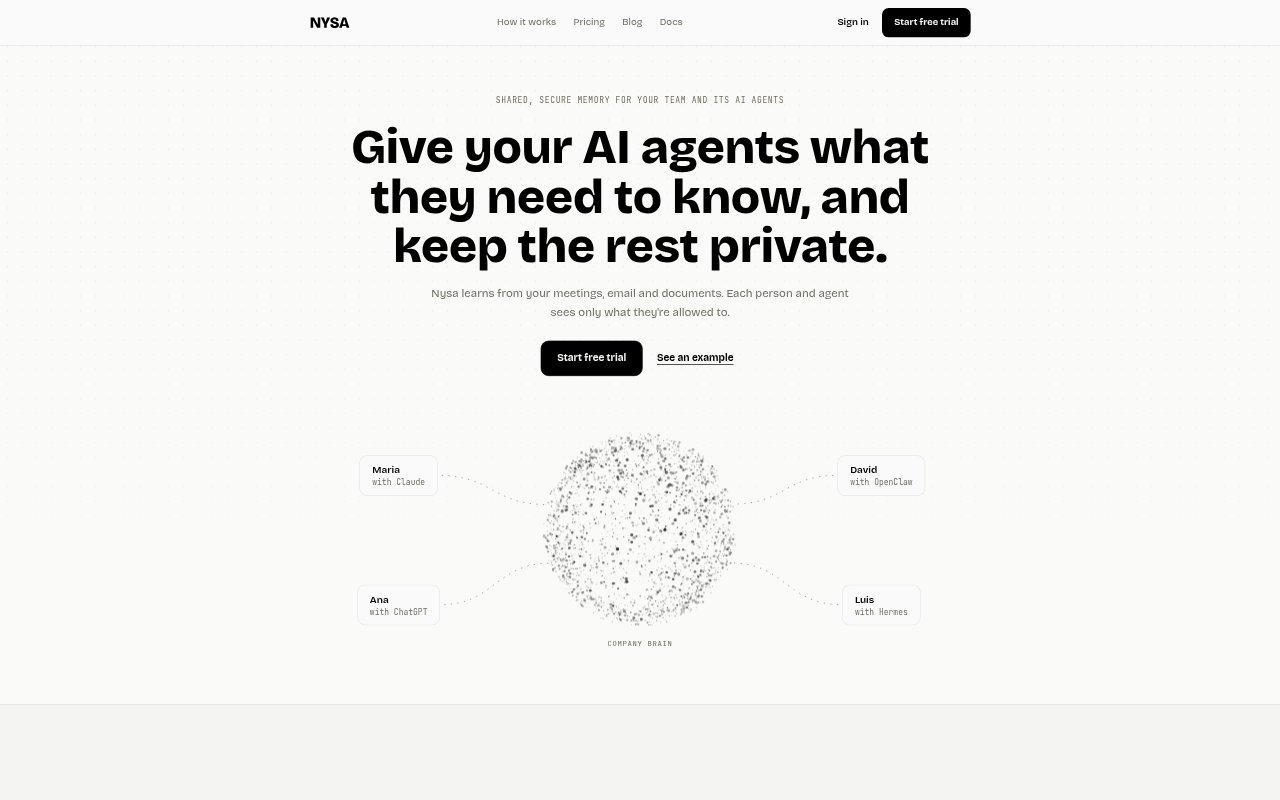
Nysa gives teams a shared memory for their work and the AI agents they use. It turns selected meetings, email, calendar activity and documents into organized facts that retain their sources, then lets each teammate’s agent read and add information over MCP. Access is scoped so agents see only what their teammate is allowed to see. It is designed for teams that want AI assistants to work with company context without sharing every detail with everyone.
Nysa Features:
Meeting Capture: Nysa’s notetaker joins calls the team chooses, records them and transcribes who said what.
Work Sync: Email, calendar, Slack and documents can flow into the shared memory, with Google Gmail and Calendar supported for account connections.
Sourced Facts: Information is organized into clear facts with a quote, date and source, so teammates can see where it came from.
Topic History: Facts are grouped into topics that preserve their history, making it possible to follow how information changes over time.
Scoped Permissions: Admins can describe scopes in plain language, keep projects private to their members and limit agent keys to selected scopes or projects.
MCP Agent Access: Teammates’ agents can read from and write to the shared memory over MCP, with each agent signed in as its teammate.
Memory Import: Teams can import existing memory from GBrain, an Obsidian vault or markdown folders, preview the content and undo the import.
Nysa Benefits:
Less Repeated Context: Agents can draw on information gathered across the team’s work instead of starting each conversation without relevant background.
Faster Handoffs: A teammate can get up to speed from shared facts and their sources rather than asking colleagues to locate separate notes.
More Trustworthy Answers: Source details give people a way to check the basis of an answer before acting on it or passing it along.
Fewer Privacy Tradeoffs: Teams can make useful context available to agents while keeping personal or sensitive information limited to authorized people.
Continuity Over Time: Keeping topic history in one place helps teams retain context as conversations develop and responsibilities move between teammates.
Use Cases:
Loan Preparation: A credit team can ask an agent to catch up on a borrower’s loan, including recent appraisal updates and promised follow-ups.
Meeting Follow Up: After a selected call, teammates can refer to its transcript and sourced facts when checking what was said or what needs attention.
Private Team Topics: A team can keep HR, legal or customer information in scopes that are visible only to the people who need it.
Agent-Assisted Research: A teammate can use a connected agent to look across shared company context while it respects that teammate’s access.
Knowledge Migration: Teams moving from markdown notes or an Obsidian vault can review an import before adding it to their shared memory.