

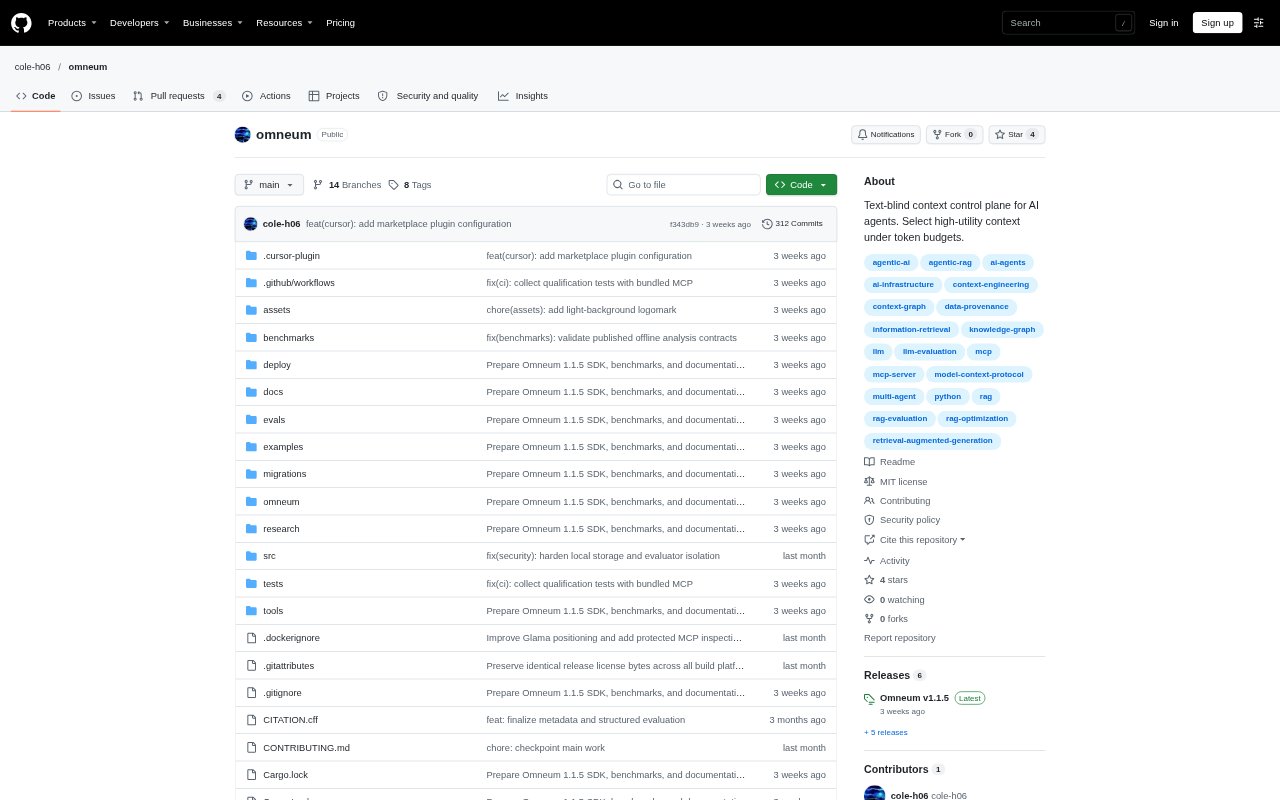
What is Omneum?
Omneum is an open-source context control plane for AI agents, designed to improve the evidence passed from retrieval and tools into an LLM. Its Python SDK evaluates structured observations about sources and claims, then selects and reconstructs original passages within a context budget. It can run between an existing retrieval pipeline and generation, or expose its tools to an agent through an MCP server. Observations can persist across sessions in a context graph backed by SQLite or PostgreSQL.
Omneum Features:
Provenance Graph: Omneum estimates source reliability and claim support with graph inference that accounts for shared origins and dependencies between sources.
Claim Mapping: It links claim identifiers to original chunks, so claim-level evaluations can inform which passages are considered for the context window.
Budgeted Selection: The SDK ranks passages by their claim contributions and selects them under a token budget, then reconstructs the chosen text.
Question Relevance: When a question is supplied, finalized claim contributions are weighted using deterministic local lexical relevance over the original passage text.
Text-Blind Evaluation: The evaluator works from structured observations without reading source text strings or calling an LLM judge.
Agent Connections: A Python SDK prepares context for an agent, while an MCP server exposes Omneum tools to compatible clients over stdio.
Omneum Benefits:
Less Repeated Evidence: Tracking shared origins helps prevent several reports derived from one upstream source from being treated as independent support.
More Useful Context: Selecting passages by claim coverage can preserve distinct relevant information instead of filling the context window in retrieval order.
Clearer Evidence Quality: Source and claim evaluations give downstream systems a structured basis for distinguishing stronger support from weaker support.
Text Stays Separate: Because graph evaluation uses structured relationships rather than source strings, the evaluator does not need to inspect the original passages.
Session Continuity: Persisted observations give agents a way to carry context across sessions without rebuilding the entire record each time.
Use Cases:
RAG Context Packing: Place Omneum after retrieval in a RAG pipeline to choose which retrieved passages reach the model under a fixed context budget.
Conflicting Sources: Use its source and claim analysis when an agent retrieves reports that repeat, depend on, or disagree about the same information.
Question-Focused Retrieval: Supply a user question when preparing context so local lexical relevance can influence which original passages are selected.
Persistent Agents: Store observations in a context graph when an agent needs to retain information from previous sessions using SQLite or PostgreSQL.
MCP Agent Setup: Connect an MCP-compatible client to Omneum when you want an agent to call its context tools through a local server.