
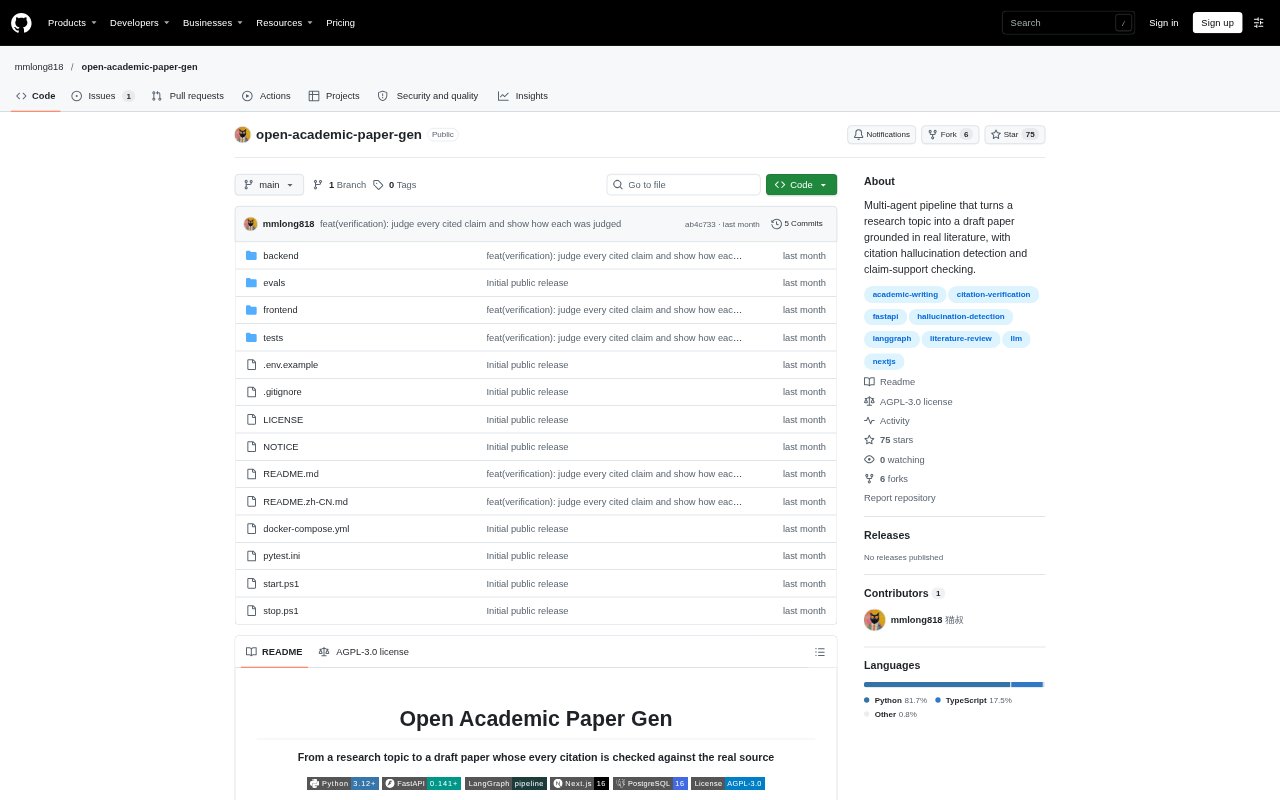
What is open academic paper gen?
Open Academic Paper Gen is a self-hosted, multi-agent pipeline that turns a research topic into a draft academic paper grounded in retrieved literature. It is designed for researchers who want help with literature discovery, synthesis, drafting and citation checks, while keeping a human review option at each stage. The draft is a starting point rather than a finished paper, and running it requires a configured environment and an OpenAI API key for claim checking and simulated review.
open academic paper gen Features:
Literature Retrieval: The pipeline searches OpenAlex, Crossref, Semantic Scholar and arXiv, screens papers against the topic, and retrieves open-access full text where available.
Citation Chaining: It follows references and citations from high-scoring papers to find additional literature, then screens those records against the research topic.
Evidence Table: For each paper, it extracts task, method, data, metric, finding and limitation into a table that can be exported as Markdown or CSV.
Novelty Diagnosis: It assesses a proposed research angle across problem, method, data and perspective, identifies close papers in the literature pool, and raises a likely reviewer objection.
Citation Checks: Each citation is checked for a resolvable key, matching DOI and metadata, and support for its associated claim, with a PDF page noted when available.
Draft Review: The pipeline drafts by section, proposes constrained revisions for flagged sentences, simulates reviews from three reviewers, and flags machine-flavoured prose as suggestions.
Export Formats: Drafts can be exported as Markdown or LaTeX in GB/T 7714, APA 7 or numeric reference style, as well as RIS or BibTeX.
open academic paper gen Benefits:
Grounded Starting Point: Researchers can begin with a structured draft tied to retrieved literature instead of assembling every section and reference from a blank page.
Fewer Citation Surprises: Checking references and claim support helps researchers spot questionable citations before sharing a draft or relying on its literature review.
Clearer Research Angle: Comparing an angle with nearby papers and likely reviewer concerns can help researchers see where their proposal needs sharper justification.
Traceable Evidence: Organized findings and notes on what text supported a claim make it easier to revisit the basis for a synthesis or citation.
Review Control: Human approval gates let researchers inspect and edit intermediate work, keeping consequential revisions from being accepted without their review.
Use Cases:
Literature Review: Start a review on a defined research topic, screen retrieved studies, follow citation links, and organize findings before writing a synthesis.
Research Proposal: Assess a proposed problem, method, dataset or perspective against related papers and identify an objection to address in a proposal.
Drafting Sections: Build an initial paper outline and section drafts after collecting literature, then inspect citations and revise flagged claims.
Citation Audit: Check a generated draft for unresolved citation markers, metadata mismatches and claims that the cited paper may not support.
Bibliography Handoff: Prepare a cited-only reference list and export the draft and bibliographic records in a format suited to a later editing workflow.