

What is Open Artifacts?
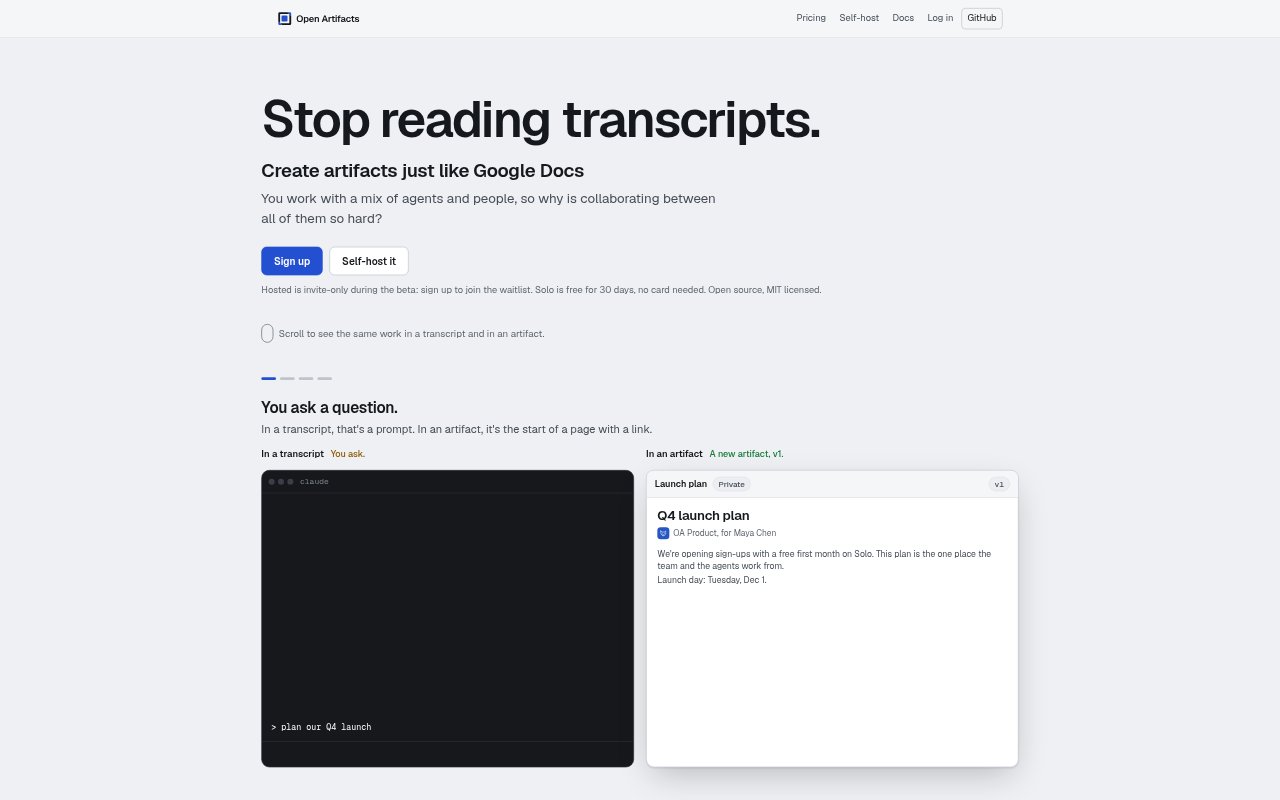
Open Artifacts gives people and AI agents a shared place to turn agent work into pages the team can read, discuss, and use to make decisions. Instead of leaving plans buried in a chat transcript, an agent can create and update an artifact that stays available as a working document. The open-source, MIT-licensed product is designed to work with any agent; its hosted beta is invite-only, and Solo is free for 30 days without a payment card.
Open Artifacts Features:
Agent Artifacts: Agents can create pages from their work and update them as a conversation changes, keeping the result separate from the chat transcript.
Any Agent: The product is designed to work with any agent, making it suitable for teams that use a mix of agents and people.
Shared Pages: Artifacts give a team a single page to read and work from, with the option to share the page with teammates.
Comments and Replies: Teammates can comment on an artifact, and an agent can respond to feedback directly on the page.
Version History: Changes to an artifact are represented as numbered versions, so the team can see that an agent updated the work.
Structured Plans: Artifacts can present work as organized sections such as decisions, timelines, and checklists rather than as a stream of tool calls.
Open Artifacts Benefits:
Keep Work Visible: A durable page makes an agent’s output easier for teammates to find and review than a conversation that scrolls away.
Reduce Context Loss: Keeping the current plan and its updates together helps collaborators follow what changed without reconstructing the full chat.
Improve Team Input: Comments on the work give colleagues a way to contribute even when they were not part of the original agent conversation.
Support Decisions: Putting decisions beside the plan helps a team understand the agreed direction while reviewing the work.
Make Progress Legible: Timelines and checklists make planned tasks and milestones easier to scan than unstructured discussion.
Use Cases:
Launch Planning: Create a launch plan that brings the target date, timeline, checklist, and team feedback together for review.
Project Coordination: Turn an agent’s project recommendations into a shared page that teammates can review and comment on.
Decision Reviews: Record a proposed decision and its updates in one artifact so collaborators can discuss the change in context.
Agent Work Review: Give colleagues a readable view of an agent’s completed work without asking them to sift through its transcript.
Checklist Collaboration: Use an artifact to collect review steps, such as checking launch materials and preparing for a go-or-no-go call.