
What is open sesame?
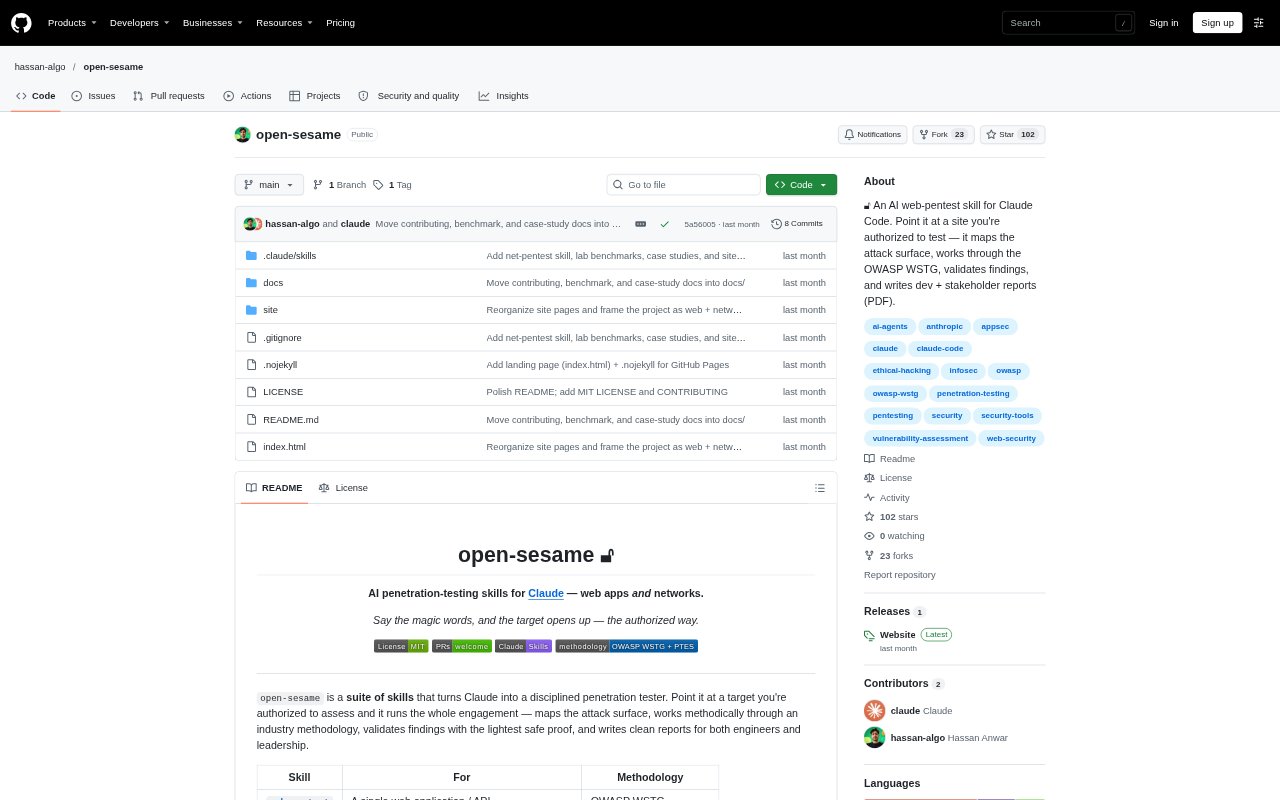
open sesame is a set of AI penetration-testing skills for Claude Code, covering web applications, APIs, networks, and infrastructure. It guides authorized assessments through structured testing workflows, from attack-surface mapping to validating findings and preparing reports. The web skill follows the OWASP Web Security Testing Guide, while the network skill draws on PTES and NIST SP 800-115. It is intended for defenders and testers assessing systems they own or have explicit permission to test.
open sesame Features:
Web Application Testing: The web-pentest skill covers OWASP WSTG areas including authentication, access control, injection, business logic, client-side security, and API testing.
Network Assessments: The net-pentest skill guides external and internal assessments, from host discovery and service enumeration to vulnerability identification, exploitation, and privilege escalation.
Identity Testing: Network workflows include Active Directory testing, hybrid identity scenarios involving Entra ID and AWS, and checks for Wi-Fi, containers, and Kubernetes.
Scope Checks: Both skills check authorization and rules of engagement before active testing, and treat third-party hosting and cloud infrastructure as out of scope by default.
Safe Validation: The workflow validates findings with a light, non-destructive proof and includes guidance for safe usage of tools such as Burp, nmap, and sqlmap.
PDF Reports: Each skill can produce a technical findings report, a plain-language stakeholder summary, and a guide to reproducing findings, with a script to render reports as PDFs.
open sesame Benefits:
Consistent Coverage: A methodology-led workflow helps testers work through assessment areas systematically instead of relying only on memory or ad hoc checks.
Clearer Priorities: Separating technical findings from a leadership summary makes results more useful to both the people fixing issues and those overseeing risk.
Safer Testing: Authorization checks and a preference for non-destructive validation help reduce the chance of testing beyond agreed boundaries or causing avoidable impact.
Reproducible Findings: A dedicated recreation guide gives engineering teams a clearer path to verify reported issues and understand how they were identified.
Readable Workflow: The skills load reference material only when needed, keeping the active instructions focused on the current phase of an engagement.
Use Cases:
Web App Review: Assess an owned staging application for weaknesses in authentication, session handling, access controls, injection, or business logic.
API Assessment: Review an authorized API for access-control gaps, including whether users or tenants can reach data outside their permitted scope.
Internal Network Test: Map hosts and services on an approved internal subnet, then investigate vulnerabilities and privilege escalation paths.
Active Directory Review: Examine a permitted Windows domain or lab for identity and privilege-escalation weaknesses using the network assessment workflow.
Client Engagement Reporting: Turn an authorized assessment into technical findings, an executive-friendly summary, and reproduction instructions for the client.