

What is OpenViking?
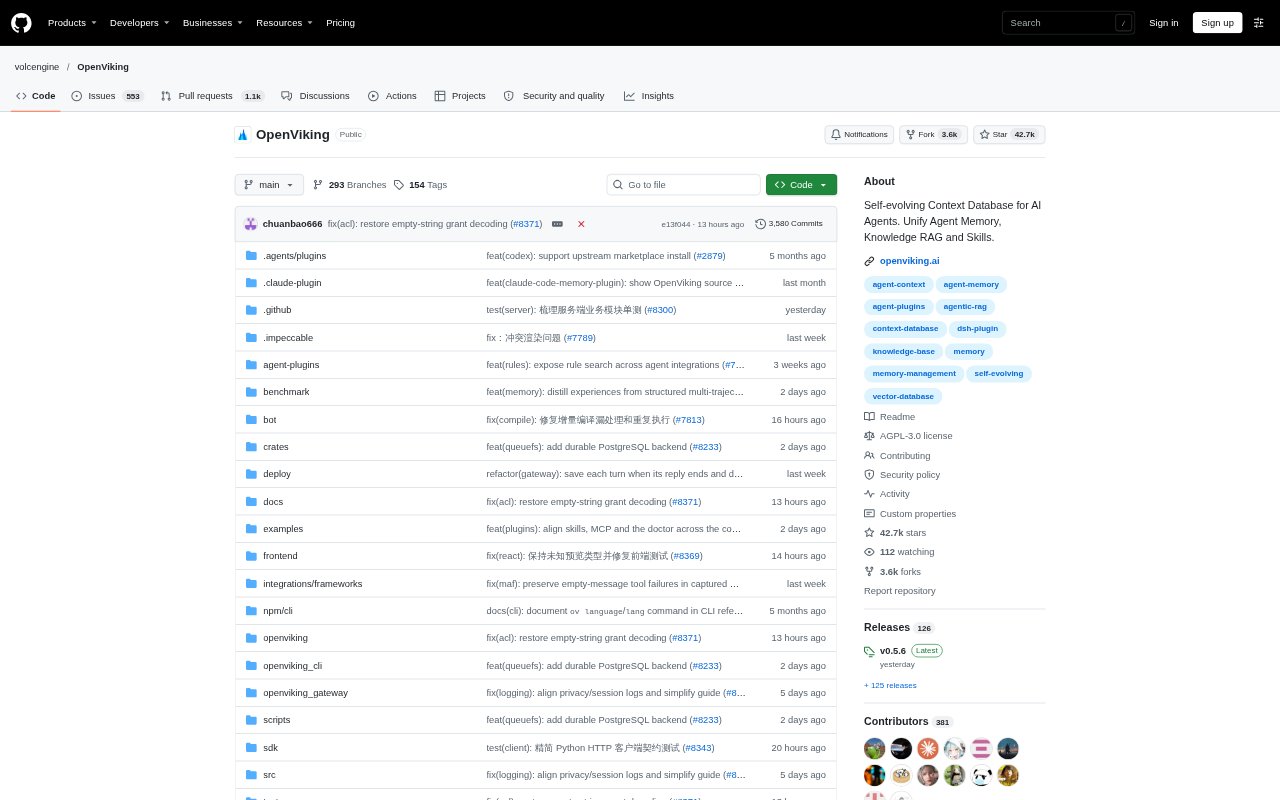
OpenViking is an open-source context database for AI agents that brings knowledge, memories, and task skills into one navigable workspace. It gives agents a virtual filesystem for storing and retrieving context, while letting people inspect and edit what has been saved. Teams building or configuring AI agents can use it to manage project information and user context across sessions, either by running the server themselves or using a hosted service.
OpenViking Features:
Context Filesystem: Organize knowledge, user memories, and task skills as files and directories under viking:// URIs, with commands to list, browse, read, write, and search them.
Scoped Retrieval: Run semantic searches within a project or memory directory, using find for a direct query or search to plan retrieval from session context.
Layered Context: Generated directory abstracts and overviews give agents a quick view of relevance before they load the full source content.
Session Memories: Commit a session to archive its conversation and extract memories as Markdown files that can be inspected, edited, and merged.
Resource Imports: Add resources such as repositories, documents, and web pages, then browse their contents and search for relevant material through the CLI.
Developer Interfaces: Connect applications through Python, Go, or TypeScript SDKs, or use the HTTP API to build an integration.
OpenViking Benefits:
Visible Agent Memory: People can check and correct stored context directly, making it easier to spot outdated or mistaken information than in an opaque memory store.
Less Unneeded Reading: Agents can assess summaries before opening full documents, helping them avoid loading detail that does not matter to the current task.
More Focused Answers: Searching a project or memory subtree narrows the material considered, which can make retrieval more relevant to the agent's immediate question.
Continuity Between Sessions: Saved user preferences and experience give agents context to draw on in later conversations instead of relying only on the current exchange.
Flexible Deployment: A self-hosted server or hosted service lets teams choose how to run the context database to suit their setup.
Use Cases:
Coding Agent Memory: Give a coding agent persistent access to preferences and project context across sessions, including when working with supported tools such as Claude Code, Codex, and Cursor.
Repository Question Answering: Import a code repository and search its documentation or source files when an agent needs to answer a project-specific question.
Preference Tracking: Store details such as a user's writing style or coding habits so an agent can refer to them when handling future requests.
Conversation Review: Archive an agent session and review the extracted memories as editable Markdown before relying on them in later work.
Knowledge Compilation: Use VikingBot with ov compile to organize source material into a wiki, knowledge graph, or report.