

What is Opik?
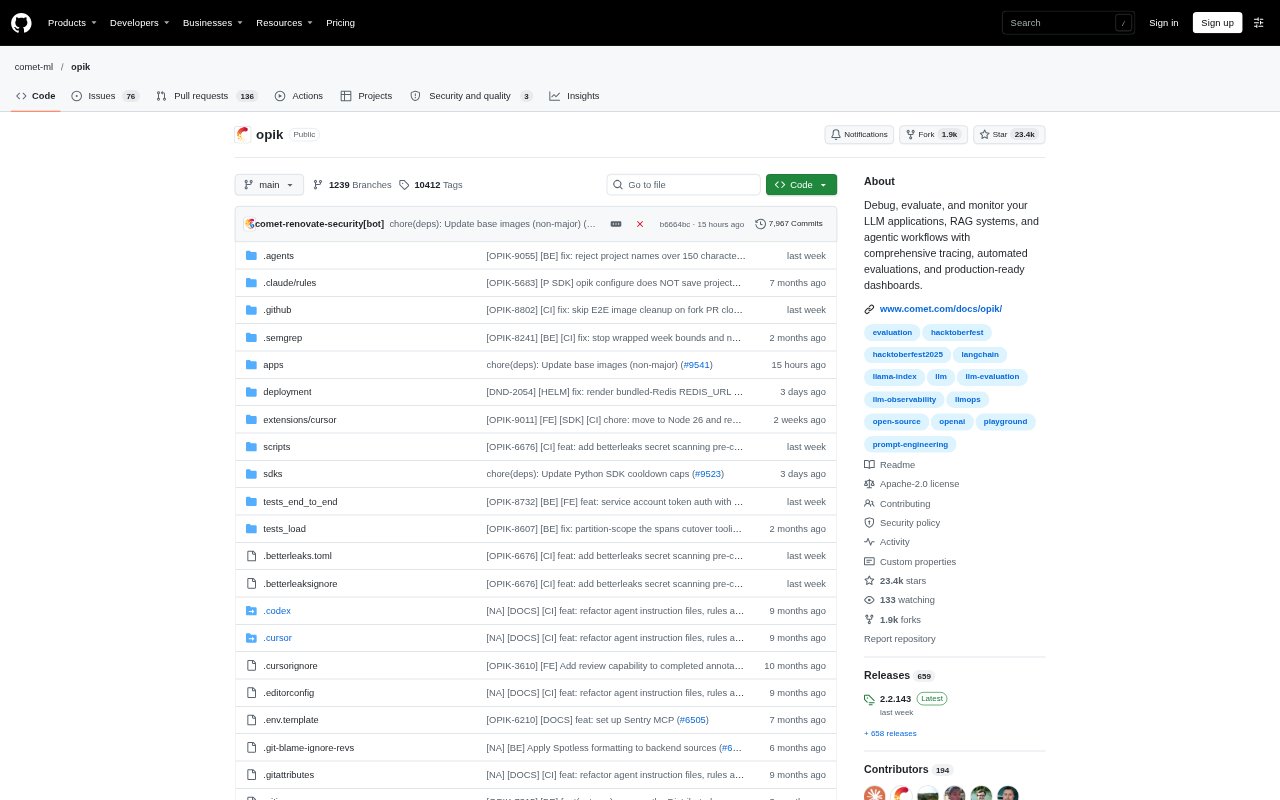
Opik is an open-source platform for tracing, evaluating, and monitoring applications built with large language models, including chatbots, RAG pipelines, and multi-step agents. It helps AI and engineering teams inspect application behavior, test output quality, and improve prompts and agents through experiments. Teams can use Opik in the cloud or deploy it on their own infrastructure, with the full AI observability and agent testing feature set available in the free open-source version.
Opik Features:
Agent Tracing: Record LLM calls, tool invocations, and agent steps, then inspect trace trees to see the sequence of events behind an output.
Automated Evaluation: Score applications with LLM-as-a-judge and heuristic metrics for tasks such as hallucination detection, context recall, and answer relevance.
Test Suites: Build datasets and pass-or-fail assertions from test cases, then run suites to check whether changes meet your requirements.
Production Monitoring: Use project dashboards and online evaluation rules to track feedback scores, latency, cost, and error rates across incoming traces.
Prompt Optimization: Run optimization algorithms against metrics and datasets to compare prompt variations and identify options that perform better.
Deployment Options: Use the hosted service or deploy Opik on your infrastructure with Docker or Kubernetes, and connect it to supported frameworks and model providers.
Opik Benefits:
Faster Debugging: Seeing model calls, tool use, and agent steps together makes it easier to locate where an unexpected answer or failure began.
More Relevant Tests: Turning problematic traces into test cases lets teams check fixes against examples drawn from actual application behavior.
Clearer Quality Signals: Metrics and expert feedback give teams a more consistent way to judge output quality than relying on informal spot checks.
Earlier Issue Detection: Monitoring traces and evaluation results in production can help teams notice changes in quality, cost, latency, or errors.
Less Prompt Guesswork: Comparing prompt variations against datasets and metrics helps teams make changes based on evaluation results rather than manual trial and error.
Use Cases:
RAG Quality Checks: Evaluate a retrieval-augmented generation system’s answers for relevance, context recall, or hallucinations using datasets and metrics.
Agent Failure Review: Inspect a multi-step agent trace to find whether a problem came from a model response, context retrieval, or tool invocation.
Release Regression Tests: Run a test suite on an LLM application after a code or prompt change to check that existing scenarios still pass.
Live Application Monitoring: Track production traces and evaluation scores for a chatbot or agent to review errors, user feedback, latency, and cost.
Prompt Experiments: Compare candidate prompts against a dataset when tuning the instructions for a chatbot, agent step, or other LLM task.