

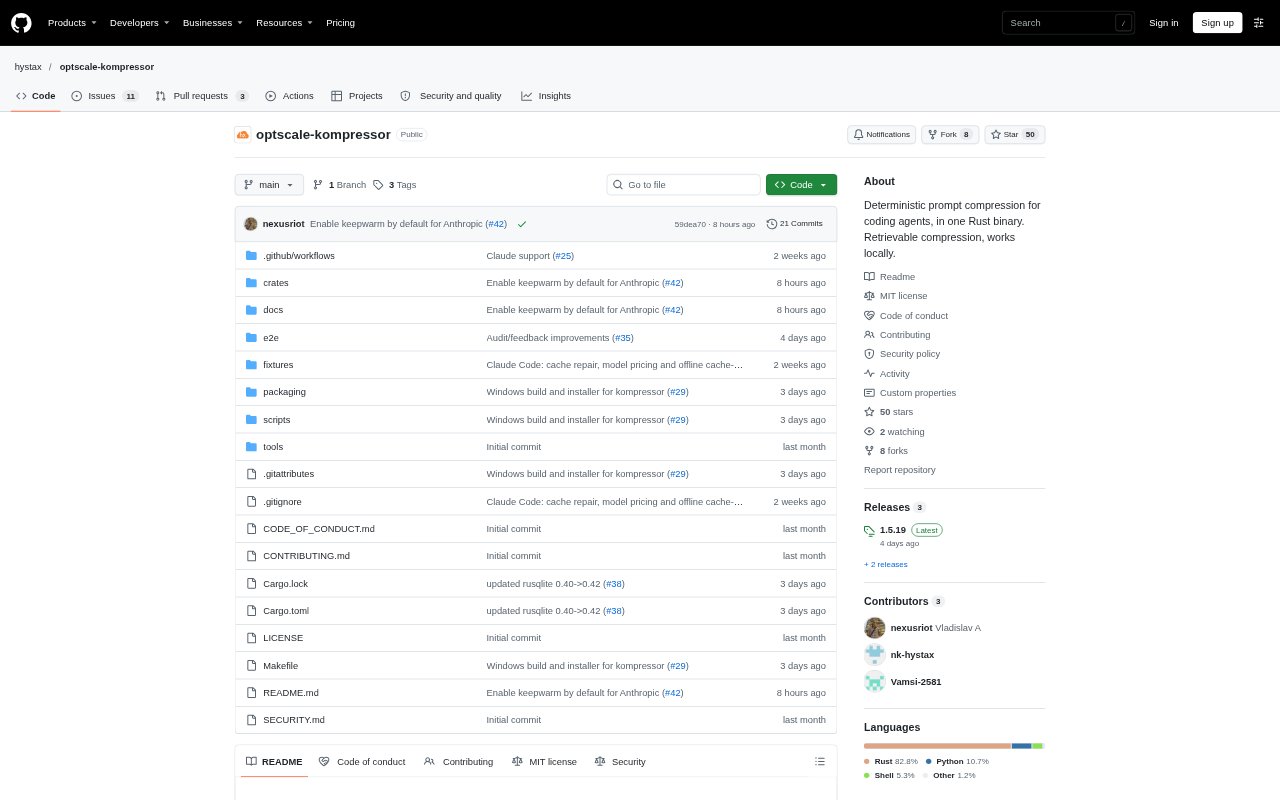
What is OptScale Kompressor?
OptScale Kompressor is a local prompt-compression proxy for coding agents, packaged as a Rust binary. It sits between an agent and its model provider, reducing repeated tool output in the conversation sent to the model while keeping compressed details available for retrieval. It is aimed at teams and developers running coding-agent sessions, including Codex and Claude Code users who want to reduce prompt traffic and manage provider prompt caching.
OptScale Kompressor Features:
Deterministic Compression: The same input produces the same compressed bytes on each turn, helping preserve prompt-cache compatibility as an agent resends its conversation.
Tool Output Reduction: The proxy removes repetitive material from agent tool output, including build logs, compiler warnings, listings, search results, and other eligible content.
Retrievable Details: Details removed during compression remain available through retrieval, so an agent can bring back information rather than treating it as permanently discarded.
Claude Code Profile: The Anthropic profile leaves messages in the cached prefix byte-identical and compresses only new, uncached conversation content.
Cache Keep-Warm: During tool runs, Kompressor can resend the last request every 4.5 minutes to refresh the provider's cache, subject to its stop conditions.
Session Cost Summary: At the end of a session, it reports request and message counts, along with estimated tokens saved and net savings after retrieval.
OptScale Kompressor Benefits:
Lower Prompt Bills: On the reported Terminal-Bench Codex run, compression reduced the provider bill by 22.7% compared with no compression.
Fewer Large Requests: Reducing repeated tool output can shrink requests and leave more room in the context window for the agent's ongoing work.
Cache-Aware Savings: Preserving cached content and keeping cache entries alive can reduce the cost of writing a long prompt prefix again.
Clearer Session Costs: A post-session summary gives teams a practical view of compression activity and estimated token savings for their agent runs.
Local Operation: Running as a local binary lets teams use the proxy without adopting a separate hosted compression platform.
Use Cases:
Long Build Sessions: Use it with a coding agent compiling software from source, where repeated build logs and warnings can accumulate across many turns.
ML Training Tasks: Run it during agent-led training, sampling, or evaluation work that produces lengthy tool output the model would otherwise see again.
Data Pipeline Work: Use the proxy for coding-agent tasks involving data pipelines or media, where logs and generated output may recur in the conversation.
Claude Code Caching: Use its Anthropic profile for Claude Code sessions with long tool runs, when keeping a cached conversation prefix matters to cost.
Codex CLI Sessions: Wrap Codex when working through multi-step coding tasks and reduce the repeated tool output sent with each model request.