

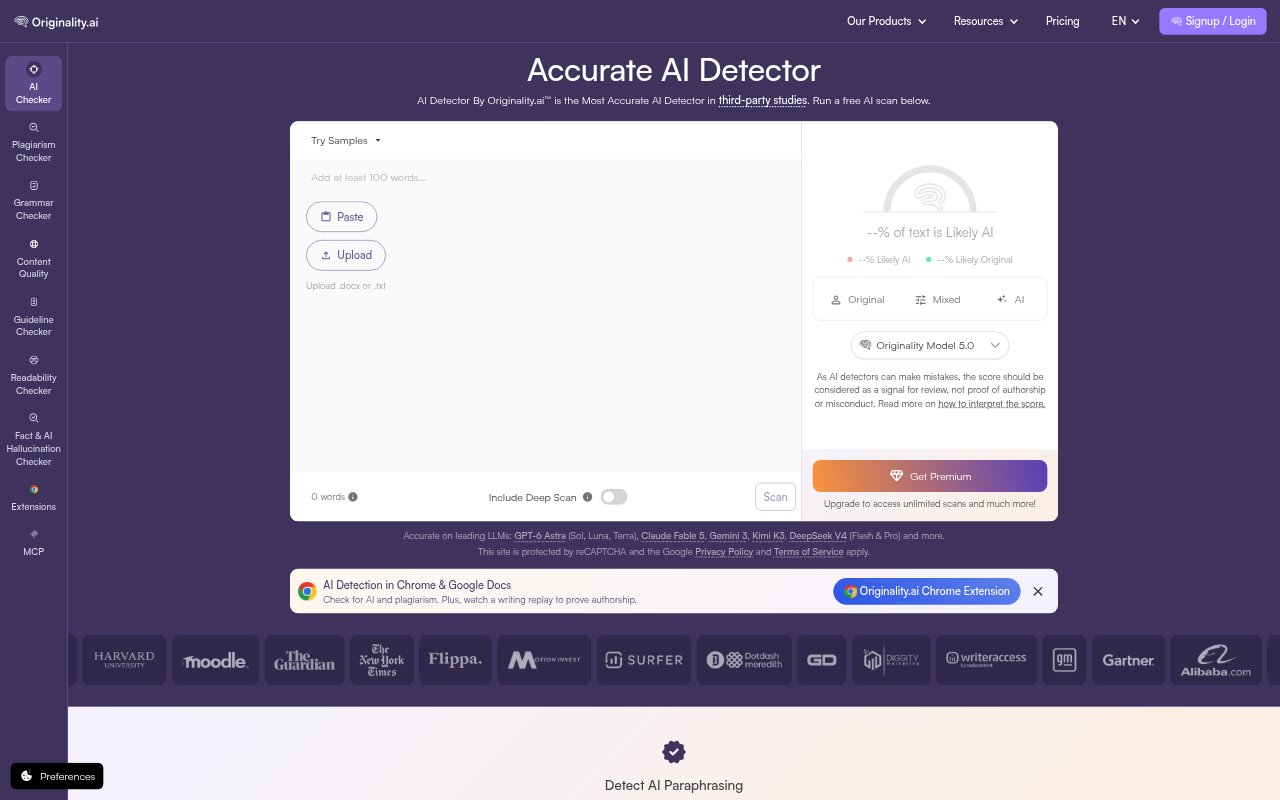
What is Originality AI?
Originality AI is a content integrity and writing review platform for writers, editors, marketers, educators, and teams that publish or assess written work. It checks text for likely AI generation and plagiarism, with additional tools for factuality, writing quality, readability, grammar, and editorial guidelines. Users can paste text, upload files, or scan a URL, then review scores and sentence-level signals; browser extensions, a Moodle plugin, and an API offer ways to use checks in different workflows.
Originality AI Features:
AI Detection: Scan writing for signs of AI generation, including text associated with ChatGPT, Gemini, Claude, Grok, and other AI platforms.
Plagiarism Checks: Check text for plagiarism, with sentence-level highlights to help locate passages that may need closer review.
Content Review: Run checks for writing quality, readability, grammar, facts, possible AI hallucinations, and compliance with editorial guidelines.
Deep Scan: Review why text may have been flagged as AI and get suggestions for revising it to sound more natural.
Bulk Scanning: Scan multiple texts at once, upload document files, and access scan history and shareable reports, including downloadable PDFs.
Workflow Integrations: Use browser extensions for Chrome, Google Docs, and Firefox, or connect through Moodle, Google Classroom, or the API.
Originality AI Benefits:
Faster Reviews: Combining several content checks in one workflow can reduce the effort of reviewing each draft with separate tools.
Focused Editing: Sentence highlights and scan results help reviewers concentrate on passages that may need attention rather than rereading blindly.
Clearer Feedback: Quality, grammar, readability, and guideline results give writers specific areas to consider when preparing content for publication.
Review Evidence: Shareable reports and writing replay can give editors, students, and reviewers more context when discussing authorship or scan results.
Team Oversight: Team roles and shared access can help organizations coordinate content checks across staff, contributors, or educational groups.
Use Cases:
Editorial Screening: An editor can review submitted articles for possible AI-generated text, plagiarism, factual concerns, and writing quality before publication.
Student Submissions: Teachers can examine student writing and use writing replay as one source of context when discussing how a document was produced.
Content Production: A marketing team can bulk-scan drafts from multiple contributors and review readability, originality, and editorial guideline checks.
Writer Self-Review: A writer can check a draft for plagiarism or AI flags, then use sentence-level signals and Deep Scan suggestions during revisions.
School Workflows: A school can use the Moodle plugin or Google Classroom workflow to bring content checks into its teaching and review process.