

What is Ork?
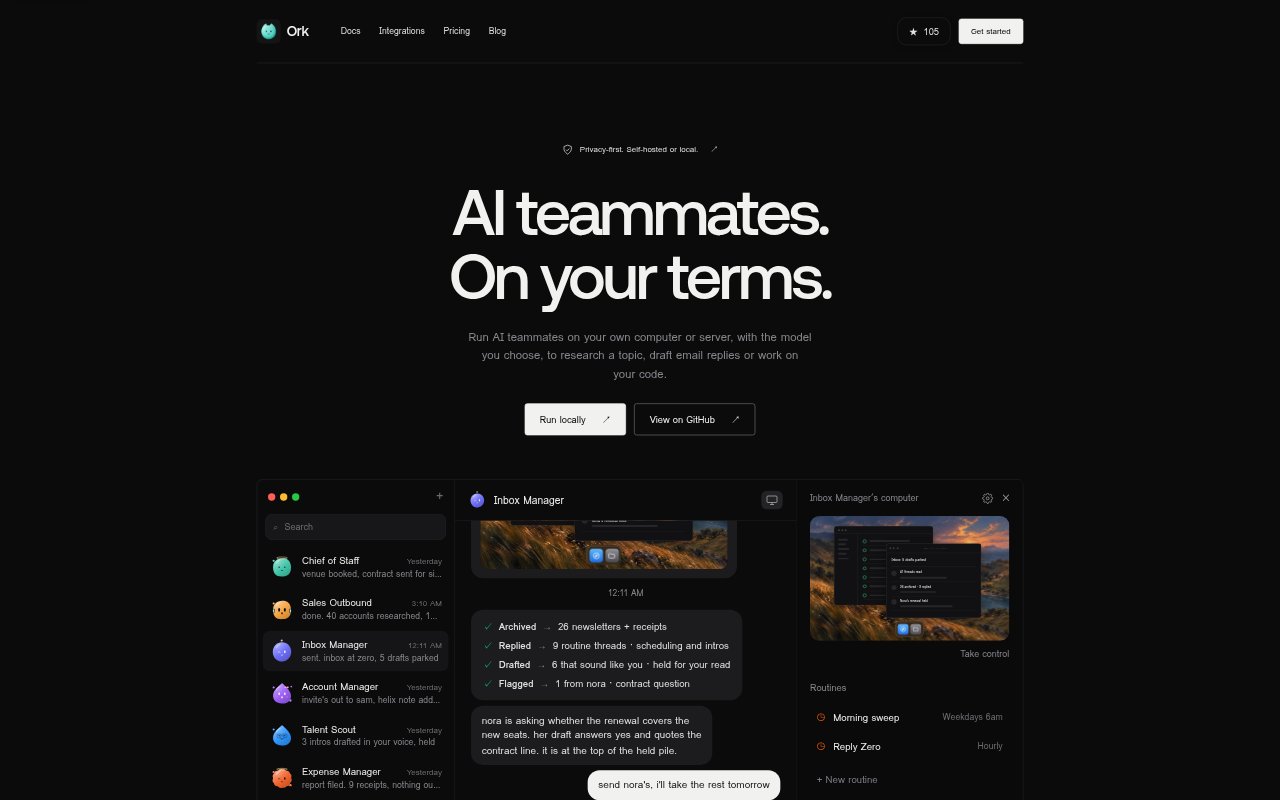
Ork is a privacy-first AI assistant for people and teams who want AI teammates for email, research, coding and other work. It runs on a computer or server they control, and each bot can use a model they choose, including a local model or a model service. Bots can connect to services such as Gmail, GitHub and Notion. Noncommercial self-hosting is free; commercial pricing is not set, and hosting and model services are separate.
Ork Features:
Role Templates: Start with bot templates for jobs such as inbox management, sales outreach, candidate review, expense matching and coding.
App Connections: Connect bots to Gmail, GitHub, Notion and any MCP server so they can work with connected services.
Learned Skills: Demonstrate a task on the bot’s computer, and Ork can save the steps as a reusable skill.
Shared Memory: Bots retain what they learn and can share that information with other bots on the team.
Task Triggers: Run bots on a schedule, through a webhook, after a GitHub event or when a watched item changes.
Bot Delegation: Bots can hand work to one another and collaborate in groups, with a chief-of-staff bot able to coordinate them.
Approval Controls: Choose which actions require your approval, and have a bot call you in the app when it needs your input.
Ork Benefits:
Local Data Choice: Using a local model can keep conversations on your machine, while allowing you to decide which connected services handle other data.
Less Repetition: Saved task steps give bots a way to repeat demonstrated workflows without requiring you to set them up again each time.
Work After Hours: Scheduled runs can keep recurring tasks moving while the computer or server hosting Ork is on.
Human Oversight: Approval settings and in-app calls let you stay involved when a bot reaches a decision that needs your attention.
Flexible Model Choice: Selecting a model for each bot lets you match different work to different local models or model services.
Use Cases:
Inbox Triage: Set up an inbox manager to sort email and draft replies for you to review.
Prospect Follow-Ups: Use a sales bot to research prospects and prepare follow-up drafts for outbound work.
Candidate Shortlisting: Have a talent scout review applications and create a shortlist for a hiring team.
Receipt Matching: Assign an expense manager to match receipts with payments as part of expense administration.
Code Changes: Give a coding agent work on code stored on your computer, with Ork running locally or on a server you control.