
What is p3-stack?
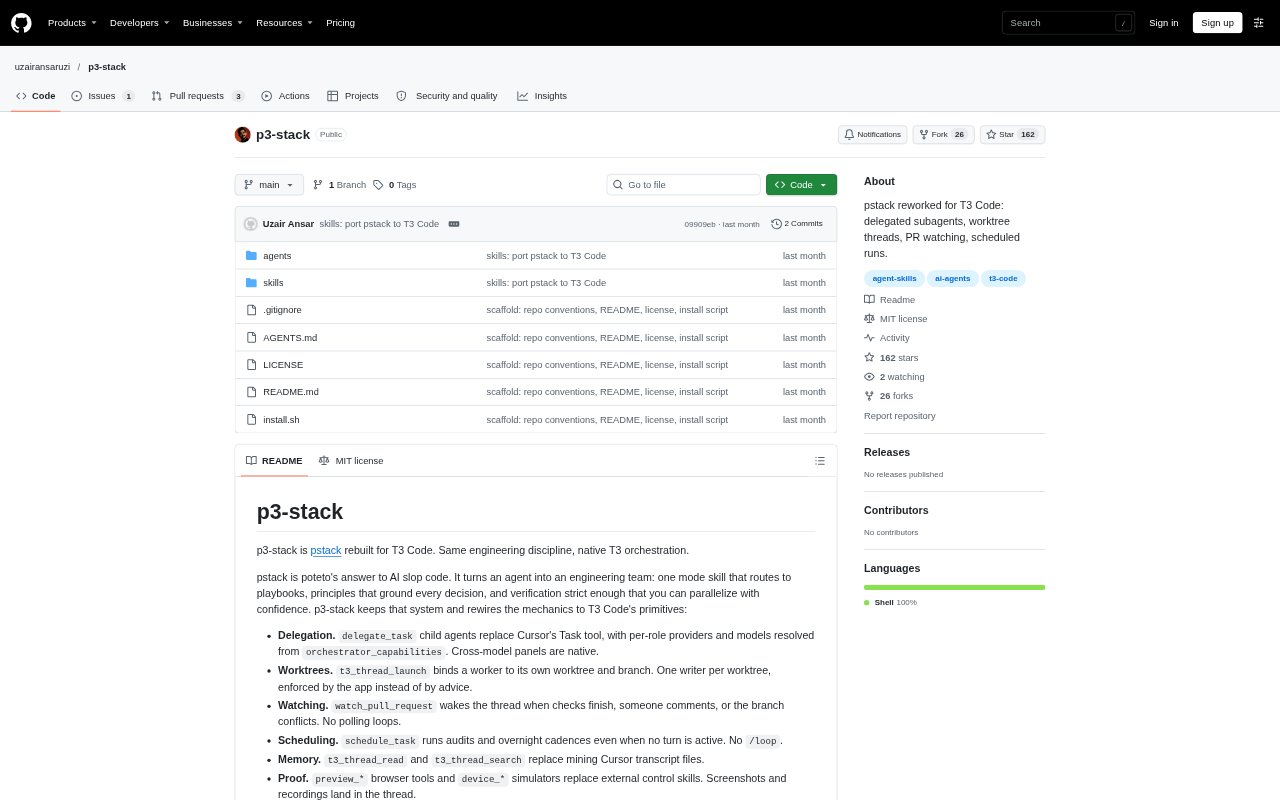
p3-stack is a set of engineering skills and orchestration workflows for T3 Code, adapted from pstack. It routes coding requests through playbooks, applies named principles, and coordinates agents using T3 Code’s tools. It is for people using T3 Code for software work who want structured processes for investigation, implementation, verification, and shipping. Setup maps available providers and models to roles such as coding, judgment, and review.
p3-stack Features:
Task Delegation: It assigns work to child agents through delegate_task, with providers and models for each role resolved from orchestrator_capabilities.
Worktree Threads: It launches workers with t3_thread_launch, binding each one to its own worktree and branch so each worktree has one writer.
Pull Request Watching: It wakes a thread when checks finish, someone comments, or a branch conflicts, using watch_pull_request rather than polling.
Scheduled Tasks: It uses schedule_task to run audits and recurring overnight work even when no agent turn is active.
Thread Memory: It uses t3_thread_read and t3_thread_search to retrieve information from threads without mining Cursor transcript files.
Browser Verification: It uses preview browser tools and device simulators for checks, with screenshots and recordings saved in the thread.
Task Playbooks: Its p3-mode skill selects from playbooks for work such as bug fixes, performance issues, refactoring, visual parity, and shipping.
p3-stack Benefits:
Parallel Progress: Separate worktrees let multiple agents handle tasks concurrently without competing to write to the same working tree.
Clearer Roles: Mapping models to coding, judgment, and review roles gives teams a defined way to divide agent responsibilities.
Fewer Check Ins: Automatic PR updates and scheduled runs reduce the need to repeatedly check for completed checks or start routine audits by hand.
Easier Continuity: Thread search and saved verification evidence make it easier to recover useful context and review what happened during a task.
More Consistent Work: Playbooks and shared principles give recurring engineering tasks a repeatable structure instead of requiring a new process each time.
Use Cases:
Investigating Bugs: Route a reported defect through an investigation or bug-fix playbook, then delegate parts of the work to child agents.
Tracing Runtime Issues: Use the runtime or trace forensics playbooks to investigate behavior that is difficult to diagnose from a surface-level symptom.
Building Features: Use a feature playbook to structure implementation and verification work when adding functionality to a software project.
Checking Visual Parity: Use the visual parity playbook alongside browser previews or device simulators to inspect an interface during development.
Shipping Pull Requests: Coordinate work toward opening a pull request and let the watcher respond to checks, comments, or branch conflicts.