

What is Pagerly?
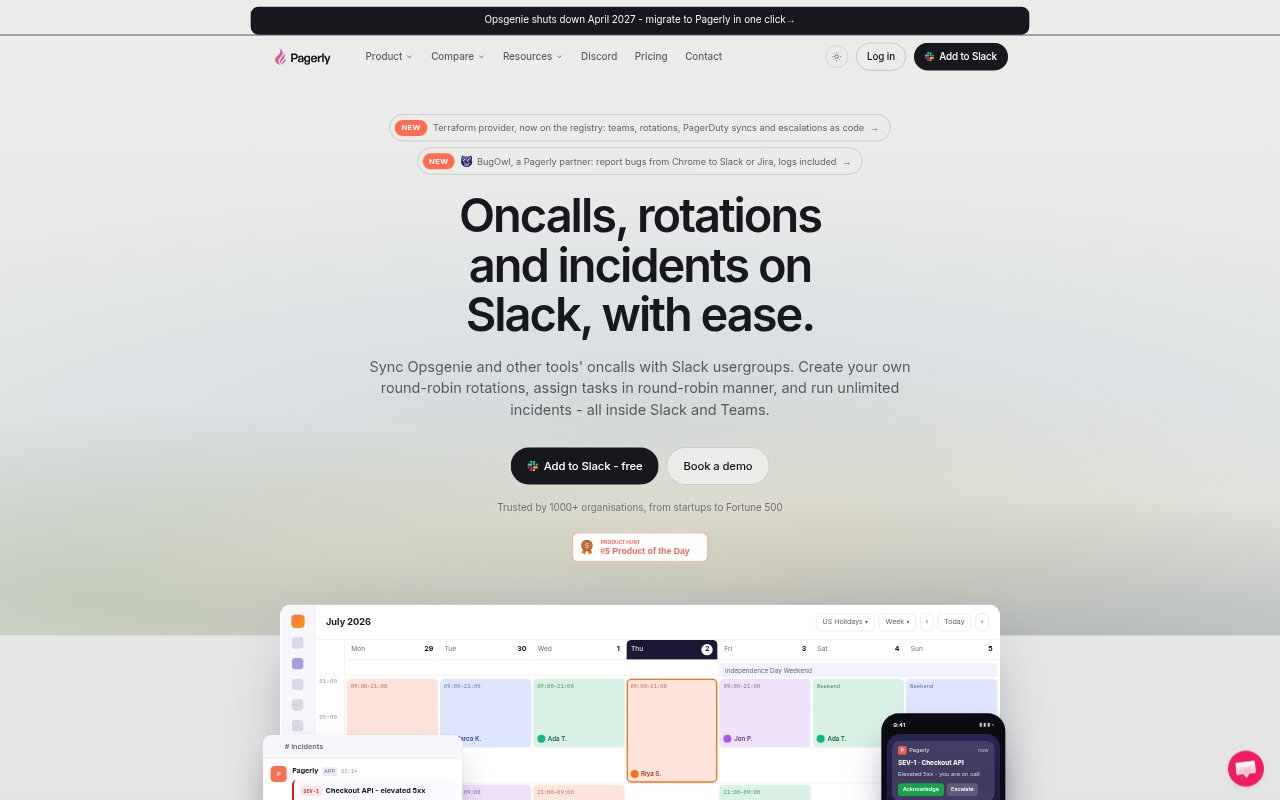
Pagerly brings on-call scheduling, alerting and incident response into Slack, with integrations for tools such as Jira, Opsgenie and Datadog. Engineering and operations teams can create rotations, coordinate responders and manage status pages without moving incident work out of their collaboration tools. Plans start at $19 per team per month for rotations, with paging available as an optional per-user add-on.
Pagerly Features:
On-Call Rotations: Create round-robin or custom schedules with daily, weekly or other shift intervals, and manage overrides, swaps and holiday coverage.
Alert Escalation: Send paging alerts through Slack, email, SMS or phone calls, and connect observability tools such as AWS, Datadog and Sentry to create incidents.
Incident Coordination: Open incident channels, assign an Incident Commander and responder roles, and create meeting links, Jira tickets and dashboard links for the response.
Status Pages: Publish service and component status for internal teams or customers, with subscriber notifications through email, RSS, Atom or webhooks.
Service Monitoring: Monitor your own sites and endpoints, as well as more than 3,000 third-party dependencies.
Connected Workflows: Use integrations including Jira, Opsgenie, Google Calendar, Zendesk, GitHub, Zoom, Salesforce, Linear and Asana, with HTTP connections also available.
Pagerly Benefits:
Fewer Tool Handoffs: Keeping scheduling and incident coordination in Slack can reduce the context-switching involved in getting the right people onto a response.
Clearer Ownership: Automatic schedule updates to Slack user groups help teams see who is on call without checking a separate rota.
Faster Triage: Putting responder roles, meeting links and related tickets in the incident channel gives participants shared context early in an outage.
Customer Updates: A public status page gives customers a central place to check service conditions and subscribe to updates.
Predictable Team Costs: Per-team pricing makes it possible to include more responders in a rotation without adding a base charge for each person.
Use Cases:
Engineering On-Call: Set up a weekly engineering rota, handle shift swaps and keep the Slack on-call group aligned with whoever is covering.
Production Alerts: Route a Datadog or AWS alert to the on-call responder and coordinate acknowledgement and follow-up in an incident channel.
Outage Response: Assign an Incident Commander, gather responders and link a Jira ticket and meeting room when a production issue needs coordinated work.
Customer Communications: Publish service updates during an outage and let customers follow changes through email, RSS, Atom or webhooks.
Dependency Tracking: Monitor external services your product depends on alongside your own endpoints, helping teams check for related service disruptions.