

What is Paveo?
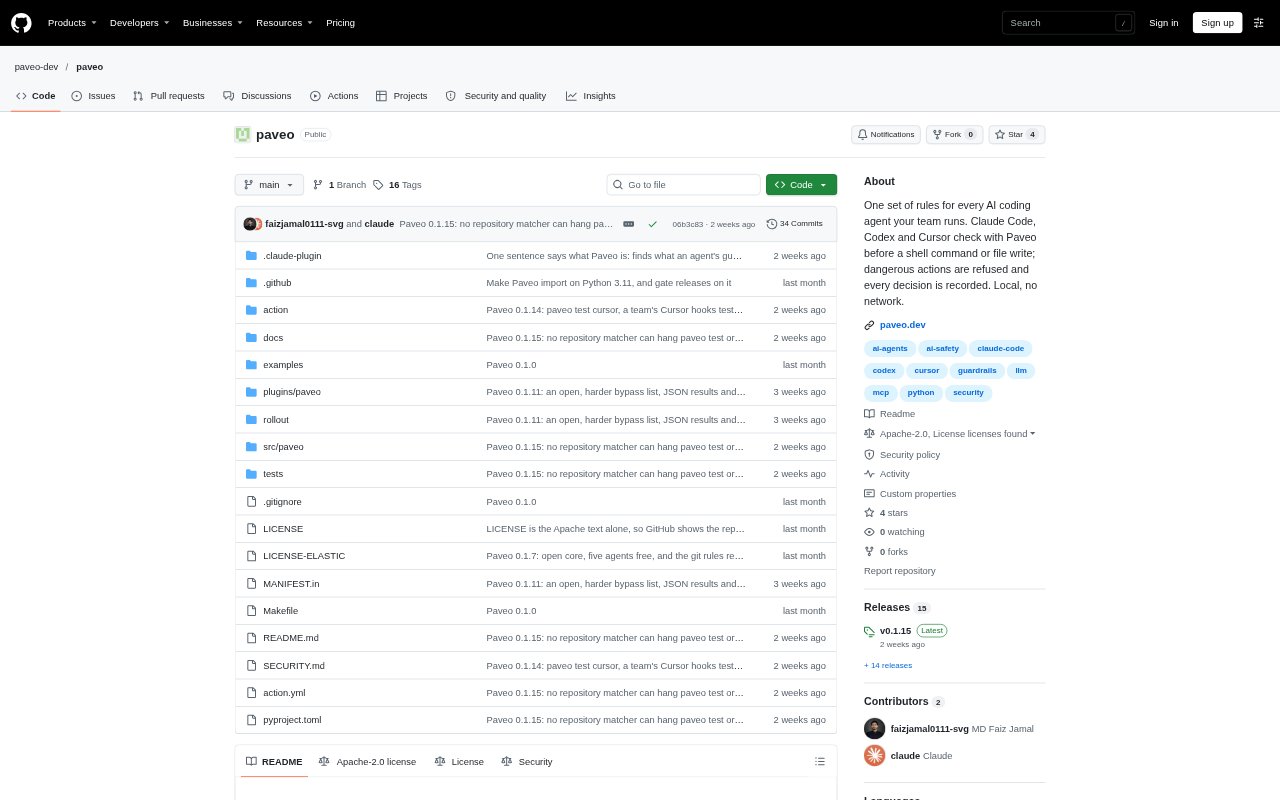
Paveo is a local guard for AI coding agents and custom agents. It checks shell commands and file writes against rules before coding agents run them, and lets teams define which tools, arguments and models their own agents may use. It also records decisions and can test existing agent guards. Paveo is aimed at developers and security teams that want to set boundaries around agent actions without sending activity off the machine.
Paveo Features:
Coding Agent Hooks: Hooks for Claude Code, Codex and Cursor check shell commands and file writes before the agent proceeds; the Cursor hook has not been tested in a real session and may refuse every call.
Command Blocking: The included guard can refuse actions such as rm -rf, git push --force and DROP TABLE, as well as attempts to alter its own policy, log or hook settings.
Policy Rules: Policies can limit available tools and arguments, require an earlier matching tool call, and set per-session rate or repeat limits.
Model Spend Limits: Policies can allow specific models and set spending ceilings, with a model call refused before it is sent if its worst-case cost would exceed the limit.
Guard Testing: Paveo tests existing Claude Code, Codex and Cursor guards against dangerous command variations, and can fail a CI build when a guard no longer blocks an expected action.
Local Audit Records: Decisions are recorded in a hash-chained log that a security team can verify, while Paveo runs locally and opens no network connections.
Paveo Benefits:
Fewer Risky Actions: Blocking disallowed commands before they run can reduce the chance that an agent makes destructive changes or carries out an unintended operation.
Clearer Boundaries: Explicit rules give teams a way to limit what agents can do and provide a consistent basis for reviewing refusals.
Earlier Guard Failures: Testing guards as part of a build can surface a weakened rule before it reaches developers using the agent.
Controlled Model Costs: A hard spending ceiling helps prevent an agent from continuing model calls beyond the amount its policy permits.
Private Activity: Keeping checks and records on the machine avoids sending agent activity to an external service.
Use Cases:
Developer Workstations: Install hooks for Claude Code or Codex so shell commands and file writes are checked as developers work.
Team Rollouts: Deploy a centrally managed hook and policy across engineers’ machines using a root-owned installation.
CI Guard Checks: Run Paveo tests in a build pipeline to catch changes that let expected dangerous commands through.
Custom Agent Rules: Set allowed tools and argument constraints for a purpose-built agent, such as requiring an order lookup before a refund.
Session Review: Replay past Claude Code tool calls against a policy to see which actions it would have refused and why.