
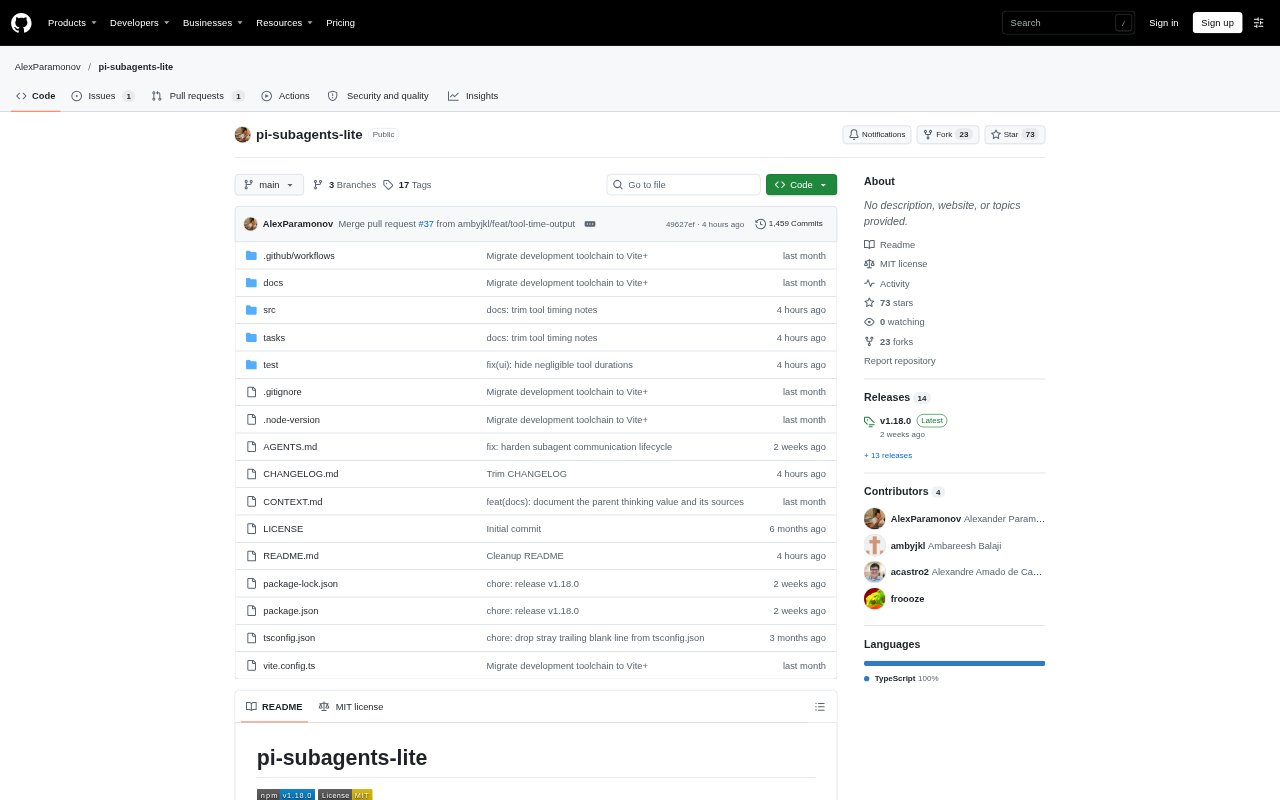
What is Pi subagents Lite?
Pi subagents Lite is an extension for pi that lets users delegate work to custom AI agents running in isolated sessions. Each agent can have its own tools, extensions, model, and instructions, while the parent session can run agents in the foreground or let them work in the background. It is for people using pi who want to divide coding and other task-execution work among configurable agents, manage those sessions, and inspect their progress.
Pi subagents Lite Features:
Agent Lifecycle: Spawn, stop, inspect, and manage agents through the Agent, StopAgent, MessageAgent, and AgentStatus tools.
Foreground And Background: Run an agent in the foreground until it finishes, or start it in the background and receive a notification when it is done.
Agent Configuration: Set an agent's model, thinking level, tools, extensions, skills, and maximum turns through its configuration.
Custom Agent Types: Define specialized agents in Markdown files with a name, description, configuration fields, and a system prompt.
Steering And Continuation: Send input to a running agent, redirect its work, or continue a settled agent when its session is still live.
Live Session Viewer: View active and recently finished agents in a widget, then open a live transcript showing thinking blocks, tool calls, and summaries.
Worktrees And Watchdog: Use cross-repo worktree support and a watchdog that monitors for agents that become stuck.
Pi subagents Lite Benefits:
Parallel Progress: Independent tasks can make progress at the same time, reducing the need to wait for one agent to finish before starting another.
Focused Delegation: Specialized instructions and tool access help keep delegated work aligned with the task and the permissions it needs.
Less Manual Checking: Completion notifications and status information make it easier to follow work without repeatedly asking whether an agent has finished.
Recoverable Work: Steering or continuing an agent gives users a way to adjust direction or resume work without starting the task over.
Visible Activity: A live transcript and cost tracking make agent activity easier to review while work is underway.
Use Cases:
Codebase Exploration: Delegate read-only codebase exploration to an Explore agent while the parent session handles another task.
Security Review: Set up a security-review agent to examine code for vulnerabilities such as injection flaws, authentication bypasses, and insecure defaults.
Parallel Coding: Assign separate implementation tasks to agents with their own sessions and, when needed, different model settings.
Long Running Tasks: Run a task in the background when it may take time, then check its transcript or receive its completion notification.
Task Redirection: Send new direction to an agent that is still working, or continue a completed agent with additional input.