

What is Plimsoll?
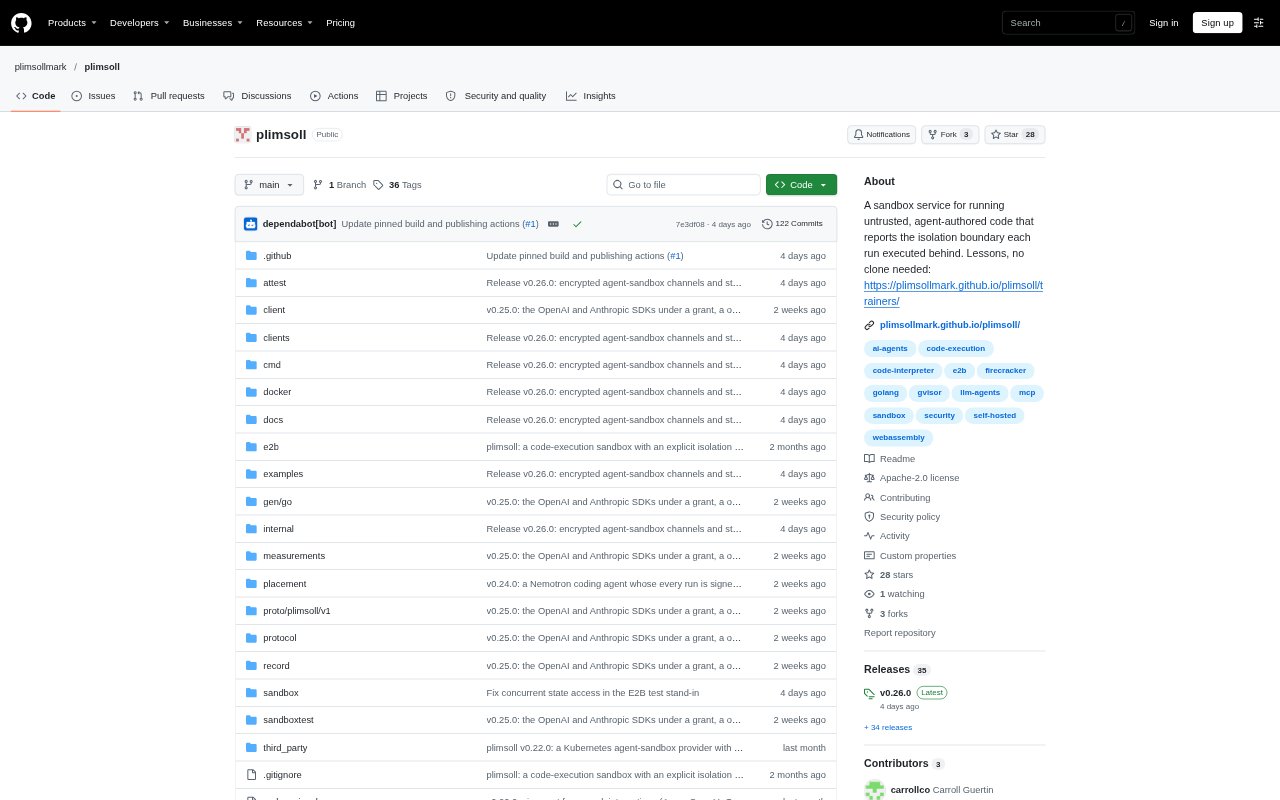
Plimsoll is a sandbox service for running code written by AI agents, with controls for isolation, API access and execution records. Developers can use it for disposable runs or persistent workspaces, choosing among providers that run locally, on their own infrastructure or through hosted sandbox services. Its server and clients report which isolation tier a run used, while supported clients check the recorded input and result.
Plimsoll Features:
Sandbox Providers: Run JavaScript snippets, projects with files and build steps, or compiled simulation modules using supported providers such as WebAssembly, Docker and hosted sandboxes.
Isolation Tiers: Set a minimum isolation tier for each request, choosing among process, container, kernel and virtual-machine boundaries according to provider support.
Persistent Sessions: Keep a sandbox and its files between calls, with supported Python and JavaScript interpreters also retaining variables.
API Grants: Allow a run to reach specified API routes through an external broker, which attaches upstream credentials without exposing them to guest code.
Run Records: Create records of submitted input, returned results and execution environments, with content hashes that official clients recompute before accepting an answer.
Signed Evidence: Create signed bundles and statements for runs, and use offline checking workflows for signed claims and external timestamps.
Plimsoll Benefits:
Credential Protection: Keeping upstream credentials outside guest code reduces the chance that agent-written code can read or expose secrets directly.
Clearer Isolation: A required tier on each request helps teams avoid running code behind a weaker boundary than their policy allows.
Reviewable Runs: Recorded inputs, results and environments give teams a basis for checking what a run did and comparing it with expectations.
Repeatable Work: Sessions preserve files and, for supported interpreters, variables, so multi-step tasks can continue without rebuilding state each call.
Evidence for Checks: Signed records and offline verification can support reviews of execution results without requiring the checker to contact a network service.
Use Cases:
Agent Code Execution: Run code generated by an AI agent for a task while setting the minimum isolation boundary required for that call.
Tool Access Control: Let an agent call approved API routes while keeping service credentials outside the code executing in its sandbox.
Multi-Step Analysis: Use a persistent session for a workflow that builds on files or interpreter variables created by earlier calls.
Build Test Run: Submit a project with files and ordered build, test and run steps when checking code changes in a sandbox.
Execution Review: Collect and verify run records when reviewing the inputs, outputs and environment associated with agent-generated work.